

Copyright © National Academy of Sciences. All rights reserved.
Solar and Space Physics: A Science for a Technological Society
REPORT OF THE PANEL ON ATMOSPHERE-IONOSPHERE-MAGNETOSPHERE INTERACTIONS
157
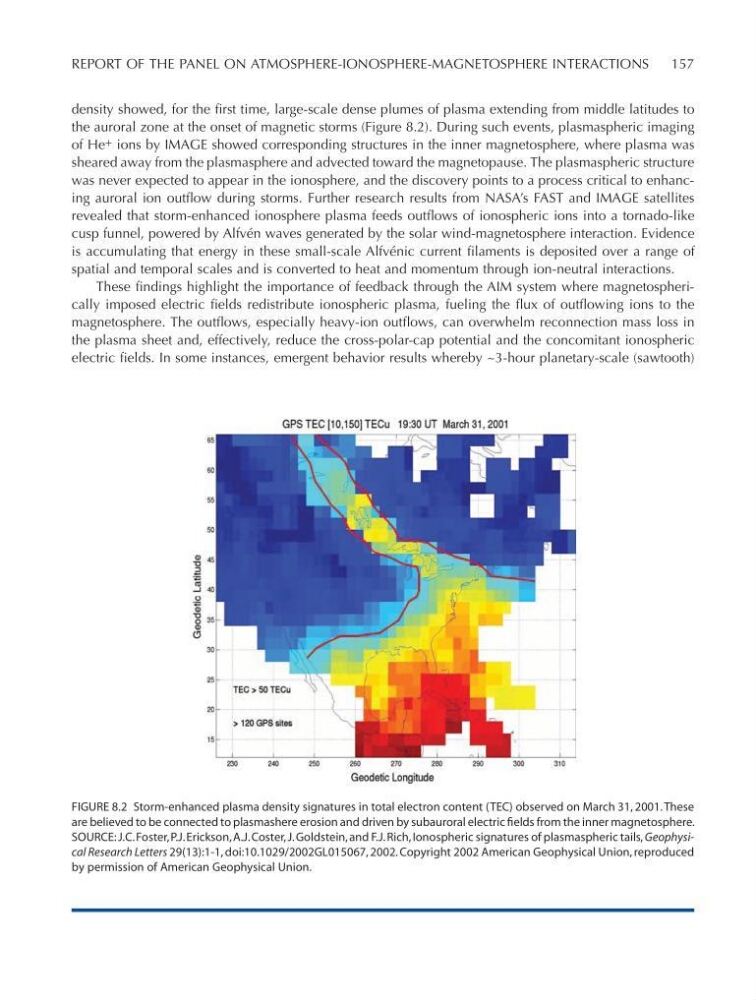
density showed, for the first time, large-scale dense plumes of plasma extending from middle latitudes to
the auroral zone at the onset of magnetic storms (Figure 8.2). During such events, plasmaspheric imaging
of He + ions by IMAGE showed corresponding structures in the inner magnetosphere, where plasma was
sheared away from the plasmasphere and advected toward the magnetopause. The plasmaspheric structure
was never expected to appear in the ionosphere, and the discovery points to a process critical to enhancing auroral ion outflow during storms. Further research results from NASA’s FAST and IMAGE satellites
revealed that storm-enhanced ionosphere plasma feeds outflows of ionospheric ions into a tornado-like
cusp funnel, powered by Alfvén waves generated by the solar wind-magnetosphere interaction. Evidence
is accumulating that energy in these small-scale Alfvénic current filaments is deposited over a range of
spatial and temporal scales and is converted to heat and momentum through ion-neutral interactions.
These findings highlight the importance of feedback through the AIM system where magnetospherically imposed electric fields redistribute ionospheric plasma, fueling the flux of outflowing ions to the
magnetosphere. The outflows, especially heavy-ion outflows, can overwhelm reconnection mass loss in
the plasma sheet and, effectively, reduce the cross-polar-cap potential and the concomitant ionospheric
electric fields. In some instances, emergent behavior results whereby ~3-hour planetary-scale (sawtooth)
FIGURE 8.2 Storm-enhanced plasma density signatures in total electron content (TEC) observed on March 31, 2001. These
are believed to be connected to plasmashere erosion and driven by subauroral electric fields from the inner magnetosphere.
SOURCE: J.C. Foster, P.J. Erickson, A.J. Coster, J. Goldstein, and F.J. Rich, Ionospheric signatures of plasmaspheric tails, Geophysical Research Letters 29(13):1-1, doi:10.1029/2002GL015067, 2002. Copyright 2002 American Geophysical Union, reproduced
by permission of American Geophysical Union.
Figure 8-2
Solar and Space Physics: A Science for a Technological Society
REPORT OF THE PANEL ON ATMOSPHERE-IONOSPHERE-MAGNETOSPHERE INTERACTIONS
157
density showed, for the first time, large-scale dense plumes of plasma extending from middle latitudes to
the auroral zone at the onset of magnetic storms (Figure 8.2). During such events, plasmaspheric imaging
of He + ions by IMAGE showed corresponding structures in the inner magnetosphere, where plasma was
sheared away from the plasmasphere and advected toward the magnetopause. The plasmaspheric structure
was never expected to appear in the ionosphere, and the discovery points to a process critical to enhancing auroral ion outflow during storms. Further research results from NASA’s FAST and IMAGE satellites
revealed that storm-enhanced ionosphere plasma feeds outflows of ionospheric ions into a tornado-like
cusp funnel, powered by Alfvén waves generated by the solar wind-magnetosphere interaction. Evidence
is accumulating that energy in these small-scale Alfvénic current filaments is deposited over a range of
spatial and temporal scales and is converted to heat and momentum through ion-neutral interactions.
These findings highlight the importance of feedback through the AIM system where magnetospherically imposed electric fields redistribute ionospheric plasma, fueling the flux of outflowing ions to the
magnetosphere. The outflows, especially heavy-ion outflows, can overwhelm reconnection mass loss in
the plasma sheet and, effectively, reduce the cross-polar-cap potential and the concomitant ionospheric
electric fields. In some instances, emergent behavior results whereby ~3-hour planetary-scale (sawtooth)
FIGURE 8.2 Storm-enhanced plasma density signatures in total electron content (TEC) observed on March 31, 2001. These
are believed to be connected to plasmashere erosion and driven by subauroral electric fields from the inner magnetosphere.
SOURCE: J.C. Foster, P.J. Erickson, A.J. Coster, J. Goldstein, and F.J. Rich, Ionospheric signatures of plasmaspheric tails, Geophysical Research Letters 29(13):1-1, doi:10.1029/2002GL015067, 2002. Copyright 2002 American Geophysical Union, reproduced
by permission of American Geophysical Union.
Figure 8-2