

Copyright © National Academy of Sciences. All rights reserved.
Solar and Space Physics: A Science for a Technological Society
154
SOLAR AND SPACE PHYSICS: A SCIENCE FOR A TECHNOLOGICAL SOCIETY
region of geospace possesses several distinguishing characteristics that define it as a domain for compelling scientific inquiry and warrant the attention of a decadal survey with an explicit focus on solar and
space physics’ connections to a technological society. Notably, this region serves as a “final link” in the
transfer of energy within the solar-terrestrial chain. The primary drivers for variability in the region consist
of direct solar energy in the form of extreme ultraviolet (EUV) and ultraviolet (UV) radiation, solar energy
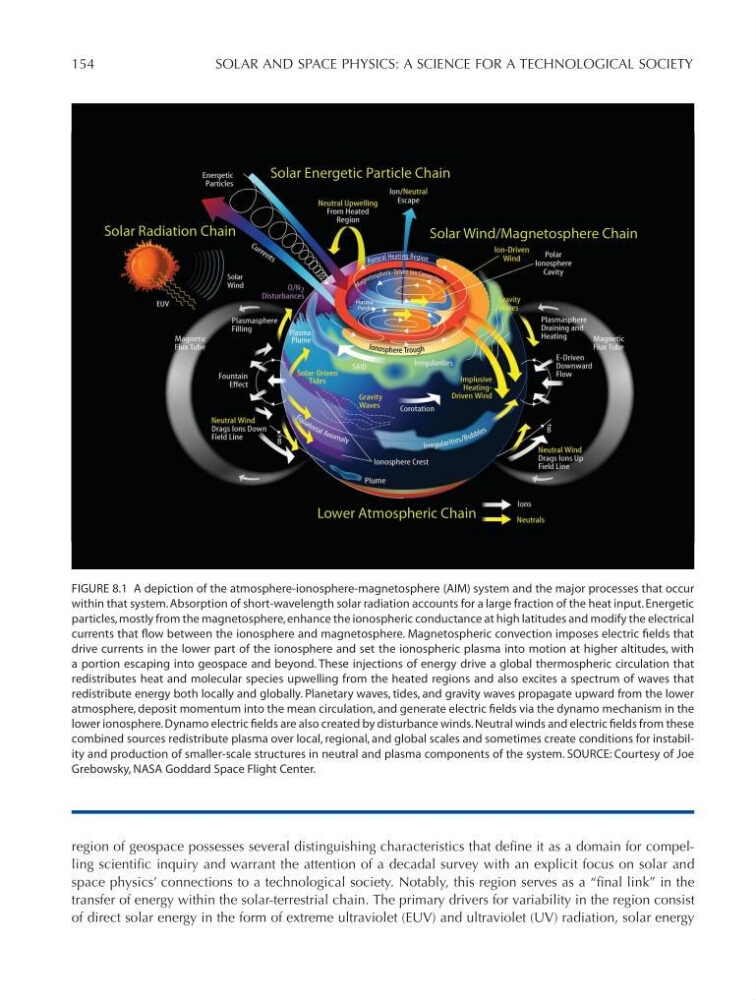
FIGURE 8.1 A depiction of the atmosphere-ionosphere-magnetosphere (AIM) system and the major processes that occur
within that system. Absorption of short-wavelength solar radiation accounts for a large fraction of the heat input. Energetic
particles, mostly from the magnetosphere, enhance the ionospheric conductance at high latitudes and modify the electrical
currents that flow between the ionosphere and magnetosphere. Magnetospheric convection imposes electric fields that
drive currents in the lower part of the ionosphere and set the ionospheric plasma into motion at higher altitudes, with
a portion escaping into geospace and beyond. These injections of energy drive a global thermospheric circulation that
redistributes heat and molecular species upwelling from the heated regions and also excites a spectrum of waves that
redistribute energy both locally and globally. Planetary waves, tides, and gravity waves propagate upward from the lower
atmosphere, deposit momentum into the mean circulation, and generate electric fields via the dynamo mechanism in the
lower ionosphere. Dynamo electric fields are also created by disturbance winds. Neutral winds and electric fields from these
combined sources redistribute plasma over local, regional, and global scales and sometimes create conditions for instability and production of smaller-scale structures in neutral and plasma components of the system. SOURCE: Courtesy of Joe
Grebowsky, NASA Goddard Space Flight Center.
Figure 8-1 revised
Solar Energetic Particle Chain
Solar Wind/Magnetosphere Chain
Lower Atmospheric Chain
Solar Radiation Chain
Solar and Space Physics: A Science for a Technological Society
154
SOLAR AND SPACE PHYSICS: A SCIENCE FOR A TECHNOLOGICAL SOCIETY
region of geospace possesses several distinguishing characteristics that define it as a domain for compelling scientific inquiry and warrant the attention of a decadal survey with an explicit focus on solar and
space physics’ connections to a technological society. Notably, this region serves as a “final link” in the
transfer of energy within the solar-terrestrial chain. The primary drivers for variability in the region consist
of direct solar energy in the form of extreme ultraviolet (EUV) and ultraviolet (UV) radiation, solar energy
FIGURE 8.1 A depiction of the atmosphere-ionosphere-magnetosphere (AIM) system and the major processes that occur
within that system. Absorption of short-wavelength solar radiation accounts for a large fraction of the heat input. Energetic
particles, mostly from the magnetosphere, enhance the ionospheric conductance at high latitudes and modify the electrical
currents that flow between the ionosphere and magnetosphere. Magnetospheric convection imposes electric fields that
drive currents in the lower part of the ionosphere and set the ionospheric plasma into motion at higher altitudes, with
a portion escaping into geospace and beyond. These injections of energy drive a global thermospheric circulation that
redistributes heat and molecular species upwelling from the heated regions and also excites a spectrum of waves that
redistribute energy both locally and globally. Planetary waves, tides, and gravity waves propagate upward from the lower
atmosphere, deposit momentum into the mean circulation, and generate electric fields via the dynamo mechanism in the
lower ionosphere. Dynamo electric fields are also created by disturbance winds. Neutral winds and electric fields from these
combined sources redistribute plasma over local, regional, and global scales and sometimes create conditions for instability and production of smaller-scale structures in neutral and plasma components of the system. SOURCE: Courtesy of Joe
Grebowsky, NASA Goddard Space Flight Center.
Figure 8-1 revised
Solar Energetic Particle Chain
Solar Wind/Magnetosphere Chain
Lower Atmospheric Chain
Solar Radiation Chain