

Copyright © National Academy of Sciences. All rights reserved.
Solar and Space Physics: A Science for a Technological Society
SPACE WEATHER AND SPACE CLIMATOLOGY: A VISION FOR FUTURE CAPABILITIES
141
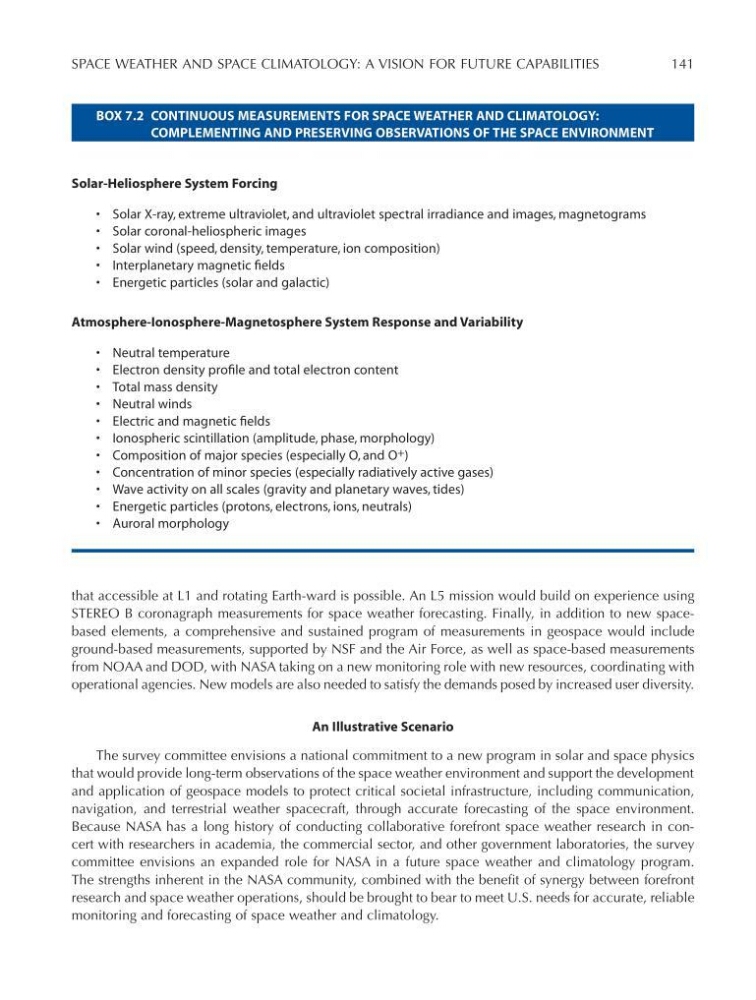
BOX 7.2 CONTINUOUS MEASUREMENTS FOR SPACE WEATHER AND CLIMATOLOGY:
COMPLEMENTING AND PRESERVING OBSERVATIONS OF THE SPACE ENVIRONMENT
Solar-Heliosphere System Forcing
• Solar X-ray, extreme ultraviolet, and ultraviolet spectral irradiance and images, magnetograms
• Solar coronal-heliospheric images
• Solar wind (speed, density, temperature, ion composition)
• Interplanetary magnetic fields
• Energetic particles (solar and galactic)
Atmosphere-Ionosphere-Magnetosphere System Response and Variability
• Neutral temperature
• Electron density profile and total electron content
• Total mass density
• Neutral winds
• Electric and magnetic fields
• Ionospheric scintillation (amplitude, phase, morphology)
• Composition of major species (especially O, and O + )
• Concentration of minor species (especially radiatively active gases)
• Wave activity on all scales (gravity and planetary waves, tides)
• Energetic particles (protons, electrons, ions, neutrals)
• Auroral morphology
that accessible at L1 and rotating Earth-ward is possible. An L5 mission would build on experience using
STEREO B coronagraph measurements for space weather forecasting. Finally, in addition to new spacebased elements, a comprehensive and sustained program of measurements in geospace would include
ground-based measurements, supported by NSF and the Air Force, as well as space-based measurements
from NOAA and DOD, with NASA taking on a new monitoring role with new resources, coordinating with
operational agencies. New models are also needed to satisfy the demands posed by increased user diversity.
An Illustrative Scenario
The survey committee envisions a national commitment to a new program in solar and space physics
that would provide long-term observations of the space weather environment and support the development
and application of geospace models to protect critical societal infrastructure, including communication,
navigation, and terrestrial weather spacecraft, through accurate forecasting of the space environment.
Because NASA has a long history of conducting collaborative forefront space weather research in concert with researchers in academia, the commercial sector, and other government laboratories, the survey
committee envisions an expanded role for NASA in a future space weather and climatology program.
The strengths inherent in the NASA community, combined with the benefit of synergy between forefront
research and space weather operations, should be brought to bear to meet U.S. needs for accurate, reliable
monitoring and forecasting of space weather and climatology.
Solar and Space Physics: A Science for a Technological Society
SPACE WEATHER AND SPACE CLIMATOLOGY: A VISION FOR FUTURE CAPABILITIES
141
BOX 7.2 CONTINUOUS MEASUREMENTS FOR SPACE WEATHER AND CLIMATOLOGY:
COMPLEMENTING AND PRESERVING OBSERVATIONS OF THE SPACE ENVIRONMENT
Solar-Heliosphere System Forcing
• Solar X-ray, extreme ultraviolet, and ultraviolet spectral irradiance and images, magnetograms
• Solar coronal-heliospheric images
• Solar wind (speed, density, temperature, ion composition)
• Interplanetary magnetic fields
• Energetic particles (solar and galactic)
Atmosphere-Ionosphere-Magnetosphere System Response and Variability
• Neutral temperature
• Electron density profile and total electron content
• Total mass density
• Neutral winds
• Electric and magnetic fields
• Ionospheric scintillation (amplitude, phase, morphology)
• Composition of major species (especially O, and O + )
• Concentration of minor species (especially radiatively active gases)
• Wave activity on all scales (gravity and planetary waves, tides)
• Energetic particles (protons, electrons, ions, neutrals)
• Auroral morphology
that accessible at L1 and rotating Earth-ward is possible. An L5 mission would build on experience using
STEREO B coronagraph measurements for space weather forecasting. Finally, in addition to new spacebased elements, a comprehensive and sustained program of measurements in geospace would include
ground-based measurements, supported by NSF and the Air Force, as well as space-based measurements
from NOAA and DOD, with NASA taking on a new monitoring role with new resources, coordinating with
operational agencies. New models are also needed to satisfy the demands posed by increased user diversity.
An Illustrative Scenario
The survey committee envisions a national commitment to a new program in solar and space physics
that would provide long-term observations of the space weather environment and support the development
and application of geospace models to protect critical societal infrastructure, including communication,
navigation, and terrestrial weather spacecraft, through accurate forecasting of the space environment.
Because NASA has a long history of conducting collaborative forefront space weather research in concert with researchers in academia, the commercial sector, and other government laboratories, the survey
committee envisions an expanded role for NASA in a future space weather and climatology program.
The strengths inherent in the NASA community, combined with the benefit of synergy between forefront
research and space weather operations, should be brought to bear to meet U.S. needs for accurate, reliable
monitoring and forecasting of space weather and climatology.