

Copyright © National Academy of Sciences. All rights reserved.
Solar and Space Physics: A Science for a Technological Society
NASA PROGRAM IMPLEMENTATION
133
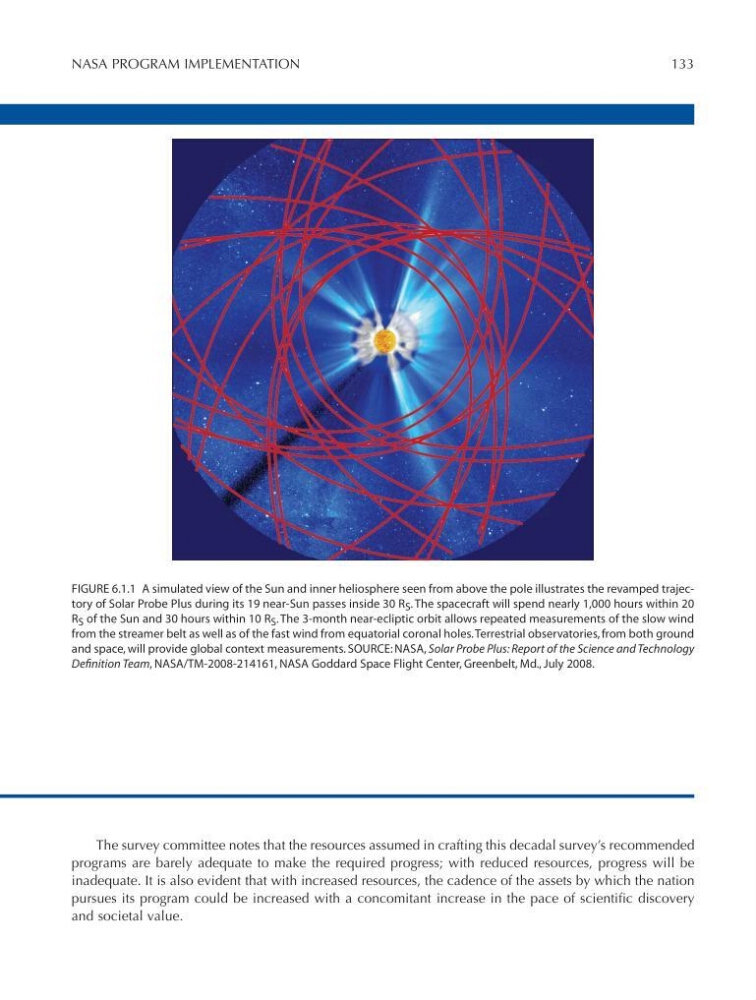
FIGURE 6.1.1 A simulated view of the Sun and inner heliosphere seen from above the pole illustrates the revamped trajectory of Solar Probe Plus during its 19 near-Sun passes inside 30 R S . The spacecraft will spend nearly 1,000 hours within 20
R S of the Sun and 30 hours within 10 R S . The 3-month near-ecliptic orbit allows repeated measurements of the slow wind
from the streamer belt as well as of the fast wind from equatorial coronal holes. Terrestrial observatories, from both ground
and space, will provide global context measurements. SOURCE: NASA, Solar Probe Plus: Report of the Science and Technology
Definition Team, NASA/TM-2008-214161, NASA Goddard Space Flight Center, Greenbelt, Md., July 2008.
The survey committee notes that the resources assumed in crafting this decadal survey’s recommended
programs are barely adequate to make the required progress; with reduced resources, progress will be
inadequate. It is also evident that with increased resources, the cadence of the assets by which the nation
pursues its program could be increased with a concomitant increase in the pace of scientific discovery
and societal value.
Figure 6-1-1
(for box)
Solar and Space Physics: A Science for a Technological Society
NASA PROGRAM IMPLEMENTATION
133
FIGURE 6.1.1 A simulated view of the Sun and inner heliosphere seen from above the pole illustrates the revamped trajectory of Solar Probe Plus during its 19 near-Sun passes inside 30 R S . The spacecraft will spend nearly 1,000 hours within 20
R S of the Sun and 30 hours within 10 R S . The 3-month near-ecliptic orbit allows repeated measurements of the slow wind
from the streamer belt as well as of the fast wind from equatorial coronal holes. Terrestrial observatories, from both ground
and space, will provide global context measurements. SOURCE: NASA, Solar Probe Plus: Report of the Science and Technology
Definition Team, NASA/TM-2008-214161, NASA Goddard Space Flight Center, Greenbelt, Md., July 2008.
The survey committee notes that the resources assumed in crafting this decadal survey’s recommended
programs are barely adequate to make the required progress; with reduced resources, progress will be
inadequate. It is also evident that with increased resources, the cadence of the assets by which the nation
pursues its program could be increased with a concomitant increase in the pace of scientific discovery
and societal value.
Figure 6-1-1
(for box)