

Copyright © National Academy of Sciences. All rights reserved.
Solar and Space Physics: A Science for a Technological Society
130
SOLAR AND SPACE PHYSICS: A SCIENCE FOR A TECHNOLOGICAL SOCIETY
beyond a simple extension of the current budget. The increase would permit the timely execution of a
major mission in coordination with related STP missions. However, if the required increase is not possible,
it is appropriate to delay both the start and the launch date of GDC.
DECISION RULES AND AUGMENTATION PRIORITIES
The recommended program for NASA addresses important and highly compelling science objectives
in a cost-effective manner. However, the survey committee recognizes that an already significantly constrained program could face further budgetary challenges. Decision rules are required to preserve an orderly
and effective program in the event that less funding than anticipated is available, or some other disruptive
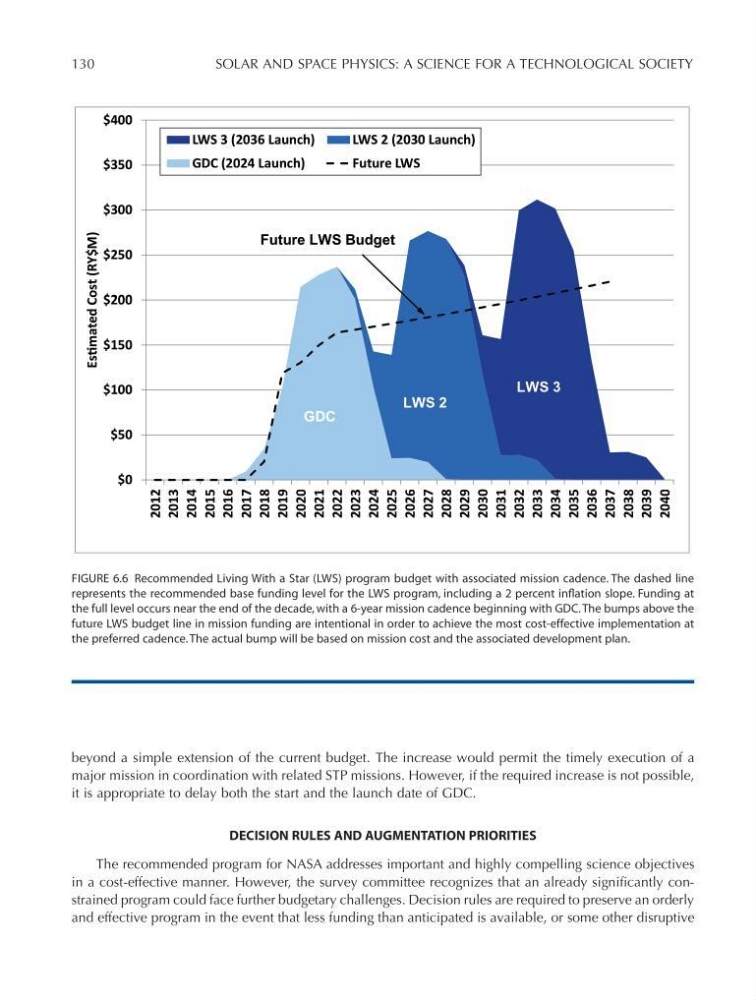
FIGURE 6.6 Recommended Living With a Star (LWS) program budget with associated mission cadence. The dashed line
represents the recommended base funding level for the LWS program, including a 2 percent inflation slope. Funding at
the full level occurs near the end of the decade, with a 6-year mission cadence beginning with GDC. The bumps above the
future LWS budget line in mission funding are intentional in order to achieve the most cost-effective implementation at
the preferred cadence. The actual bump will be based on mission cost and the associated development plan.
$350
$400
LWS 3 (2036 Launch)
LWS 2 (2030 Launch)
GDC (2024 Launch)
Future LWS
$300
$350
(
)
$200
$250
ost (RY$M)
Future LWS Budget
$150
$200
sƟmated Co
$100
E
GDC
LWS 2
LWS 3
$0
$50
4
6
8
0
4
6
8
0
4
6
8
0
2012
2013
2014
2015
2016
2017
2018
2019
2020
2021
2022
2023
2024
2025
2026
2027
2028
2029
2030
2031
2032
2033
2034
2035
2036
2037
2038
2039
2040
Solar and Space Physics: A Science for a Technological Society
130
SOLAR AND SPACE PHYSICS: A SCIENCE FOR A TECHNOLOGICAL SOCIETY
beyond a simple extension of the current budget. The increase would permit the timely execution of a
major mission in coordination with related STP missions. However, if the required increase is not possible,
it is appropriate to delay both the start and the launch date of GDC.
DECISION RULES AND AUGMENTATION PRIORITIES
The recommended program for NASA addresses important and highly compelling science objectives
in a cost-effective manner. However, the survey committee recognizes that an already significantly constrained program could face further budgetary challenges. Decision rules are required to preserve an orderly
and effective program in the event that less funding than anticipated is available, or some other disruptive
FIGURE 6.6 Recommended Living With a Star (LWS) program budget with associated mission cadence. The dashed line
represents the recommended base funding level for the LWS program, including a 2 percent inflation slope. Funding at
the full level occurs near the end of the decade, with a 6-year mission cadence beginning with GDC. The bumps above the
future LWS budget line in mission funding are intentional in order to achieve the most cost-effective implementation at
the preferred cadence. The actual bump will be based on mission cost and the associated development plan.
$350
$400
LWS 3 (2036 Launch)
LWS 2 (2030 Launch)
GDC (2024 Launch)
Future LWS
$300
$350
(
)
$200
$250
ost (RY$M)
Future LWS Budget
$150
$200
sƟmated Co
$100
E
GDC
LWS 2
LWS 3
$0
$50
4
6
8
0
4
6
8
0
4
6
8
0
2012
2013
2014
2015
2016
2017
2018
2019
2020
2021
2022
2023
2024
2025
2026
2027
2028
2029
2030
2031
2032
2033
2034
2035
2036
2037
2038
2039
2040