

Copyright © National Academy of Sciences. All rights reserved.
Solar and Space Physics: A Science for a Technological Society
114
SOLAR AND SPACE PHYSICS: A SCIENCE FOR A TECHNOLOGICAL SOCIETY
From an operational perspective, it is clear that models are essential to predict the state of the system,
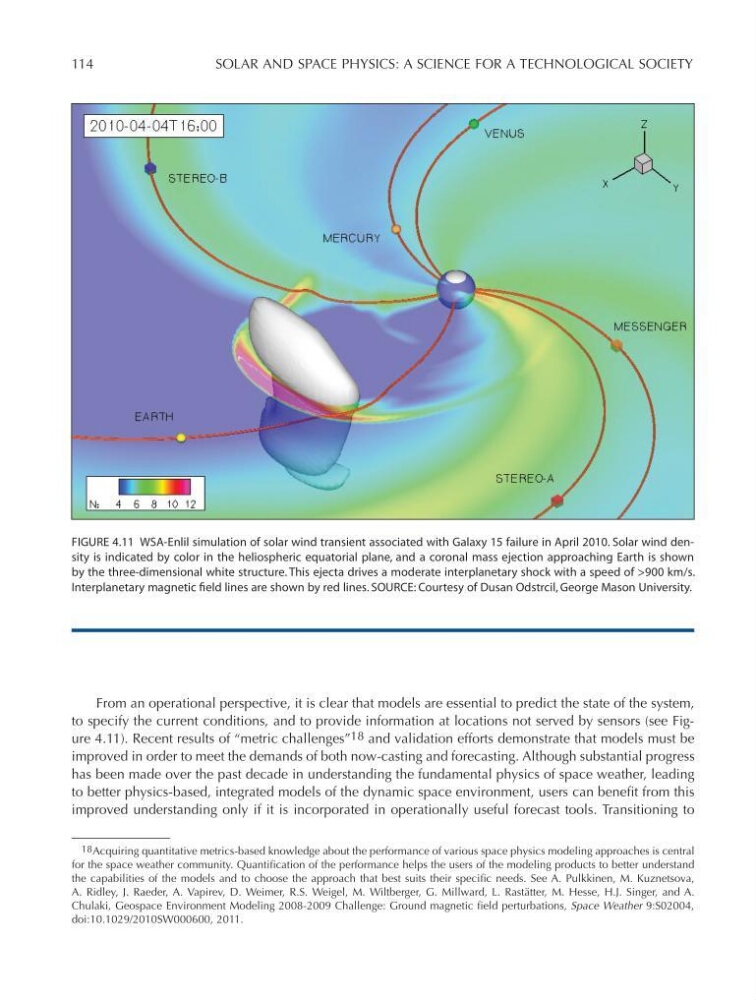
to specify the current conditions, and to provide information at locations not served by sensors (see Figure 4.11). Recent results of “metric challenges” 18 and validation efforts demonstrate that models must be
improved in order to meet the demands of both now-casting and forecasting. Although substantial progress
has been made over the past decade in understanding the fundamental physics of space weather, leading
to better physics-based, integrated models of the dynamic space environment, users can benefit from this
improved understanding only if it is incorporated in operationally useful forecast tools. Transitioning to
18 Acquiring quantitative metrics-based knowledge about the performance of various space physics modeling approaches is central
for the space weather community. Quantification of the performance helps the users of the modeling products to better understand
the capabilities of the models and to choose the approach that best suits their specific needs. See A. Pulkkinen, M. Kuznetsova,
A. Ridley, J. Raeder, A. Vapirev, D. Weimer, R.S. Weigel, M. Wiltberger, G. Millward, L. Rastätter, M. Hesse, H.J. Singer, and A.
Chulaki, Geospace Environment Modeling 2008-2009 Challenge: Ground magnetic field perturbations, Space Weather 9:S02004,
doi:10.1029/2010SW000600, 2011.
FIGURE 4.11 WSA-Enlil simulation of solar wind transient associated with Galaxy 15 failure in April 2010. Solar wind density is indicated by color in the heliospheric equatorial plane, and a coronal mass ejection approaching Earth is shown
by the three-dimensional white structure. This ejecta drives a moderate interplanetary shock with a speed of >900 km/s.
Interplanetary magnetic field lines are shown by red lines. SOURCE: Courtesy of Dusan Odstrcil, George Mason University.
Figure 4-11 replaced
Solar and Space Physics: A Science for a Technological Society
114
SOLAR AND SPACE PHYSICS: A SCIENCE FOR A TECHNOLOGICAL SOCIETY
From an operational perspective, it is clear that models are essential to predict the state of the system,
to specify the current conditions, and to provide information at locations not served by sensors (see Figure 4.11). Recent results of “metric challenges” 18 and validation efforts demonstrate that models must be
improved in order to meet the demands of both now-casting and forecasting. Although substantial progress
has been made over the past decade in understanding the fundamental physics of space weather, leading
to better physics-based, integrated models of the dynamic space environment, users can benefit from this
improved understanding only if it is incorporated in operationally useful forecast tools. Transitioning to
18 Acquiring quantitative metrics-based knowledge about the performance of various space physics modeling approaches is central
for the space weather community. Quantification of the performance helps the users of the modeling products to better understand
the capabilities of the models and to choose the approach that best suits their specific needs. See A. Pulkkinen, M. Kuznetsova,
A. Ridley, J. Raeder, A. Vapirev, D. Weimer, R.S. Weigel, M. Wiltberger, G. Millward, L. Rastätter, M. Hesse, H.J. Singer, and A.
Chulaki, Geospace Environment Modeling 2008-2009 Challenge: Ground magnetic field perturbations, Space Weather 9:S02004,
doi:10.1029/2010SW000600, 2011.
FIGURE 4.11 WSA-Enlil simulation of solar wind transient associated with Galaxy 15 failure in April 2010. Solar wind density is indicated by color in the heliospheric equatorial plane, and a coronal mass ejection approaching Earth is shown
by the three-dimensional white structure. This ejecta drives a moderate interplanetary shock with a speed of >900 km/s.
Interplanetary magnetic field lines are shown by red lines. SOURCE: Courtesy of Dusan Odstrcil, George Mason University.
Figure 4-11 replaced