

Copyright © National Academy of Sciences. All rights reserved.
Solar and Space Physics: A Science for a Technological Society
RECOMMENDATIONS
105
Complementing and augmenting the high-altitude observations, MEDICI includes funded participation
for significant low-altitude components: measurements from a large range of resources including DMSP or
its follow-on Defense Weather Satellite System, IRIDIUM/AMPERE current maps, radar arrays from high to
midlatitudes (SuperDARN, Millstone Hill, AMISR), GPS TEC maps, and magnetometer and ground-based
auroral all-sky camera arrays. The result will be global specification of the ionospheric electric field and
electric current patterns in both hemispheres, essentially completing observational constraints on the
electrodynamic system at low altitude.
MEDICI Contributions to the HSO
MEDICI will both benefit from and enhance the science return from almost any geospace mission
that flies contemporaneously, such as upstream solar wind monitors, geostationary satellites, and lowEarth-orbit missions. In particular, by providing global context and quantitative estimates for magnetospheric-ionospheric plasma and energy exchange, MEDICI has significant value for missions investigating
ionospheric conditions, outflow of ionospheric plasma into the magnetosphere, energy input from the
magnetosphere into the ionosphere, and AIM coupling in general. Thus it will add value to a host of possible ionospheric strategic missions, Explorers, and rocket and balloon campaigns. Further, with continuous
imaging and in situ observations from two separate platforms, it would provide indispensable validating
observations of system-level interactions and processes that feed geospace predictive models. The likely
long duration of the notional MEDICI mission will allow it to provide a transformative framework into
which additional future science missions can naturally fit.
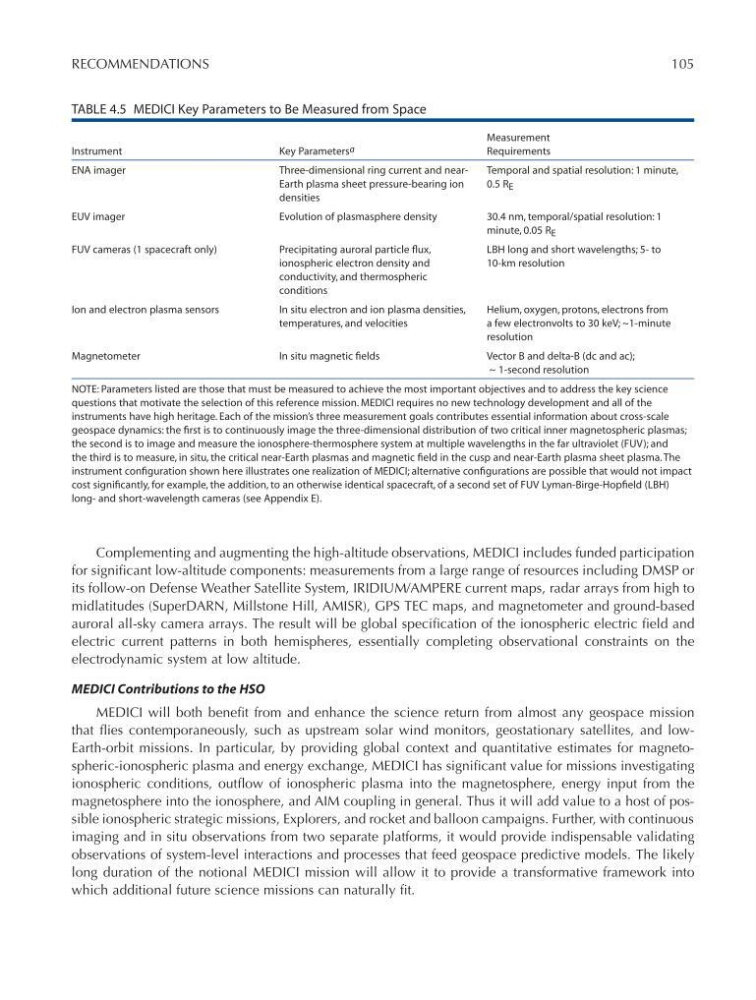
TABLE 4.5 MEDICI Key Parameters to Be Measured from Space
Instrument
Key Parameters a
Measurement
Requirements
ENA imager
Three-dimensional ring current and nearEarth plasma sheet pressure-bearing ion
densities
Temporal and spatial resolution: 1 minute,
0.5 R E
EUV imager
Evolution of plasmasphere density
30.4 nm, temporal/spatial resolution: 1
minute, 0.05 R E
FUV cameras (1 spacecraft only)
Precipitating auroral particle flux,
ionospheric electron density and
conductivity, and thermospheric
conditions
LBH long and short wavelengths; 5- to
10-km resolution
Ion and electron plasma sensors
In situ electron and ion plasma densities,
temperatures, and velocities
Helium, oxygen, protons, electrons from
a few electronvolts to 30 keV; ~1-minute
resolution
Magnetometer
In situ magnetic fields
Vector B and delta-B (dc and ac);
~ 1-second resolution
NOTE: Parameters listed are those that must be measured to achieve the most important objectives and to address the key science
questions that motivate the selection of this reference mission. MEDICI requires no new technology development and all of the
instruments have high heritage. Each of the mission’s three measurement goals contributes essential information about cross-scale
geospace dynamics: the first is to continuously image the three-dimensional distribution of two critical inner magnetospheric plasmas;
the second is to image and measure the ionosphere-thermosphere system at multiple wavelengths in the far ultraviolet (FUV); and
the third is to measure, in situ, the critical near-Earth plasmas and magnetic field in the cusp and near-Earth plasma sheet plasma. The
instrument configuration shown here illustrates one realization of MEDICI; alternative configurations are possible that would not impact
cost significantly, for example, the addition, to an otherwise identical spacecraft, of a second set of FUV Lyman-Birge-Hopfield (LBH)
long- and short-wavelength cameras (see Appendix E).
Solar and Space Physics: A Science for a Technological Society
RECOMMENDATIONS
105
Complementing and augmenting the high-altitude observations, MEDICI includes funded participation
for significant low-altitude components: measurements from a large range of resources including DMSP or
its follow-on Defense Weather Satellite System, IRIDIUM/AMPERE current maps, radar arrays from high to
midlatitudes (SuperDARN, Millstone Hill, AMISR), GPS TEC maps, and magnetometer and ground-based
auroral all-sky camera arrays. The result will be global specification of the ionospheric electric field and
electric current patterns in both hemispheres, essentially completing observational constraints on the
electrodynamic system at low altitude.
MEDICI Contributions to the HSO
MEDICI will both benefit from and enhance the science return from almost any geospace mission
that flies contemporaneously, such as upstream solar wind monitors, geostationary satellites, and lowEarth-orbit missions. In particular, by providing global context and quantitative estimates for magnetospheric-ionospheric plasma and energy exchange, MEDICI has significant value for missions investigating
ionospheric conditions, outflow of ionospheric plasma into the magnetosphere, energy input from the
magnetosphere into the ionosphere, and AIM coupling in general. Thus it will add value to a host of possible ionospheric strategic missions, Explorers, and rocket and balloon campaigns. Further, with continuous
imaging and in situ observations from two separate platforms, it would provide indispensable validating
observations of system-level interactions and processes that feed geospace predictive models. The likely
long duration of the notional MEDICI mission will allow it to provide a transformative framework into
which additional future science missions can naturally fit.
TABLE 4.5 MEDICI Key Parameters to Be Measured from Space
Instrument
Key Parameters a
Measurement
Requirements
ENA imager
Three-dimensional ring current and nearEarth plasma sheet pressure-bearing ion
densities
Temporal and spatial resolution: 1 minute,
0.5 R E
EUV imager
Evolution of plasmasphere density
30.4 nm, temporal/spatial resolution: 1
minute, 0.05 R E
FUV cameras (1 spacecraft only)
Precipitating auroral particle flux,
ionospheric electron density and
conductivity, and thermospheric
conditions
LBH long and short wavelengths; 5- to
10-km resolution
Ion and electron plasma sensors
In situ electron and ion plasma densities,
temperatures, and velocities
Helium, oxygen, protons, electrons from
a few electronvolts to 30 keV; ~1-minute
resolution
Magnetometer
In situ magnetic fields
Vector B and delta-B (dc and ac);
~ 1-second resolution
NOTE: Parameters listed are those that must be measured to achieve the most important objectives and to address the key science
questions that motivate the selection of this reference mission. MEDICI requires no new technology development and all of the
instruments have high heritage. Each of the mission’s three measurement goals contributes essential information about cross-scale
geospace dynamics: the first is to continuously image the three-dimensional distribution of two critical inner magnetospheric plasmas;
the second is to image and measure the ionosphere-thermosphere system at multiple wavelengths in the far ultraviolet (FUV); and
the third is to measure, in situ, the critical near-Earth plasmas and magnetic field in the cusp and near-Earth plasma sheet plasma. The
instrument configuration shown here illustrates one realization of MEDICI; alternative configurations are possible that would not impact
cost significantly, for example, the addition, to an otherwise identical spacecraft, of a second set of FUV Lyman-Birge-Hopfield (LBH)
long- and short-wavelength cameras (see Appendix E).