

Copyright © National Academy of Sciences. All rights reserved.
Solar and Space Physics: A Science for a Technological Society
100
SOLAR AND SPACE PHYSICS: A SCIENCE FOR A TECHNOLOGICAL SOCIETY
of local time, providing the coverage necessary to resolve critical atmospheric tidal components and the
effects of wave-wave interaction. The name coined for this mission is DYNAMIC (Figure 4.8).
The DYNAMIC mission addresses the following fundamental science questions:
1. How does lower-atmosphere variability affect geospace?
2. How do neutrals and plasmas interact to produce multiscale structures in the AIM system?
3. How does the IT system respond over global, regional, and local scales to changes in magnetospheric
inputs?
4. How is magnetospheric electromagnetic energy converted to heat and momentum drivers for the
AIM system?
5. How is our planetary environment changing over multi-decadal scales, and what are the underlying
causes?
It is important to note that while DYNAMIC’s primary focus is to address the question of meteorological
driving of geospace, the orbital sampling and the instruments that are flown also address broader science
questions. For instance, the composition, temperature, and wind measurements will enable researchers to
understand the relative roles of upwelling, advection, and thermal expansion in determining latitude-time
evolution of the O/N 2 ratio during changing geomagnetic conditions, which affects total mass density
and plasma density concentrations. Measurement of winds, plasma drifts, and plasma densities at high
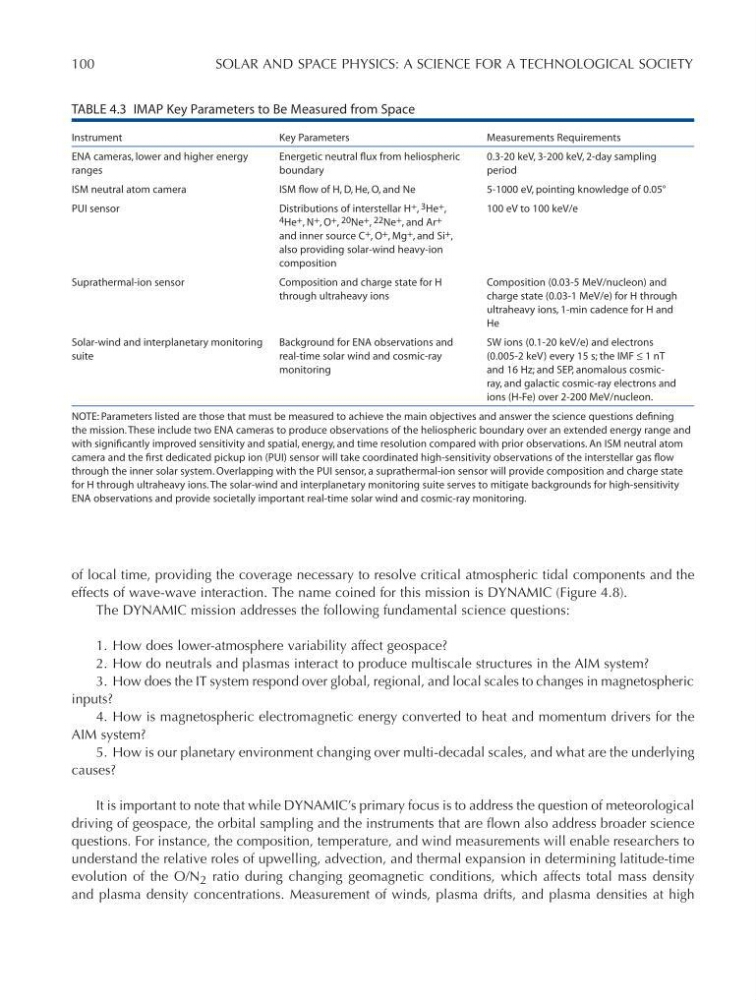
TABLE 4.3 IMAP Key Parameters to Be Measured from Space
Instrument
Key Parameters
Measurements Requirements
ENA cameras, lower and higher energy
ranges
Energetic neutral flux from heliospheric
boundary
0.3-20 keV, 3-200 keV, 2-day sampling
period
ISM neutral atom camera
ISM flow of H, D, He, O, and Ne
5-1000 eV, pointing knowledge of 0.05°
PUI sensor
Distributions of interstellar H + , 3 He + ,
4 He + , N + , O + , 20 Ne + , 22 Ne + , and Ar +
and inner source C + , O + , Mg + , and Si + ,
also providing solar-wind heavy-ion
composition
100 eV to 100 keV/e
Suprathermal-ion sensor
Composition and charge state for H
through ultraheavy ions
Composition (0.03-5 MeV/nucleon) and
charge state (0.03-1 MeV/e) for H through
ultraheavy ions, 1-min cadence for H and
He
Solar-wind and interplanetary monitoring
suite
Background for ENA observations and
real-time solar wind and cosmic-ray
monitoring
SW ions (0.1-20 keV/e) and electrons
(0.005-2 keV) every 15 s; the IMF ≤ 1 nT
and 16 Hz; and SEP, anomalous cosmicray, and galactic cosmic-ray electrons and
ions (H-Fe) over 2-200 MeV/nucleon.
NOTE: Parameters listed are those that must be measured to achieve the main objectives and answer the science questions defining
the mission. These include two ENA cameras to produce observations of the heliospheric boundary over an extended energy range and
with significantly improved sensitivity and spatial, energy, and time resolution compared with prior observations. An ISM neutral atom
camera and the first dedicated pickup ion (PUI) sensor will take coordinated high-sensitivity observations of the interstellar gas flow
through the inner solar system. Overlapping with the PUI sensor, a suprathermal-ion sensor will provide composition and charge state
for H through ultraheavy ions. The solar-wind and interplanetary monitoring suite serves to mitigate backgrounds for high-sensitivity
ENA observations and provide societally important real-time solar wind and cosmic-ray monitoring.
Solar and Space Physics: A Science for a Technological Society
100
SOLAR AND SPACE PHYSICS: A SCIENCE FOR A TECHNOLOGICAL SOCIETY
of local time, providing the coverage necessary to resolve critical atmospheric tidal components and the
effects of wave-wave interaction. The name coined for this mission is DYNAMIC (Figure 4.8).
The DYNAMIC mission addresses the following fundamental science questions:
1. How does lower-atmosphere variability affect geospace?
2. How do neutrals and plasmas interact to produce multiscale structures in the AIM system?
3. How does the IT system respond over global, regional, and local scales to changes in magnetospheric
inputs?
4. How is magnetospheric electromagnetic energy converted to heat and momentum drivers for the
AIM system?
5. How is our planetary environment changing over multi-decadal scales, and what are the underlying
causes?
It is important to note that while DYNAMIC’s primary focus is to address the question of meteorological
driving of geospace, the orbital sampling and the instruments that are flown also address broader science
questions. For instance, the composition, temperature, and wind measurements will enable researchers to
understand the relative roles of upwelling, advection, and thermal expansion in determining latitude-time
evolution of the O/N 2 ratio during changing geomagnetic conditions, which affects total mass density
and plasma density concentrations. Measurement of winds, plasma drifts, and plasma densities at high
TABLE 4.3 IMAP Key Parameters to Be Measured from Space
Instrument
Key Parameters
Measurements Requirements
ENA cameras, lower and higher energy
ranges
Energetic neutral flux from heliospheric
boundary
0.3-20 keV, 3-200 keV, 2-day sampling
period
ISM neutral atom camera
ISM flow of H, D, He, O, and Ne
5-1000 eV, pointing knowledge of 0.05°
PUI sensor
Distributions of interstellar H + , 3 He + ,
4 He + , N + , O + , 20 Ne + , 22 Ne + , and Ar +
and inner source C + , O + , Mg + , and Si + ,
also providing solar-wind heavy-ion
composition
100 eV to 100 keV/e
Suprathermal-ion sensor
Composition and charge state for H
through ultraheavy ions
Composition (0.03-5 MeV/nucleon) and
charge state (0.03-1 MeV/e) for H through
ultraheavy ions, 1-min cadence for H and
He
Solar-wind and interplanetary monitoring
suite
Background for ENA observations and
real-time solar wind and cosmic-ray
monitoring
SW ions (0.1-20 keV/e) and electrons
(0.005-2 keV) every 15 s; the IMF ≤ 1 nT
and 16 Hz; and SEP, anomalous cosmicray, and galactic cosmic-ray electrons and
ions (H-Fe) over 2-200 MeV/nucleon.
NOTE: Parameters listed are those that must be measured to achieve the main objectives and answer the science questions defining
the mission. These include two ENA cameras to produce observations of the heliospheric boundary over an extended energy range and
with significantly improved sensitivity and spatial, energy, and time resolution compared with prior observations. An ISM neutral atom
camera and the first dedicated pickup ion (PUI) sensor will take coordinated high-sensitivity observations of the interstellar gas flow
through the inner solar system. Overlapping with the PUI sensor, a suprathermal-ion sensor will provide composition and charge state
for H through ultraheavy ions. The solar-wind and interplanetary monitoring suite serves to mitigate backgrounds for high-sensitivity
ENA observations and provide societally important real-time solar wind and cosmic-ray monitoring.