

Copyright © National Academy of Sciences. All rights reserved.
Solar and Space Physics: A Science for a Technological Society
98
SOLAR AND SPACE PHYSICS: A SCIENCE FOR A TECHNOLOGICAL SOCIETY
IMAP
IMAP Overview
The past decade has seen breakthroughs in knowledge of the outer boundaries of the heliosphere
and the interaction between the Sun and its local galactic neighborhood. These advances range from the
crossing of the termination shock by the Voyager spacecraft to the images captured by IBEX of enhanced
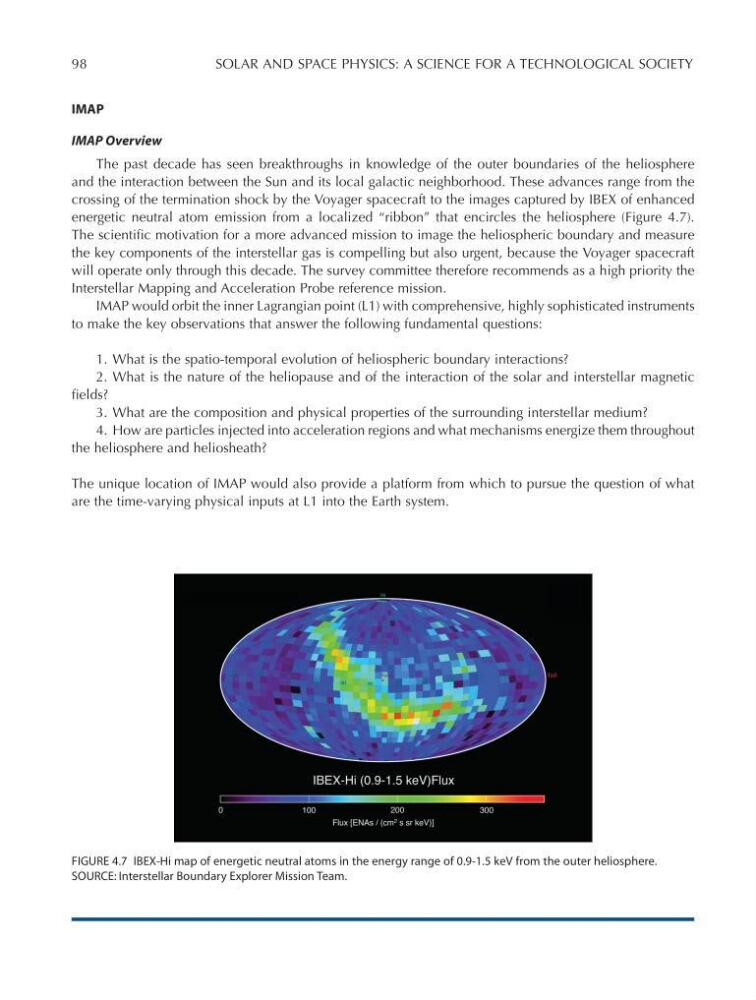
energetic neutral atom emission from a localized “ribbon” that encircles the heliosphere (Figure 4.7).
The scientific motivation for a more advanced mission to image the heliospheric boundary and measure
the key components of the interstellar gas is compelling but also urgent, because the Voyager spacecraft
will operate only through this decade. The survey committee therefore recommends as a high priority the
Interstellar Mapping and Acceleration Probe reference mission.
IMAP would orbit the inner Lagrangian point (L1) with comprehensive, highly sophisticated instruments
to make the key observations that answer the following fundamental questions:
1. What is the spatio-temporal evolution of heliospheric boundary interactions?
2. What is the nature of the heliopause and of the interaction of the solar and interstellar magnetic
fields?
3. What are the composition and physical properties of the surrounding interstellar medium?
4. How are particles injected into acceleration regions and what mechanisms energize them throughout
the heliosphere and heliosheath?
The unique location of IMAP would also provide a platform from which to pursue the question of what
are the time-varying physical inputs at L1 into the Earth system.
FIGURE 4.7 IBEX-Hi map of energetic neutral atoms in the energy range of 0.9-1.5 keV from the outer heliosphere.
SOURCE: Interstellar Boundary Explorer Mission Team.
Figure 4-7
Solar and Space Physics: A Science for a Technological Society
98
SOLAR AND SPACE PHYSICS: A SCIENCE FOR A TECHNOLOGICAL SOCIETY
IMAP
IMAP Overview
The past decade has seen breakthroughs in knowledge of the outer boundaries of the heliosphere
and the interaction between the Sun and its local galactic neighborhood. These advances range from the
crossing of the termination shock by the Voyager spacecraft to the images captured by IBEX of enhanced
energetic neutral atom emission from a localized “ribbon” that encircles the heliosphere (Figure 4.7).
The scientific motivation for a more advanced mission to image the heliospheric boundary and measure
the key components of the interstellar gas is compelling but also urgent, because the Voyager spacecraft
will operate only through this decade. The survey committee therefore recommends as a high priority the
Interstellar Mapping and Acceleration Probe reference mission.
IMAP would orbit the inner Lagrangian point (L1) with comprehensive, highly sophisticated instruments
to make the key observations that answer the following fundamental questions:
1. What is the spatio-temporal evolution of heliospheric boundary interactions?
2. What is the nature of the heliopause and of the interaction of the solar and interstellar magnetic
fields?
3. What are the composition and physical properties of the surrounding interstellar medium?
4. How are particles injected into acceleration regions and what mechanisms energize them throughout
the heliosphere and heliosheath?
The unique location of IMAP would also provide a platform from which to pursue the question of what
are the time-varying physical inputs at L1 into the Earth system.
FIGURE 4.7 IBEX-Hi map of energetic neutral atoms in the energy range of 0.9-1.5 keV from the outer heliosphere.
SOURCE: Interstellar Boundary Explorer Mission Team.
Figure 4-7