

Copyright © National Academy of Sciences. All rights reserved.
Solar and Space Physics: A Science for a Technological Society
90
SOLAR AND SPACE PHYSICS: A SCIENCE FOR A TECHNOLOGICAL SOCIETY
Educate: Educate, Empower, and Inspire the Next Generation of Space Researchers
Solar and space physics is a field with global consequences that are both intellectually stimulating and
relevant to society. Heliophysics programs empower young scientists and engineers to perform analytical thinking on real science and technology problems, forging a multitalented, creative workforce for the
future of the United States. Through education and public outreach, the general public is inspired by the
sheer beauty of dynamic solar events and the response seen at Earth in visually stunning auroral forms.
However, it is critical to ensure sufficient resources for education and training, and to develop the skills
necessary for the next generation of space researchers and for technologically literate workers in many
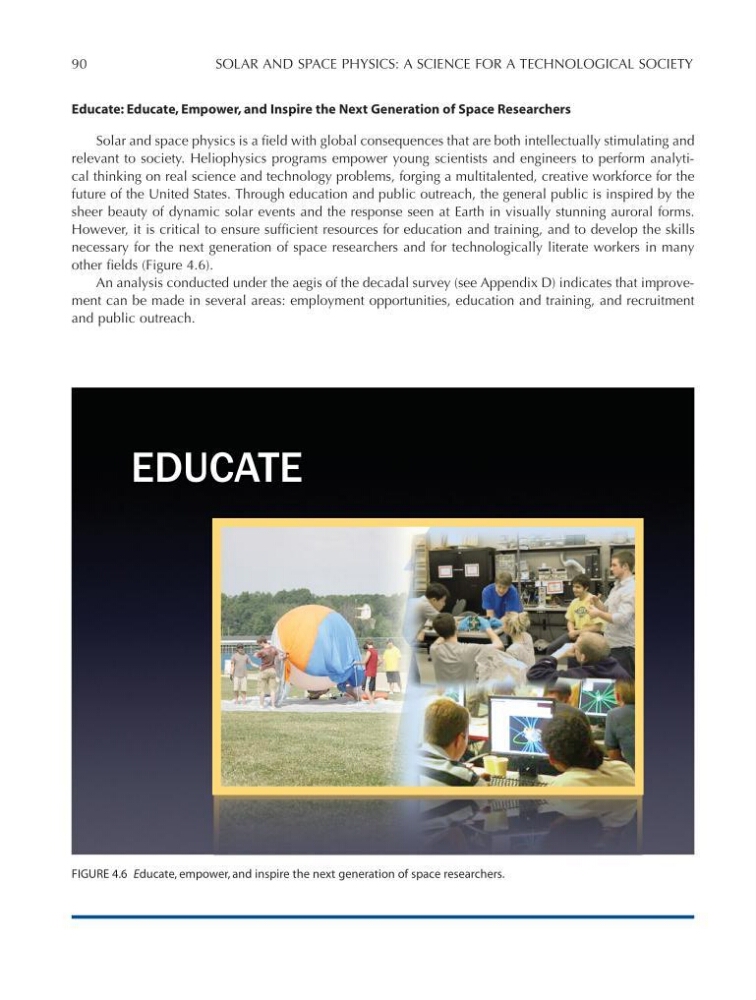
other fields (Figure 4.6).
An analysis conducted under the aegis of the decadal survey (see Appendix D) indicates that improvement can be made in several areas: employment opportunities, education and training, and recruitment
and public outreach.
FIGURE 4.6 Educate, empower, and inspire the next generation of space researchers.
EDUCATE
Figure 4-6
Solar and Space Physics: A Science for a Technological Society
90
SOLAR AND SPACE PHYSICS: A SCIENCE FOR A TECHNOLOGICAL SOCIETY
Educate: Educate, Empower, and Inspire the Next Generation of Space Researchers
Solar and space physics is a field with global consequences that are both intellectually stimulating and
relevant to society. Heliophysics programs empower young scientists and engineers to perform analytical thinking on real science and technology problems, forging a multitalented, creative workforce for the
future of the United States. Through education and public outreach, the general public is inspired by the
sheer beauty of dynamic solar events and the response seen at Earth in visually stunning auroral forms.
However, it is critical to ensure sufficient resources for education and training, and to develop the skills
necessary for the next generation of space researchers and for technologically literate workers in many
other fields (Figure 4.6).
An analysis conducted under the aegis of the decadal survey (see Appendix D) indicates that improvement can be made in several areas: employment opportunities, education and training, and recruitment
and public outreach.
FIGURE 4.6 Educate, empower, and inspire the next generation of space researchers.
EDUCATE
Figure 4-6