

Copyright © National Academy of Sciences. All rights reserved.
Solar and Space Physics: A Science for a Technological Society
88
SOLAR AND SPACE PHYSICS: A SCIENCE FOR A TECHNOLOGICAL SOCIETY
of the HTP at current funding levels. The committee further concluded that, as the heliophysics science
centers are implemented it may be more effective to reduce the total number of HTP awards but increase
their average size to the range of ~$400,000 to $600,000 per year.
NASA Instrumentation and Technology
A 2010 National Research Council (NRC) study, An Enabling Foundation for NASA’s Earth and Space
Science Missions, 6 discussed the importance of advanced technology development in all of the science
areas of NASA’s Science Mission Directorate, and it recommended that instrument and mission technology
activities be managed strategically so as to maximize the opportunities to meet each division’s strategic
6 National Research Council, An Enabling Foundation for NASA’s Space and Earth Science Missions, The National Academies
Press, Washington, D.C, 2010.
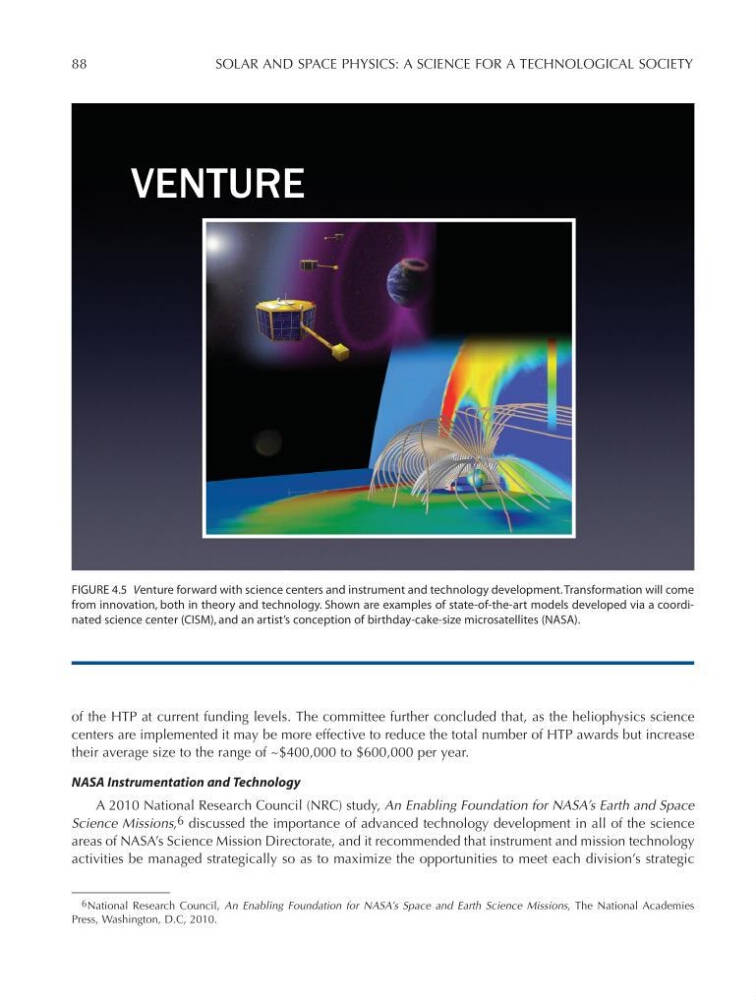
FIGURE 4.5 Venture forward with science centers and instrument and technology development. Transformation will come
from innovation, both in theory and technology. Shown are examples of state-of-the-art models developed via a coordinated science center (CISM), and an artist’s conception of birthday-cake-size microsatellites (NASA).
VENTURE
Figure 4-5
Solar and Space Physics: A Science for a Technological Society
88
SOLAR AND SPACE PHYSICS: A SCIENCE FOR A TECHNOLOGICAL SOCIETY
of the HTP at current funding levels. The committee further concluded that, as the heliophysics science
centers are implemented it may be more effective to reduce the total number of HTP awards but increase
their average size to the range of ~$400,000 to $600,000 per year.
NASA Instrumentation and Technology
A 2010 National Research Council (NRC) study, An Enabling Foundation for NASA’s Earth and Space
Science Missions, 6 discussed the importance of advanced technology development in all of the science
areas of NASA’s Science Mission Directorate, and it recommended that instrument and mission technology
activities be managed strategically so as to maximize the opportunities to meet each division’s strategic
6 National Research Council, An Enabling Foundation for NASA’s Space and Earth Science Missions, The National Academies
Press, Washington, D.C, 2010.
FIGURE 4.5 Venture forward with science centers and instrument and technology development. Transformation will come
from innovation, both in theory and technology. Shown are examples of state-of-the-art models developed via a coordinated science center (CISM), and an artist’s conception of birthday-cake-size microsatellites (NASA).
VENTURE
Figure 4-5