

Copyright © National Academy of Sciences. All rights reserved.
Solar and Space Physics: A Science for a Technological Society
RECOMMENDATIONS
85
arrangement concerns the ongoing exploration of the boundary regions of the heliosphere—currently one
of the most fruitful and exciting areas of research, but one that has very little focus at NSF.
Recommendation: NSF should ensure that funding is available for basic research in subjects that fall
between sections, divisions, and directorates, such as planetary magnetospheres and ionospheres, the Sun
as a star, and the outer heliosphere. In particular, research on the outer heliosphere should be included
explicitly in the scope of research supported by the Atmospheric and Geospace Sciences Division at NSF.
Solar and space physics has a clear home in NASA’s Heliophysics Division. However, there remain
important scientific links between the Heliophysics Division and the Astrophysics, Planetary Sciences, and
Earth Sciences divisions. The survey committee concluded that multidisciplinary collaborations between
the solar, heliosphere, Earth science, and climate change communities are valuable, and it recognizes in
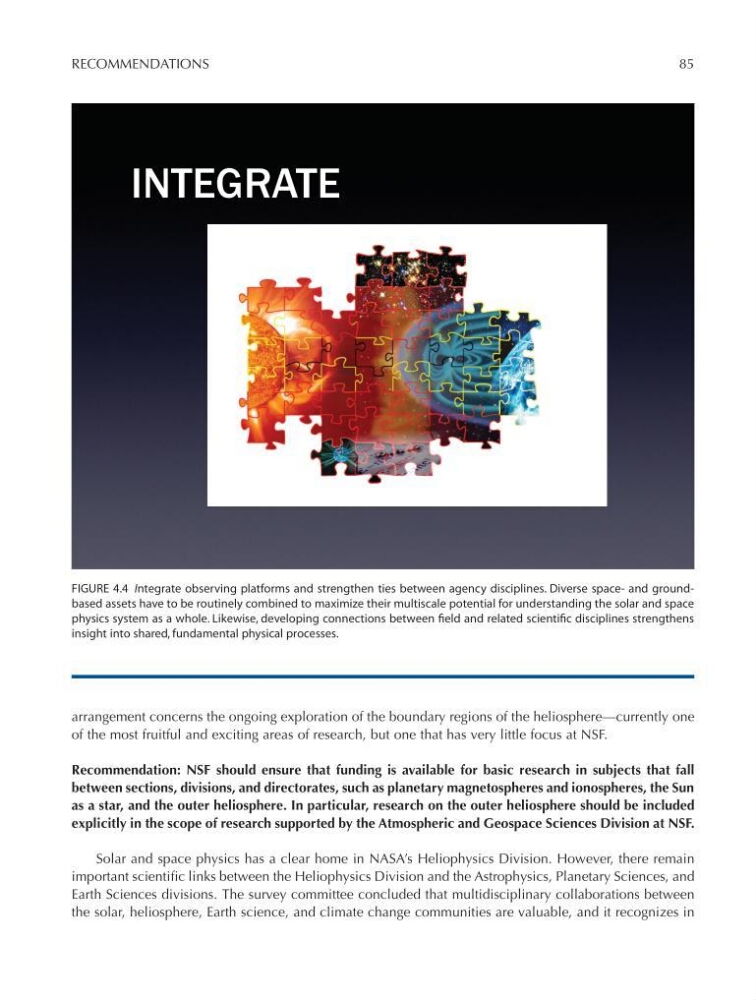
FIGURE 4.4 Integrate observing platforms and strengthen ties between agency disciplines. Diverse space- and groundbased assets have to be routinely combined to maximize their multiscale potential for understanding the solar and space
physics system as a whole. Likewise, developing connections between field and related scientific disciplines strengthens
insight into shared, fundamental physical processes.
INTEGRATE
Figure 4-4
Solar and Space Physics: A Science for a Technological Society
RECOMMENDATIONS
85
arrangement concerns the ongoing exploration of the boundary regions of the heliosphere—currently one
of the most fruitful and exciting areas of research, but one that has very little focus at NSF.
Recommendation: NSF should ensure that funding is available for basic research in subjects that fall
between sections, divisions, and directorates, such as planetary magnetospheres and ionospheres, the Sun
as a star, and the outer heliosphere. In particular, research on the outer heliosphere should be included
explicitly in the scope of research supported by the Atmospheric and Geospace Sciences Division at NSF.
Solar and space physics has a clear home in NASA’s Heliophysics Division. However, there remain
important scientific links between the Heliophysics Division and the Astrophysics, Planetary Sciences, and
Earth Sciences divisions. The survey committee concluded that multidisciplinary collaborations between
the solar, heliosphere, Earth science, and climate change communities are valuable, and it recognizes in
FIGURE 4.4 Integrate observing platforms and strengthen ties between agency disciplines. Diverse space- and groundbased assets have to be routinely combined to maximize their multiscale potential for understanding the solar and space
physics system as a whole. Likewise, developing connections between field and related scientific disciplines strengthens
insight into shared, fundamental physical processes.
INTEGRATE
Figure 4-4