

Copyright © National Academy of Sciences. All rights reserved.
Solar and Space Physics: A Science for a Technological Society
80
SOLAR AND SPACE PHYSICS: A SCIENCE FOR A TECHNOLOGICAL SOCIETY
Recommendation: The National Science Foundation should create a new, competitively selected midscale
project funding line in order to enable midscale projects and instrumentation for large projects.
Tiny Satellites
Since the 2003 solar and space physics decadal survey, a new experimental capability has emerged for
very small spacecraft, which can act as stand-alone measurement platforms or be integrated into a greater
whole. These platforms are enabled by innovations in miniature, low-power, highly integrated electronics and nanoscale manufacturing techniques, and they provide potentially revolutionary approaches to
experimental space science. For example, small, low-cost satellites may be deployed into regions where
satellite lifetimes are short but where important yet poorly characterized interactions take place. Operation of miniaturized avionics and instrumentation in high radiation environments both spurs technological
development and provides valuable knowledge of space weather.
Experiments on very small spacecraft have an important educational impact, as well. A survey of
solar and space physics graduate students at NSF’s GEM, SHINE, and CEDAR workshops indicated that
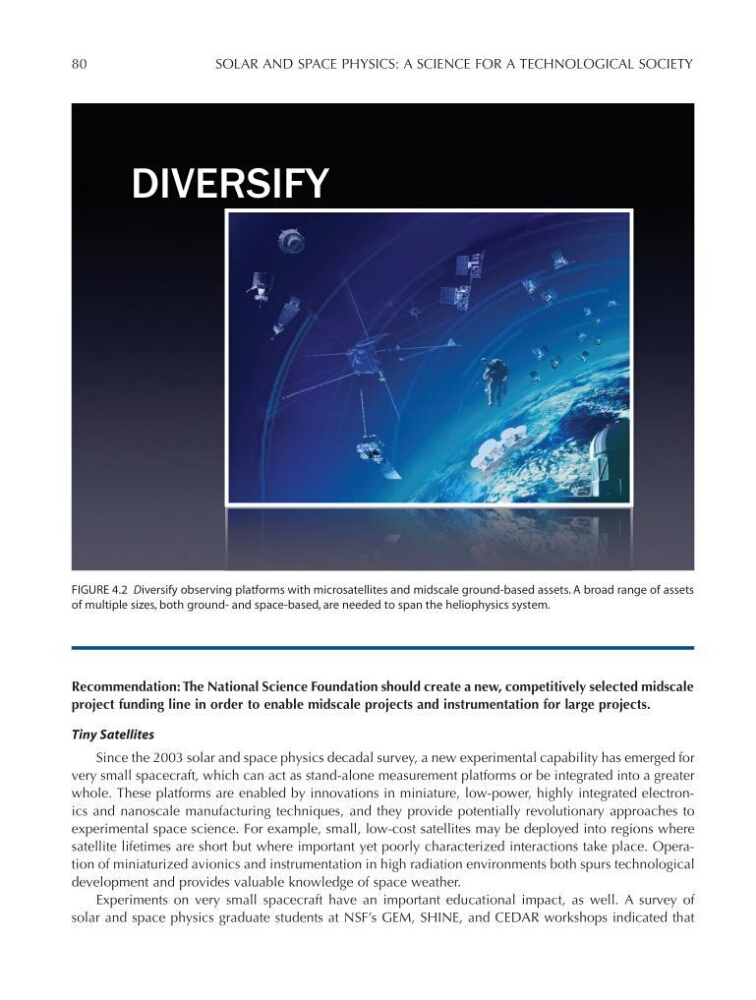
FIGURE 4.2 Diversify observing platforms with microsatellites and midscale ground-based assets. A broad range of assets
of multiple sizes, both ground- and space-based, are needed to span the heliophysics system.
DIVERSIFY
Figure 4-2
Solar and Space Physics: A Science for a Technological Society
80
SOLAR AND SPACE PHYSICS: A SCIENCE FOR A TECHNOLOGICAL SOCIETY
Recommendation: The National Science Foundation should create a new, competitively selected midscale
project funding line in order to enable midscale projects and instrumentation for large projects.
Tiny Satellites
Since the 2003 solar and space physics decadal survey, a new experimental capability has emerged for
very small spacecraft, which can act as stand-alone measurement platforms or be integrated into a greater
whole. These platforms are enabled by innovations in miniature, low-power, highly integrated electronics and nanoscale manufacturing techniques, and they provide potentially revolutionary approaches to
experimental space science. For example, small, low-cost satellites may be deployed into regions where
satellite lifetimes are short but where important yet poorly characterized interactions take place. Operation of miniaturized avionics and instrumentation in high radiation environments both spurs technological
development and provides valuable knowledge of space weather.
Experiments on very small spacecraft have an important educational impact, as well. A survey of
solar and space physics graduate students at NSF’s GEM, SHINE, and CEDAR workshops indicated that
FIGURE 4.2 Diversify observing platforms with microsatellites and midscale ground-based assets. A broad range of assets
of multiple sizes, both ground- and space-based, are needed to span the heliophysics system.
DIVERSIFY
Figure 4-2