

Copyright © National Academy of Sciences. All rights reserved.
Solar and Space Physics: A Science for a Technological Society
ADDRESSING SOCIETAL NEEDS
73
electrically charged particles, supersonic flows and shock waves, explosive release of magnetic energy,
and solar-driven winds and tides in Earth’s atmosphere.
Moreover, the Sun, the heliosphere, Earth, and the planets together constitute a coupled and intertwined
system. It is a formidable challenge to understand the detailed individual processes that control the space
environment, while also accounting for the global couplings among the various interacting members of
the Sun-heliosphere-Earth system and their subelements, such as the neutral atmosphere and ionosphere.
Significant progress has accrued during the past few decades from observations made by space missions and
ground-based observatories and from theories and models developed to explain the observations. However,
owing to the complexity of this variable, coupled system, scientists have not yet achieved a sufficiently
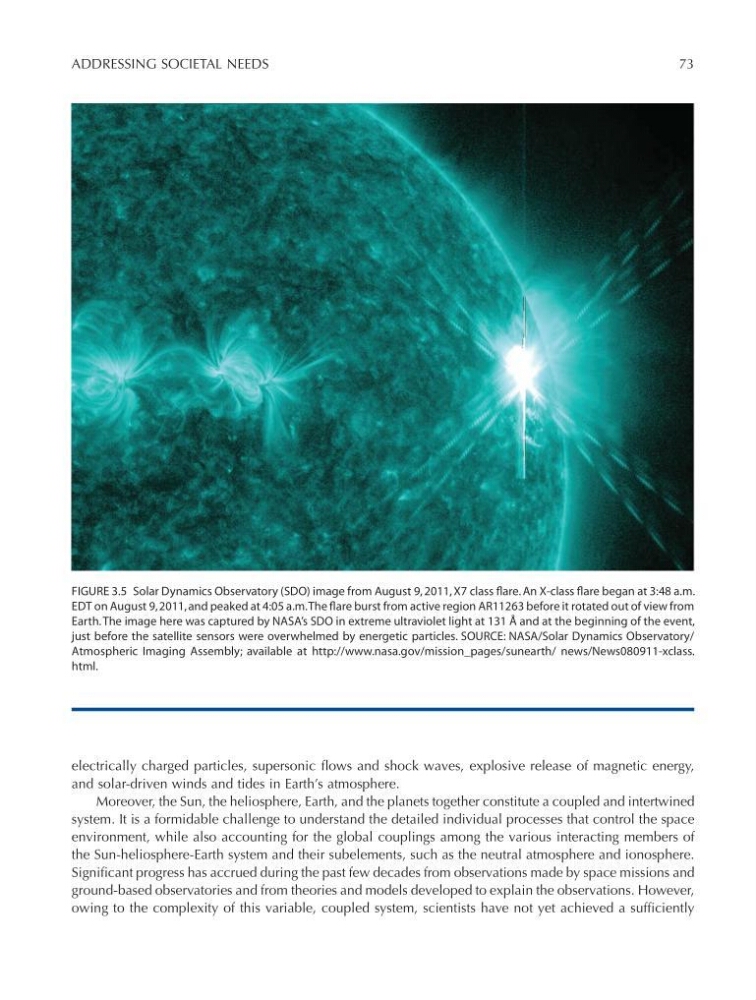
FIGURE 3.5 Solar Dynamics Observatory (SDO) image from August 9, 2011, X7 class flare. An X-class flare began at 3:48 a.m.
EDT on August 9, 2011, and peaked at 4:05 a.m. The flare burst from active region AR11263 before it rotated out of view from
Earth. The image here was captured by NASA’s SDO in extreme ultraviolet light at 131 Å and at the beginning of the event,
just before the satellite sensors were overwhelmed by energetic particles. SOURCE: NASA/Solar Dynamics Observatory/
Atmospheric Imaging Assembly; available at http://www.nasa.gov/mission_pages/sunearth/ news/News080911-xclass.
html.
Figure 3-5
Solar and Space Physics: A Science for a Technological Society
ADDRESSING SOCIETAL NEEDS
73
electrically charged particles, supersonic flows and shock waves, explosive release of magnetic energy,
and solar-driven winds and tides in Earth’s atmosphere.
Moreover, the Sun, the heliosphere, Earth, and the planets together constitute a coupled and intertwined
system. It is a formidable challenge to understand the detailed individual processes that control the space
environment, while also accounting for the global couplings among the various interacting members of
the Sun-heliosphere-Earth system and their subelements, such as the neutral atmosphere and ionosphere.
Significant progress has accrued during the past few decades from observations made by space missions and
ground-based observatories and from theories and models developed to explain the observations. However,
owing to the complexity of this variable, coupled system, scientists have not yet achieved a sufficiently
FIGURE 3.5 Solar Dynamics Observatory (SDO) image from August 9, 2011, X7 class flare. An X-class flare began at 3:48 a.m.
EDT on August 9, 2011, and peaked at 4:05 a.m. The flare burst from active region AR11263 before it rotated out of view from
Earth. The image here was captured by NASA’s SDO in extreme ultraviolet light at 131 Å and at the beginning of the event,
just before the satellite sensors were overwhelmed by energetic particles. SOURCE: NASA/Solar Dynamics Observatory/
Atmospheric Imaging Assembly; available at http://www.nasa.gov/mission_pages/sunearth/ news/News080911-xclass.
html.
Figure 3-5