

64
M. Hadj Kacem et al.
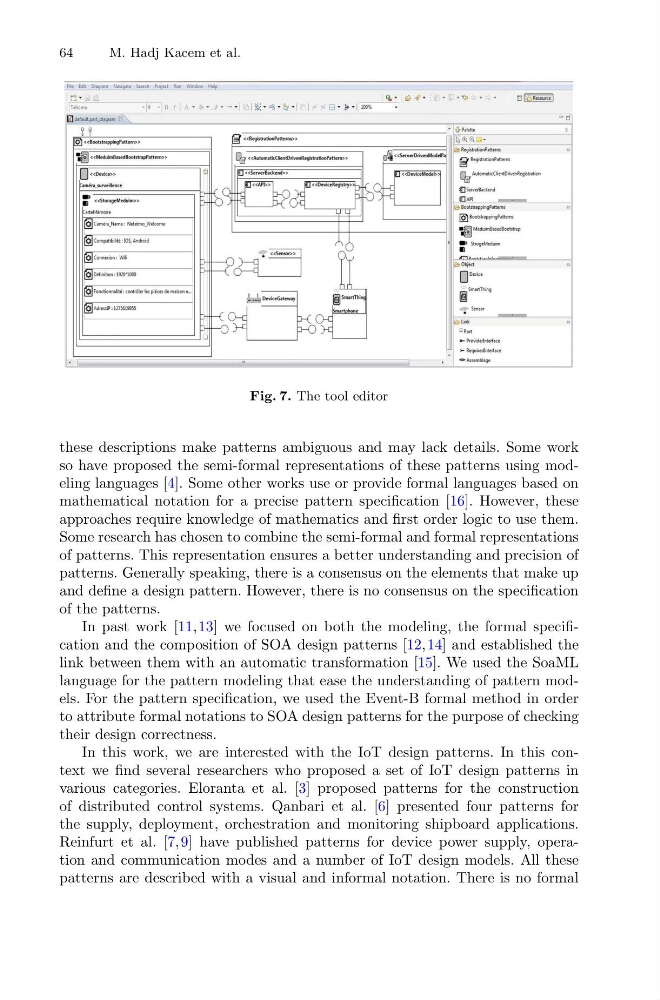
Fig. 7. The tool editor
these descriptions make patterns ambiguous and may lack details. Some work
so have proposed the semi-formal representations of these patterns using modeling languages [4]. Some other works use or provide formal languages based on
mathematical notation for a precise pattern specification [16]. However, these
approaches require knowledge of mathematics and first order logic to use them.
Some research has chosen to combine the semi-formal and formal representations
of patterns. This representation ensures a better understanding and precision of
patterns. Generally speaking, there is a consensus on the elements that make up
and define a design pattern. However, there is no consensus on the specification
of the patterns.
In past work [11,13] we focused on both the modeling, the formal specification and the composition of SOA design patterns [12,14] and established the
link between them with an automatic transformation [15]. We used the SoaML
language for the pattern modeling that ease the understanding of pattern models. For the pattern specification, we used the Event-B formal method in order
to attribute formal notations to SOA design patterns for the purpose of checking
their design correctness.
In this work, we are interested with the IoT design patterns. In this context we find several researchers who proposed a set of IoT design patterns in
various categories. Eloranta et al. [3] proposed patterns for the construction
of distributed control systems. Qanbari et al. [6] presented four patterns for
the supply, deployment, orchestration and monitoring shipboard applications.
Reinfurt et al. [7,9] have published patterns for device power supply, operation and communication modes and a number of IoT design models. All these
patterns are described with a visual and informal notation. There is no formal
M. Hadj Kacem et al.
Fig. 7. The tool editor
these descriptions make patterns ambiguous and may lack details. Some work
so have proposed the semi-formal representations of these patterns using modeling languages [4]. Some other works use or provide formal languages based on
mathematical notation for a precise pattern specification [16]. However, these
approaches require knowledge of mathematics and first order logic to use them.
Some research has chosen to combine the semi-formal and formal representations
of patterns. This representation ensures a better understanding and precision of
patterns. Generally speaking, there is a consensus on the elements that make up
and define a design pattern. However, there is no consensus on the specification
of the patterns.
In past work [11,13] we focused on both the modeling, the formal specification and the composition of SOA design patterns [12,14] and established the
link between them with an automatic transformation [15]. We used the SoaML
language for the pattern modeling that ease the understanding of pattern models. For the pattern specification, we used the Event-B formal method in order
to attribute formal notations to SOA design patterns for the purpose of checking
their design correctness.
In this work, we are interested with the IoT design patterns. In this context we find several researchers who proposed a set of IoT design patterns in
various categories. Eloranta et al. [3] proposed patterns for the construction
of distributed control systems. Qanbari et al. [6] presented four patterns for
the supply, deployment, orchestration and monitoring shipboard applications.
Reinfurt et al. [7,9] have published patterns for device power supply, operation and communication modes and a number of IoT design models. All these
patterns are described with a visual and informal notation. There is no formal