

48
L. Chaari Fourati and S. Said
- Slave latency: is the number of connection events, that sensor node can skip
to save energy without the risk of disconnected.
- Connection supervision timeout: specifies the maximum time between two
valid data received before a connection is lost.
The master coordinates the MAC using a TDMA scheme, determines the
instants in which slaves are required to listen, and provides them with the map
of data channels to be used.
3.2 BLE Protocols Stack
BLE protocol stack involves two main elements: the controller and the Host. The
Controller includes the physical layer and the link layer. Both implemented on
a single chip with an integrated radio interface. The Host runs on an application processor. It covers five upper layer functionalities (the Logical Link
Control and Adaptation Protocol (L2CAP), the Attribute Protocol (ATT), the
Generic Attribute Profile (GATT), the Security Manager Protocol (SMP) and
the Generic Access Profile (GAP). The standardized Host Controller Interface
(HCI) provides the exchange between the Host and the Controller. An application layer can be developed on the top of the Host.
- L2CAP: acts as an interface between the link layer and the Upper layer protocols (ATT, SMP and Link Layer control signaling). It multiplexes, segments,
reassembles data packets and offers support quality of service management.
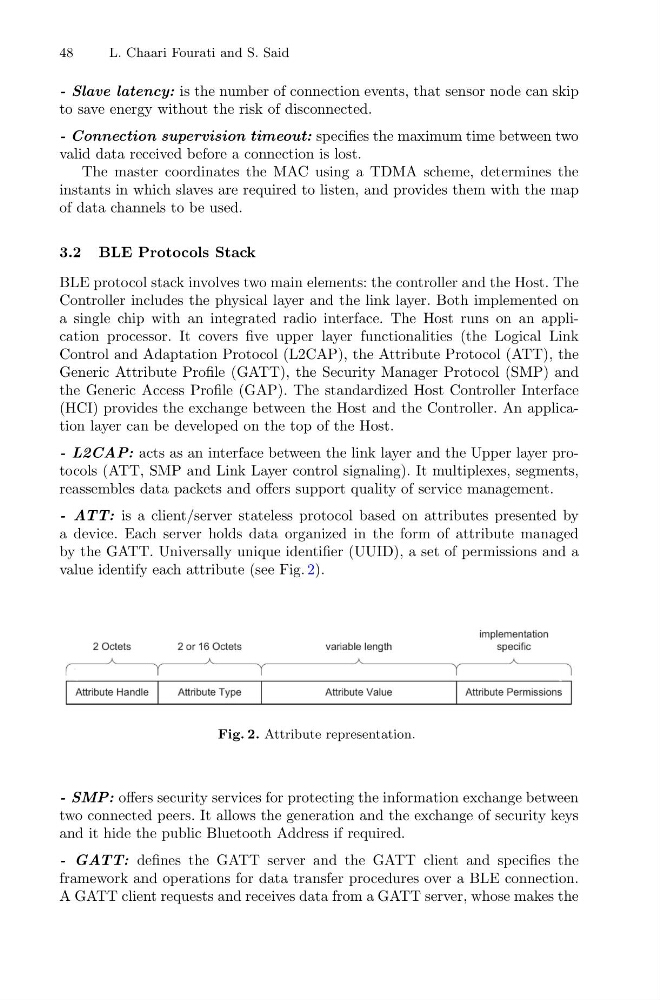
- ATT: is a client/server stateless protocol based on attributes presented by
a device. Each server holds data organized in the form of attribute managed
by the GATT. Universally unique identifier (UUID), a set of permissions and a
value identify each attribute (see Fig. 2).
Fig. 2. Attribute representation.
- SMP: offers security services for protecting the information exchange between
two connected peers. It allows the generation and the exchange of security keys
and it hide the public Bluetooth Address if required.
- GATT: defines the GATT server and the GATT client and specifies the
framework and operations for data transfer procedures over a BLE connection.
A GATT client requests and receives data from a GATT server, whose makes the
L. Chaari Fourati and S. Said
- Slave latency: is the number of connection events, that sensor node can skip
to save energy without the risk of disconnected.
- Connection supervision timeout: specifies the maximum time between two
valid data received before a connection is lost.
The master coordinates the MAC using a TDMA scheme, determines the
instants in which slaves are required to listen, and provides them with the map
of data channels to be used.
3.2 BLE Protocols Stack
BLE protocol stack involves two main elements: the controller and the Host. The
Controller includes the physical layer and the link layer. Both implemented on
a single chip with an integrated radio interface. The Host runs on an application processor. It covers five upper layer functionalities (the Logical Link
Control and Adaptation Protocol (L2CAP), the Attribute Protocol (ATT), the
Generic Attribute Profile (GATT), the Security Manager Protocol (SMP) and
the Generic Access Profile (GAP). The standardized Host Controller Interface
(HCI) provides the exchange between the Host and the Controller. An application layer can be developed on the top of the Host.
- L2CAP: acts as an interface between the link layer and the Upper layer protocols (ATT, SMP and Link Layer control signaling). It multiplexes, segments,
reassembles data packets and offers support quality of service management.
- ATT: is a client/server stateless protocol based on attributes presented by
a device. Each server holds data organized in the form of attribute managed
by the GATT. Universally unique identifier (UUID), a set of permissions and a
value identify each attribute (see Fig. 2).
Fig. 2. Attribute representation.
- SMP: offers security services for protecting the information exchange between
two connected peers. It allows the generation and the exchange of security keys
and it hide the public Bluetooth Address if required.
- GATT: defines the GATT server and the GATT client and specifies the
framework and operations for data transfer procedures over a BLE connection.
A GATT client requests and receives data from a GATT server, whose makes the