

3 Well Being Model and Urban Wellbeing
The WHO definition of health includes reference to wellbeing: health is “a state of
complete physical, mental and social wellbeing and not merely the absence of disease
or infirmity” [4]. Wellbeing is a dynamic construct comprised of several dimensions. In
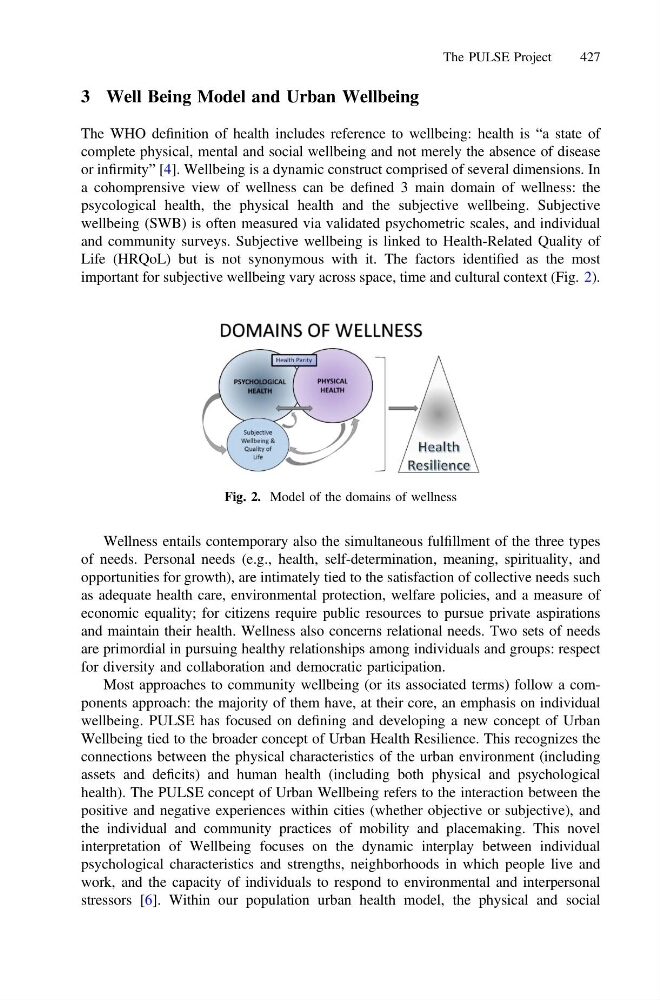
a cohomprensive view of wellness can be defined 3 main domain of wellness: the
psycological health, the physical health and the subjective wellbeing. Subjective
wellbeing (SWB) is often measured via validated psychometric scales, and individual
and community surveys. Subjective wellbeing is linked to Health-Related Quality of
Life (HRQoL) but is not synonymous with it. The factors identified as the most
important for subjective wellbeing vary across space, time and cultural context (Fig. 2).
Wellness entails contemporary also the simultaneous fulfillment of the three types
of needs. Personal needs (e.g., health, self-determination, meaning, spirituality, and
opportunities for growth), are intimately tied to the satisfaction of collective needs such
as adequate health care, environmental protection, welfare policies, and a measure of
economic equality; for citizens require public resources to pursue private aspirations
and maintain their health. Wellness also concerns relational needs. Two sets of needs
are primordial in pursuing healthy relationships among individuals and groups: respect
for diversity and collaboration and democratic participation.
Most approaches to community wellbeing (or its associated terms) follow a components approach: the majority of them have, at their core, an emphasis on individual
wellbeing. PULSE has focused on defining and developing a new concept of Urban
Wellbeing tied to the broader concept of Urban Health Resilience. This recognizes the
connections between the physical characteristics of the urban environment (including
assets and deficits) and human health (including both physical and psychological
health). The PULSE concept of Urban Wellbeing refers to the interaction between the
positive and negative experiences within cities (whether objective or subjective), and
the individual and community practices of mobility and placemaking. This novel
interpretation of Wellbeing focuses on the dynamic interplay between individual
psychological characteristics and strengths, neighborhoods in which people live and
work, and the capacity of individuals to respond to environmental and interpersonal
stressors [6]. Within our population urban health model, the physical and social
Fig. 2. Model of the domains of wellness
The PULSE Project
427
The WHO definition of health includes reference to wellbeing: health is “a state of
complete physical, mental and social wellbeing and not merely the absence of disease
or infirmity” [4]. Wellbeing is a dynamic construct comprised of several dimensions. In
a cohomprensive view of wellness can be defined 3 main domain of wellness: the
psycological health, the physical health and the subjective wellbeing. Subjective
wellbeing (SWB) is often measured via validated psychometric scales, and individual
and community surveys. Subjective wellbeing is linked to Health-Related Quality of
Life (HRQoL) but is not synonymous with it. The factors identified as the most
important for subjective wellbeing vary across space, time and cultural context (Fig. 2).
Wellness entails contemporary also the simultaneous fulfillment of the three types
of needs. Personal needs (e.g., health, self-determination, meaning, spirituality, and
opportunities for growth), are intimately tied to the satisfaction of collective needs such
as adequate health care, environmental protection, welfare policies, and a measure of
economic equality; for citizens require public resources to pursue private aspirations
and maintain their health. Wellness also concerns relational needs. Two sets of needs
are primordial in pursuing healthy relationships among individuals and groups: respect
for diversity and collaboration and democratic participation.
Most approaches to community wellbeing (or its associated terms) follow a components approach: the majority of them have, at their core, an emphasis on individual
wellbeing. PULSE has focused on defining and developing a new concept of Urban
Wellbeing tied to the broader concept of Urban Health Resilience. This recognizes the
connections between the physical characteristics of the urban environment (including
assets and deficits) and human health (including both physical and psychological
health). The PULSE concept of Urban Wellbeing refers to the interaction between the
positive and negative experiences within cities (whether objective or subjective), and
the individual and community practices of mobility and placemaking. This novel
interpretation of Wellbeing focuses on the dynamic interplay between individual
psychological characteristics and strengths, neighborhoods in which people live and
work, and the capacity of individuals to respond to environmental and interpersonal
stressors [6]. Within our population urban health model, the physical and social
Fig. 2. Model of the domains of wellness
The PULSE Project
427