

Towards a Formal Context-Aware Workflow Model for Ambient Environment
417
to model activities in the workflow. However, the process in the workflow context
indicates a set of activities.
Ag-LOTOS expressions are written by composing actions through the
LOTOS operators.
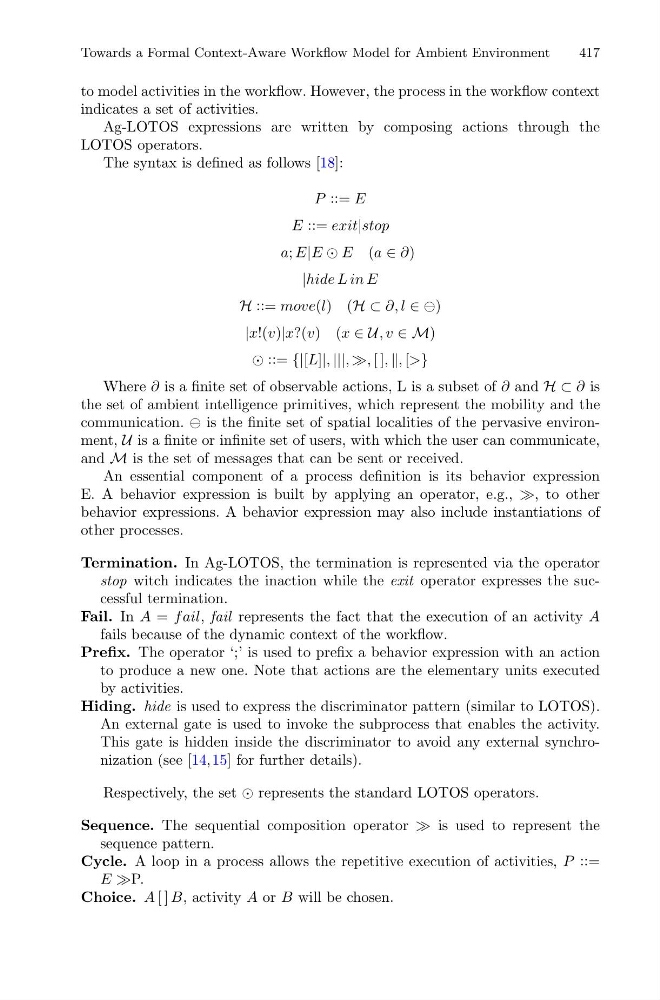
The syntax is defined as follows [18]:
P ::= E
E ::= exit|stop
a; E|E E (a ∈ ∂)
|hide L in E
H ::= move(l) (H ⊂ ∂, l ∈ ∈)
|x!(v)|x?(v) (x ∈ U, v ∈ M)
::= {|[L]|, |||, , [ ], , [>}
Where ∂ is a finite set of observable actions, L is a subset of ∂ and H ⊂ ∂ is
the set of ambient intelligence primitives, which represent the mobility and the
communication. is the finite set of spatial localities of the pervasive environment, U is a finite or infinite set of users, with which the user can communicate,
and M is the set of messages that can be sent or received.
An essential component of a process definition is its behavior expression
E. A behavior expression is built by applying an operator, e.g., , to other
behavior expressions. A behavior expression may also include instantiations of
other processes.
Termination. In Ag-LOTOS, the termination is represented via the operator
stop witch indicates the inaction while the exit operator expresses the successful termination.
Fail. In A = fail, fail represents the fact that the execution of an activity A
fails because of the dynamic context of the workflow.
Prefix. The operator ‘;’ is used to prefix a behavior expression with an action
to produce a new one. Note that actions are the elementary units executed
by activities.
Hiding. hide is used to express the discriminator pattern (similar to LOTOS).
An external gate is used to invoke the subprocess that enables the activity.
This gate is hidden inside the discriminator to avoid any external synchronization (see [14,15] for further details).
Respectively, the set represents the standard LOTOS operators.
Sequence. The sequential composition operator is used to represent the
sequence pattern.
Cycle. A loop in a process allows the repetitive execution of activities, P ::=
E P.
Choice. A [ ] B, activity A or B will be chosen.
417
to model activities in the workflow. However, the process in the workflow context
indicates a set of activities.
Ag-LOTOS expressions are written by composing actions through the
LOTOS operators.
The syntax is defined as follows [18]:
P ::= E
E ::= exit|stop
a; E|E E (a ∈ ∂)
|hide L in E
H ::= move(l) (H ⊂ ∂, l ∈ ∈)
|x!(v)|x?(v) (x ∈ U, v ∈ M)
::= {|[L]|, |||, , [ ], , [>}
Where ∂ is a finite set of observable actions, L is a subset of ∂ and H ⊂ ∂ is
the set of ambient intelligence primitives, which represent the mobility and the
communication. is the finite set of spatial localities of the pervasive environment, U is a finite or infinite set of users, with which the user can communicate,
and M is the set of messages that can be sent or received.
An essential component of a process definition is its behavior expression
E. A behavior expression is built by applying an operator, e.g., , to other
behavior expressions. A behavior expression may also include instantiations of
other processes.
Termination. In Ag-LOTOS, the termination is represented via the operator
stop witch indicates the inaction while the exit operator expresses the successful termination.
Fail. In A = fail, fail represents the fact that the execution of an activity A
fails because of the dynamic context of the workflow.
Prefix. The operator ‘;’ is used to prefix a behavior expression with an action
to produce a new one. Note that actions are the elementary units executed
by activities.
Hiding. hide is used to express the discriminator pattern (similar to LOTOS).
An external gate is used to invoke the subprocess that enables the activity.
This gate is hidden inside the discriminator to avoid any external synchronization (see [14,15] for further details).
Respectively, the set represents the standard LOTOS operators.
Sequence. The sequential composition operator is used to represent the
sequence pattern.
Cycle. A loop in a process allows the repetitive execution of activities, P ::=
E P.
Choice. A [ ] B, activity A or B will be chosen.