

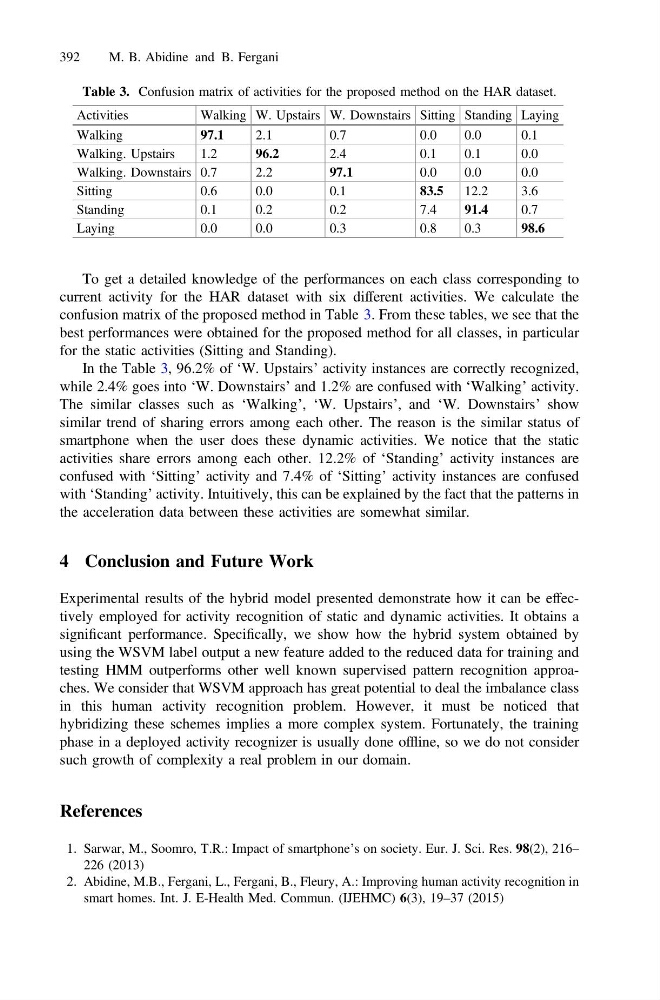
To get a detailed knowledge of the performances on each class corresponding to
current activity for the HAR dataset with six different activities. We calculate the
confusion matrix of the proposed method in Table 3. From these tables, we see that the
best performances were obtained for the proposed method for all classes, in particular
for the static activities (Sitting and Standing).
In the Table 3, 96.2% of ‘W. Upstairs’ activity instances are correctly recognized,
while 2.4% goes into ‘W. Downstairs’ and 1.2% are confused with ‘Walking’ activity.
The similar classes such as ‘Walking’, ‘W. Upstairs’, and ‘W. Downstairs’ show
similar trend of sharing errors among each other. The reason is the similar status of
smartphone when the user does these dynamic activities. We notice that the static
activities share errors among each other. 12.2% of ‘Standing’ activity instances are
confused with ‘Sitting’ activity and 7.4% of ‘Sitting’ activity instances are confused
with ‘Standing’ activity. Intuitively, this can be explained by the fact that the patterns in
the acceleration data between these activities are somewhat similar.
4 Conclusion and Future Work
Experimental results of the hybrid model presented demonstrate how it can be effectively employed for activity recognition of static and dynamic activities. It obtains a
significant performance. Specifically, we show how the hybrid system obtained by
using the WSVM label output a new feature added to the reduced data for training and
testing HMM outperforms other well known supervised pattern recognition approaches. We consider that WSVM approach has great potential to deal the imbalance class
in this human activity recognition problem. However, it must be noticed that
hybridizing these schemes implies a more complex system. Fortunately, the training
phase in a deployed activity recognizer is usually done offline, so we do not consider
such growth of complexity a real problem in our domain.
References
1. Sarwar, M., Soomro, T.R.: Impact of smartphone’s on society. Eur. J. Sci. Res. 98(2), 216–
226 (2013)
2. Abidine, M.B., Fergani, L., Fergani, B., Fleury, A.: Improving human activity recognition in
smart homes. Int. J. E-Health Med. Commun. (IJEHMC) 6(3), 19–37 (2015)
Table 3. Confusion matrix of activities for the proposed method on the HAR dataset.
Activities
Walking W. Upstairs W. Downstairs Sitting Standing Laying
Walking
97.1
2.1
0.7
0.0
0.0
0.1
Walking. Upstairs
1.2
96.2
2.4
0.1
0.1
0.0
Walking. Downstairs 0.7
2.2
97.1
0.0
0.0
0.0
Sitting
0.6
0.0
0.1
83.5
12.2
3.6
Standing
0.1
0.2
0.2
7.4
91.4
0.7
Laying
0.0
0.0
0.3
0.8
0.3
98.6
392
M. B. Abidine and B. Fergani
current activity for the HAR dataset with six different activities. We calculate the
confusion matrix of the proposed method in Table 3. From these tables, we see that the
best performances were obtained for the proposed method for all classes, in particular
for the static activities (Sitting and Standing).
In the Table 3, 96.2% of ‘W. Upstairs’ activity instances are correctly recognized,
while 2.4% goes into ‘W. Downstairs’ and 1.2% are confused with ‘Walking’ activity.
The similar classes such as ‘Walking’, ‘W. Upstairs’, and ‘W. Downstairs’ show
similar trend of sharing errors among each other. The reason is the similar status of
smartphone when the user does these dynamic activities. We notice that the static
activities share errors among each other. 12.2% of ‘Standing’ activity instances are
confused with ‘Sitting’ activity and 7.4% of ‘Sitting’ activity instances are confused
with ‘Standing’ activity. Intuitively, this can be explained by the fact that the patterns in
the acceleration data between these activities are somewhat similar.
4 Conclusion and Future Work
Experimental results of the hybrid model presented demonstrate how it can be effectively employed for activity recognition of static and dynamic activities. It obtains a
significant performance. Specifically, we show how the hybrid system obtained by
using the WSVM label output a new feature added to the reduced data for training and
testing HMM outperforms other well known supervised pattern recognition approaches. We consider that WSVM approach has great potential to deal the imbalance class
in this human activity recognition problem. However, it must be noticed that
hybridizing these schemes implies a more complex system. Fortunately, the training
phase in a deployed activity recognizer is usually done offline, so we do not consider
such growth of complexity a real problem in our domain.
References
1. Sarwar, M., Soomro, T.R.: Impact of smartphone’s on society. Eur. J. Sci. Res. 98(2), 216–
226 (2013)
2. Abidine, M.B., Fergani, L., Fergani, B., Fleury, A.: Improving human activity recognition in
smart homes. Int. J. E-Health Med. Commun. (IJEHMC) 6(3), 19–37 (2015)
Table 3. Confusion matrix of activities for the proposed method on the HAR dataset.
Activities
Walking W. Upstairs W. Downstairs Sitting Standing Laying
Walking
97.1
2.1
0.7
0.0
0.0
0.1
Walking. Upstairs
1.2
96.2
2.4
0.1
0.1
0.0
Walking. Downstairs 0.7
2.2
97.1
0.0
0.0
0.0
Sitting
0.6
0.0
0.1
83.5
12.2
3.6
Standing
0.1
0.2
0.2
7.4
91.4
0.7
Laying
0.0
0.0
0.3
0.8
0.3
98.6
392
M. B. Abidine and B. Fergani