

p i ¼ P q 0 ¼ i
ð
Þ:
ð10Þ
With: i, j {1,2, …, N}
O t : Vector of observations
A standard HMM is a generative probabilistic model, which generates hidden states
y t from observable data x t at each discrete time instant. In our case the hidden variable
is the activities that the subject was performing at a given time step and the observable
variable is the vector of sensor readings. HMM model mainly works on two basic
principles as follows: the observable variable at time t, namely x t , depends only on the
hidden variable y t . The hidden variable at time t, namely y t , depends only on the
previous hidden variable y t−1 .
Learning the parameters of these parameters corresponds to maximizing the joint
probability p(x, y) between the sensor data and activities in the training data. The joint
probability therefore factorizes as follows:
Pðx; yÞ ¼
Y T
t¼1
pðy t jy tÀ1 Þpðx t jy t Þ :
ð11Þ
The main aim of this model is to determine the best hidden state sequence from the
observed output sequence that maximizes p(x, y).
3 Experimental Results and Analysis
3.1 Datasets
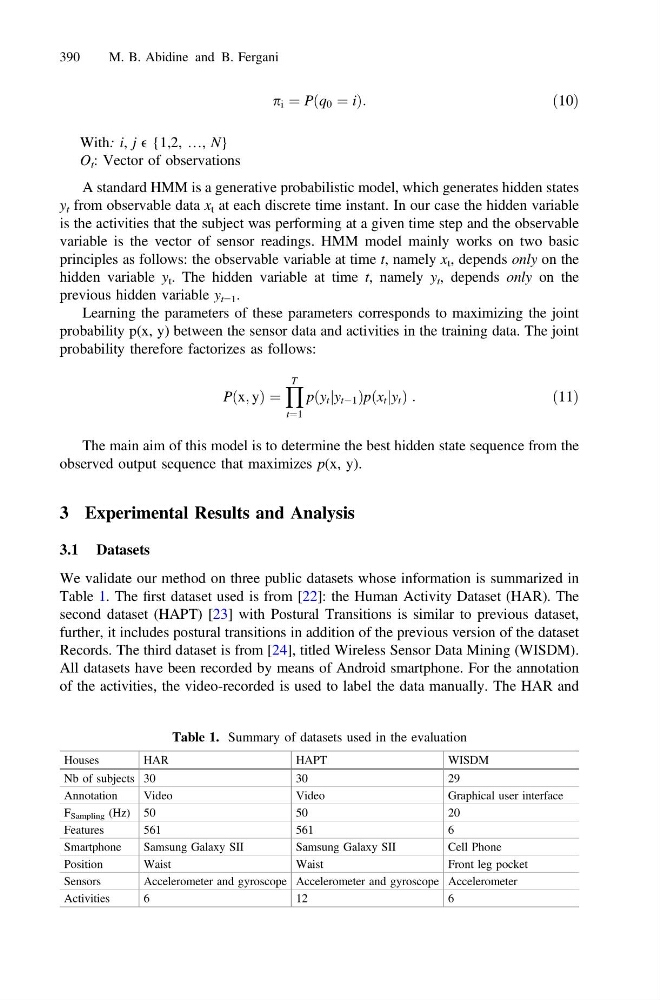
We validate our method on three public datasets whose information is summarized in
Table 1. The first dataset used is from [22]: the Human Activity Dataset (HAR). The
second dataset (HAPT) [23] with Postural Transitions is similar to previous dataset,
further, it includes postural transitions in addition of the previous version of the dataset
Records. The third dataset is from [24], titled Wireless Sensor Data Mining (WISDM).
All datasets have been recorded by means of Android smartphone. For the annotation
of the activities, the video-recorded is used to label the data manually. The HAR and
Table 1. Summary of datasets used in the evaluation
Houses
HAR
HAPT
WISDM
Nb of subjects 30
30
29
Annotation
Video
Video
Graphical user interface
F Sampling (Hz) 50
50
20
Features
561
561
6
Smartphone
Samsung Galaxy SII
Samsung Galaxy SII
Cell Phone
Position
Waist
Waist
Front leg pocket
Sensors
Accelerometer and gyroscope Accelerometer and gyroscope Accelerometer
Activities
6
12
6
390
M. B. Abidine and B. Fergani
ð
Þ:
ð10Þ
With: i, j {1,2, …, N}
O t : Vector of observations
A standard HMM is a generative probabilistic model, which generates hidden states
y t from observable data x t at each discrete time instant. In our case the hidden variable
is the activities that the subject was performing at a given time step and the observable
variable is the vector of sensor readings. HMM model mainly works on two basic
principles as follows: the observable variable at time t, namely x t , depends only on the
hidden variable y t . The hidden variable at time t, namely y t , depends only on the
previous hidden variable y t−1 .
Learning the parameters of these parameters corresponds to maximizing the joint
probability p(x, y) between the sensor data and activities in the training data. The joint
probability therefore factorizes as follows:
Pðx; yÞ ¼
Y T
t¼1
pðy t jy tÀ1 Þpðx t jy t Þ :
ð11Þ
The main aim of this model is to determine the best hidden state sequence from the
observed output sequence that maximizes p(x, y).
3 Experimental Results and Analysis
3.1 Datasets
We validate our method on three public datasets whose information is summarized in
Table 1. The first dataset used is from [22]: the Human Activity Dataset (HAR). The
second dataset (HAPT) [23] with Postural Transitions is similar to previous dataset,
further, it includes postural transitions in addition of the previous version of the dataset
Records. The third dataset is from [24], titled Wireless Sensor Data Mining (WISDM).
All datasets have been recorded by means of Android smartphone. For the annotation
of the activities, the video-recorded is used to label the data manually. The HAR and
Table 1. Summary of datasets used in the evaluation
Houses
HAR
HAPT
WISDM
Nb of subjects 30
30
29
Annotation
Video
Video
Graphical user interface
F Sampling (Hz) 50
50
20
Features
561
561
6
Smartphone
Samsung Galaxy SII
Samsung Galaxy SII
Cell Phone
Position
Waist
Waist
Front leg pocket
Sensors
Accelerometer and gyroscope Accelerometer and gyroscope Accelerometer
Activities
6
12
6
390
M. B. Abidine and B. Fergani