

2.2 Principal Component Analysis (PCA)
PCA [16] is an orthogonal projection-based technique such that the variance of the
projected data is maximized. In our case, a large number of features are extracted by
prepossessing the raw signals generated from different sensors. It is a widely used
technique for dimensionality reduction, feature extraction, and data visualization
through the construction of uncorrelated principal components that are a linear combination of the original variables. The PCA components can be counted by performing
the eigenvector decomposition of the covariance matrix S:
S ¼
X m
j¼1
ð~ xÞ j À l
ð~ xÞ j À l
T ; l ¼
1
m
X m
j¼m
~ x
ð Þ j :
ð1Þ
This problem leads to solve the eigenvalue equation with k is the eigenvalue of S
and V is the eigenvector corresponding to the k:
kV ¼ SV; V
j j
j j ¼ 1:
ð2Þ
Where V = [v 1 , v 2 , …, v i ], (i = 1, …, n) is the n  n matrix containing n eigenvectors and k is an n  n diagonal matrix of eigenvalues of the covariance matrix. In
Eq. (2), each n dimensional eigenvector v i corresponds to the ith eigenvalue k i .
2.3 Weighted Support Vector Machines (WSVM)
Osuna et al. [17] proposed an extension of the SVM modeling, Weighted SVM
algorithm to overcome the imbalance problem by introducing two different penalty
parameter C À and C þ in the primal Lagrangian (Eq. 3) for the minority (y i = −1) and
majority classes (y i = +1), as follow
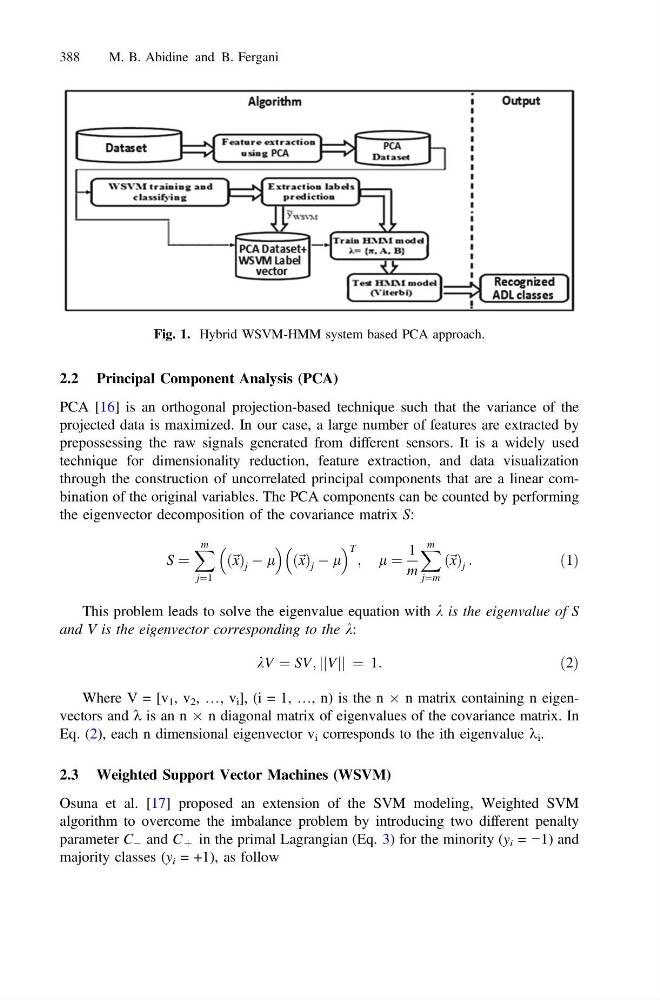
Fig. 1. Hybrid WSVM-HMM system based PCA approach.
388
M. B. Abidine and B. Fergani
PCA [16] is an orthogonal projection-based technique such that the variance of the
projected data is maximized. In our case, a large number of features are extracted by
prepossessing the raw signals generated from different sensors. It is a widely used
technique for dimensionality reduction, feature extraction, and data visualization
through the construction of uncorrelated principal components that are a linear combination of the original variables. The PCA components can be counted by performing
the eigenvector decomposition of the covariance matrix S:
S ¼
X m
j¼1
ð~ xÞ j À l
ð~ xÞ j À l
T ; l ¼
1
m
X m
j¼m
~ x
ð Þ j :
ð1Þ
This problem leads to solve the eigenvalue equation with k is the eigenvalue of S
and V is the eigenvector corresponding to the k:
kV ¼ SV; V
j j
j j ¼ 1:
ð2Þ
Where V = [v 1 , v 2 , …, v i ], (i = 1, …, n) is the n  n matrix containing n eigenvectors and k is an n  n diagonal matrix of eigenvalues of the covariance matrix. In
Eq. (2), each n dimensional eigenvector v i corresponds to the ith eigenvalue k i .
2.3 Weighted Support Vector Machines (WSVM)
Osuna et al. [17] proposed an extension of the SVM modeling, Weighted SVM
algorithm to overcome the imbalance problem by introducing two different penalty
parameter C À and C þ in the primal Lagrangian (Eq. 3) for the minority (y i = −1) and
majority classes (y i = +1), as follow
Fig. 1. Hybrid WSVM-HMM system based PCA approach.
388
M. B. Abidine and B. Fergani