

Relevant Methods for MRI/X Brain Image Registration
343
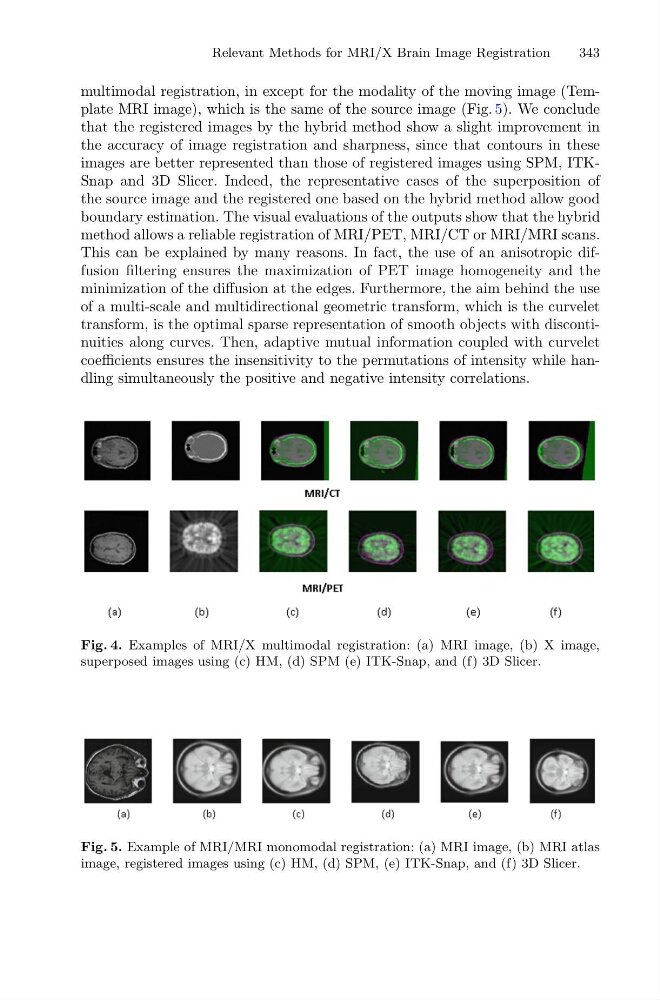
multimodal registration, in except for the modality of the moving image (Template MRI image), which is the same of the source image (Fig. 5). We conclude
that the registered images by the hybrid method show a slight improvement in
the accuracy of image registration and sharpness, since that contours in these
images are better represented than those of registered images using SPM, ITKSnap and 3D Slicer. Indeed, the representative cases of the superposition of
the source image and the registered one based on the hybrid method allow good
boundary estimation. The visual evaluations of the outputs show that the hybrid
method allows a reliable registration of MRI/PET, MRI/CT or MRI/MRI scans.
This can be explained by many reasons. In fact, the use of an anisotropic diffusion filtering ensures the maximization of PET image homogeneity and the
minimization of the diffusion at the edges. Furthermore, the aim behind the use
of a multi-scale and multidirectional geometric transform, which is the curvelet
transform, is the optimal sparse representation of smooth objects with discontinuities along curves. Then, adaptive mutual information coupled with curvelet
coefficients ensures the insensitivity to the permutations of intensity while handling simultaneously the positive and negative intensity correlations.
Fig. 4. Examples of MRI/X multimodal registration: (a) MRI image, (b) X image,
superposed images using (c) HM, (d) SPM (e) ITK-Snap, and (f) 3D Slicer.
Fig. 5. Example of MRI/MRI monomodal registration: (a) MRI image, (b) MRI atlas
image, registered images using (c) HM, (d) SPM, (e) ITK-Snap, and (f) 3D Slicer.
343
multimodal registration, in except for the modality of the moving image (Template MRI image), which is the same of the source image (Fig. 5). We conclude
that the registered images by the hybrid method show a slight improvement in
the accuracy of image registration and sharpness, since that contours in these
images are better represented than those of registered images using SPM, ITKSnap and 3D Slicer. Indeed, the representative cases of the superposition of
the source image and the registered one based on the hybrid method allow good
boundary estimation. The visual evaluations of the outputs show that the hybrid
method allows a reliable registration of MRI/PET, MRI/CT or MRI/MRI scans.
This can be explained by many reasons. In fact, the use of an anisotropic diffusion filtering ensures the maximization of PET image homogeneity and the
minimization of the diffusion at the edges. Furthermore, the aim behind the use
of a multi-scale and multidirectional geometric transform, which is the curvelet
transform, is the optimal sparse representation of smooth objects with discontinuities along curves. Then, adaptive mutual information coupled with curvelet
coefficients ensures the insensitivity to the permutations of intensity while handling simultaneously the positive and negative intensity correlations.
Fig. 4. Examples of MRI/X multimodal registration: (a) MRI image, (b) X image,
superposed images using (c) HM, (d) SPM (e) ITK-Snap, and (f) 3D Slicer.
Fig. 5. Example of MRI/MRI monomodal registration: (a) MRI image, (b) MRI atlas
image, registered images using (c) HM, (d) SPM, (e) ITK-Snap, and (f) 3D Slicer.