

for the development of SAS [15]. This framework allows designers to identify system
properties, architectural patterns, and different adaptation mechanisms. FUSION is a
reusable feature architecture that incorporates a learning-based adaptive cycle. The
adaptation cycle consists of three main steps—detect, plan, and effect [14]. MOSES is a
service-oriented framework that focuses on quality of service (QoS) requirements at
runtime. MOSES provides a reusable implementation strategy of the adaptation logic
following the MAPE cycle (Monitoring, Analysis, Planning, and Execution) [14]. The
Contract-Based Adaptive Software Application framework (CASA) [16] is specialized
in handling resources instability. The framework assumes that a system should not make
any assumptions about the resources that will be available and should be prepared for
any resource availability scenario cases. Service-Oriented Architectures (SSOA) is a
software framework that specifies any kind of adaptation by decomposing of functionalities [17]. Each of these functionalities shall be specialized to fit a particular
purpose. CareDroid is an adaptation framework for android context-aware applications
[18]. This framework CareDroid monitors the contexts at run-time, and active methods
only when it intercepts calls to sensitive methods.
3 System Requirements and Self-adaptation Characteristics
and Taxonomy
3.1 Requirements Extraction and Gathering
The first step to designing a self-adaptive system is to well identify the system
requirements; we will depend on W5H-Pattern [19], which presents six questions that
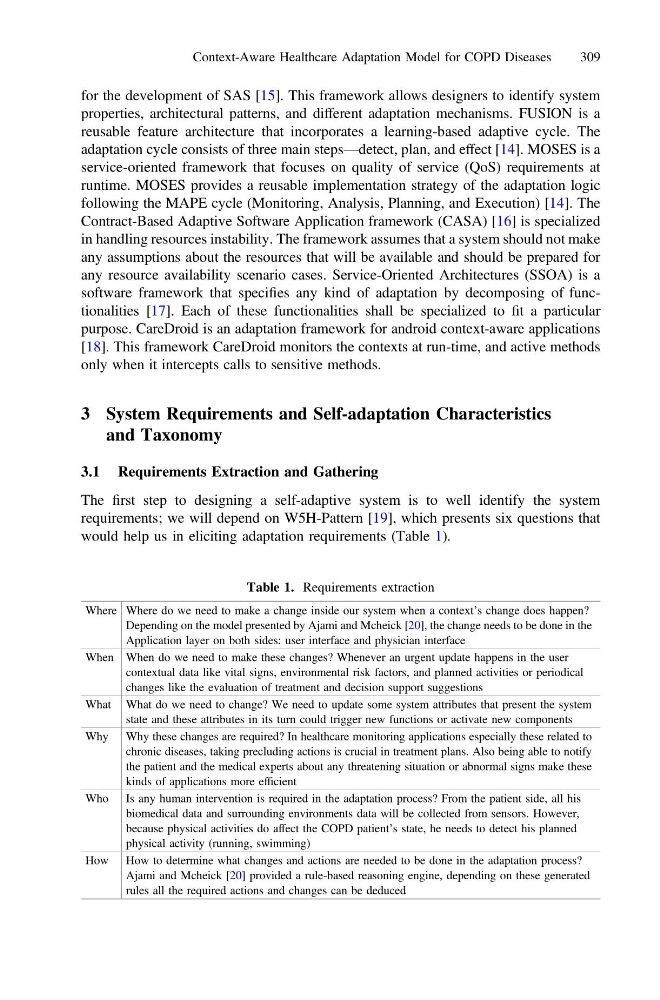
would help us in eliciting adaptation requirements (Table 1).
Table 1. Requirements extraction
Where Where do we need to make a change inside our system when a context’s change does happen?
Depending on the model presented by Ajami and Mcheick [20], the change needs to be done in the
Application layer on both sides: user interface and physician interface
When When do we need to make these changes? Whenever an urgent update happens in the user
contextual data like vital signs, environmental risk factors, and planned activities or periodical
changes like the evaluation of treatment and decision support suggestions
What What do we need to change? We need to update some system attributes that present the system
state and these attributes in its turn could trigger new functions or activate new components
Why Why these changes are required? In healthcare monitoring applications especially these related to
chronic diseases, taking precluding actions is crucial in treatment plans. Also being able to notify
the patient and the medical experts about any threatening situation or abnormal signs make these
kinds of applications more efficient
Who Is any human intervention is required in the adaptation process? From the patient side, all his
biomedical data and surrounding environments data will be collected from sensors. However,
because physical activities do affect the COPD patient’s state, he needs to detect his planned
physical activity (running, swimming)
How How to determine what changes and actions are needed to be done in the adaptation process?
Ajami and Mcheick [20] provided a rule-based reasoning engine, depending on these generated
rules all the required actions and changes can be deduced
Context-Aware Healthcare Adaptation Model for COPD Diseases
309
properties, architectural patterns, and different adaptation mechanisms. FUSION is a
reusable feature architecture that incorporates a learning-based adaptive cycle. The
adaptation cycle consists of three main steps—detect, plan, and effect [14]. MOSES is a
service-oriented framework that focuses on quality of service (QoS) requirements at
runtime. MOSES provides a reusable implementation strategy of the adaptation logic
following the MAPE cycle (Monitoring, Analysis, Planning, and Execution) [14]. The
Contract-Based Adaptive Software Application framework (CASA) [16] is specialized
in handling resources instability. The framework assumes that a system should not make
any assumptions about the resources that will be available and should be prepared for
any resource availability scenario cases. Service-Oriented Architectures (SSOA) is a
software framework that specifies any kind of adaptation by decomposing of functionalities [17]. Each of these functionalities shall be specialized to fit a particular
purpose. CareDroid is an adaptation framework for android context-aware applications
[18]. This framework CareDroid monitors the contexts at run-time, and active methods
only when it intercepts calls to sensitive methods.
3 System Requirements and Self-adaptation Characteristics
and Taxonomy
3.1 Requirements Extraction and Gathering
The first step to designing a self-adaptive system is to well identify the system
requirements; we will depend on W5H-Pattern [19], which presents six questions that
would help us in eliciting adaptation requirements (Table 1).
Table 1. Requirements extraction
Where Where do we need to make a change inside our system when a context’s change does happen?
Depending on the model presented by Ajami and Mcheick [20], the change needs to be done in the
Application layer on both sides: user interface and physician interface
When When do we need to make these changes? Whenever an urgent update happens in the user
contextual data like vital signs, environmental risk factors, and planned activities or periodical
changes like the evaluation of treatment and decision support suggestions
What What do we need to change? We need to update some system attributes that present the system
state and these attributes in its turn could trigger new functions or activate new components
Why Why these changes are required? In healthcare monitoring applications especially these related to
chronic diseases, taking precluding actions is crucial in treatment plans. Also being able to notify
the patient and the medical experts about any threatening situation or abnormal signs make these
kinds of applications more efficient
Who Is any human intervention is required in the adaptation process? From the patient side, all his
biomedical data and surrounding environments data will be collected from sensors. However,
because physical activities do affect the COPD patient’s state, he needs to detect his planned
physical activity (running, swimming)
How How to determine what changes and actions are needed to be done in the adaptation process?
Ajami and Mcheick [20] provided a rule-based reasoning engine, depending on these generated
rules all the required actions and changes can be deduced
Context-Aware Healthcare Adaptation Model for COPD Diseases
309