

Selection (GGA-FS). After the models are trained, the instances of the dataset are
classified according to the training and test files. These results are the inputs for the
visualization and test modules. The module Vis-Clas-Tabular receives these results as
inputs and generates output files with several performance metrics computed from
them, such as confusion matrices for each method. There is also another type of results
flow which interconnects each possible pair of methods with a test module. In this case,
the test module used is the signed-rank Wilcoxon non-parametrical procedure ClasWilcoxon-ST which compares two samples of results. The experiment establishes a
pair-wise statistical comparison of the three methods. Once the experiment has been
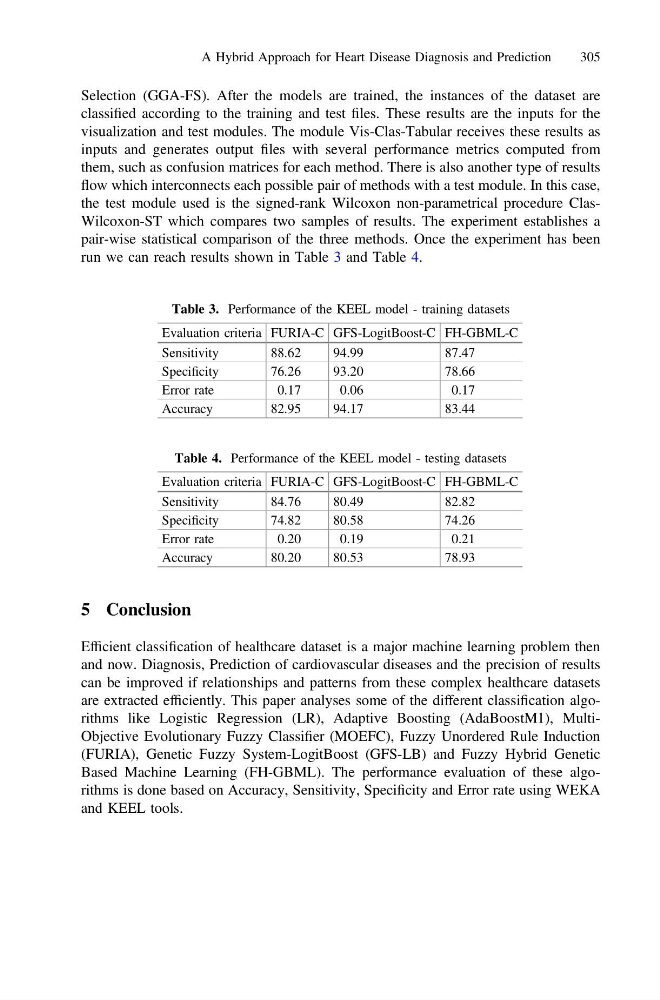
run we can reach results shown in Table 3 and Table 4.
5 Conclusion
Efficient classification of healthcare dataset is a major machine learning problem then
and now. Diagnosis, Prediction of cardiovascular diseases and the precision of results
can be improved if relationships and patterns from these complex healthcare datasets
are extracted efficiently. This paper analyses some of the different classification algorithms like Logistic Regression (LR), Adaptive Boosting (AdaBoostM1), MultiObjective Evolutionary Fuzzy Classifier (MOEFC), Fuzzy Unordered Rule Induction
(FURIA), Genetic Fuzzy System-LogitBoost (GFS-LB) and Fuzzy Hybrid Genetic
Based Machine Learning (FH-GBML). The performance evaluation of these algorithms is done based on Accuracy, Sensitivity, Specificity and Error rate using WEKA
and KEEL tools.
Table 3. Performance of the KEEL model - training datasets
Evaluation criteria FURIA-C GFS-LogitBoost-C FH-GBML-C
Sensitivity
88.62
94.99
87.47
Specificity
76.26
93.20
78.66
Error rate
0.17
0.06
0.17
Accuracy
82.95
94.17
83.44
Table 4. Performance of the KEEL model - testing datasets
Evaluation criteria FURIA-C GFS-LogitBoost-C FH-GBML-C
Sensitivity
84.76
80.49
82.82
Specificity
74.82
80.58
74.26
Error rate
0.20
0.19
0.21
Accuracy
80.20
80.53
78.93
A Hybrid Approach for Heart Disease Diagnosis and Prediction
305
classified according to the training and test files. These results are the inputs for the
visualization and test modules. The module Vis-Clas-Tabular receives these results as
inputs and generates output files with several performance metrics computed from
them, such as confusion matrices for each method. There is also another type of results
flow which interconnects each possible pair of methods with a test module. In this case,
the test module used is the signed-rank Wilcoxon non-parametrical procedure ClasWilcoxon-ST which compares two samples of results. The experiment establishes a
pair-wise statistical comparison of the three methods. Once the experiment has been
run we can reach results shown in Table 3 and Table 4.
5 Conclusion
Efficient classification of healthcare dataset is a major machine learning problem then
and now. Diagnosis, Prediction of cardiovascular diseases and the precision of results
can be improved if relationships and patterns from these complex healthcare datasets
are extracted efficiently. This paper analyses some of the different classification algorithms like Logistic Regression (LR), Adaptive Boosting (AdaBoostM1), MultiObjective Evolutionary Fuzzy Classifier (MOEFC), Fuzzy Unordered Rule Induction
(FURIA), Genetic Fuzzy System-LogitBoost (GFS-LB) and Fuzzy Hybrid Genetic
Based Machine Learning (FH-GBML). The performance evaluation of these algorithms is done based on Accuracy, Sensitivity, Specificity and Error rate using WEKA
and KEEL tools.
Table 3. Performance of the KEEL model - training datasets
Evaluation criteria FURIA-C GFS-LogitBoost-C FH-GBML-C
Sensitivity
88.62
94.99
87.47
Specificity
76.26
93.20
78.66
Error rate
0.17
0.06
0.17
Accuracy
82.95
94.17
83.44
Table 4. Performance of the KEEL model - testing datasets
Evaluation criteria FURIA-C GFS-LogitBoost-C FH-GBML-C
Sensitivity
84.76
80.49
82.82
Specificity
74.82
80.58
74.26
Error rate
0.20
0.19
0.21
Accuracy
80.20
80.53
78.93
A Hybrid Approach for Heart Disease Diagnosis and Prediction
305