

2.1 National Early Warning Scoring (NEWS)2 Approach
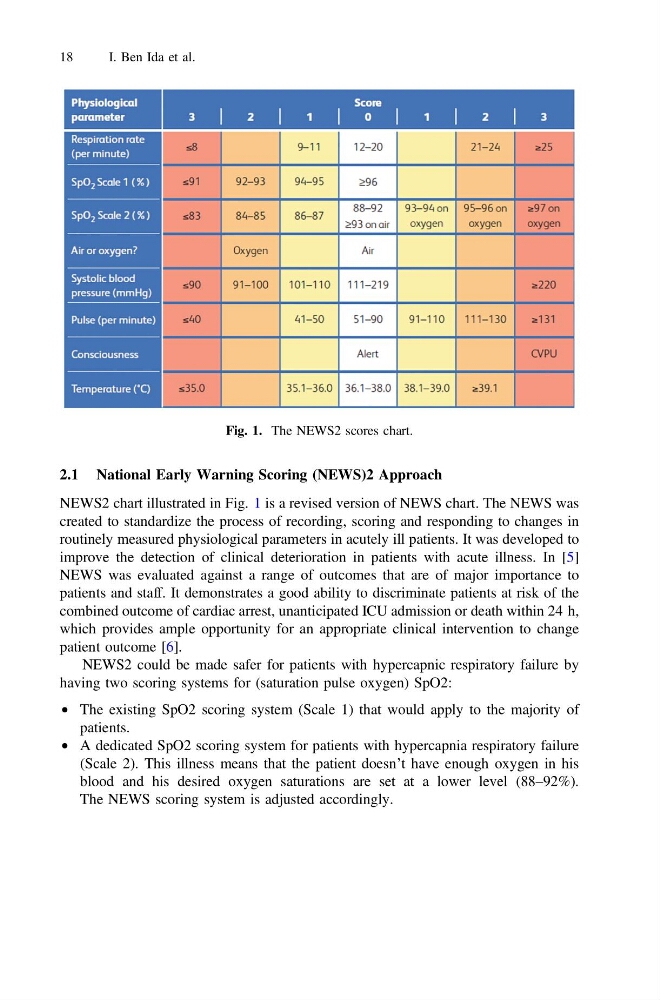
NEWS2 chart illustrated in Fig. 1 is a revised version of NEWS chart. The NEWS was
created to standardize the process of recording, scoring and responding to changes in
routinely measured physiological parameters in acutely ill patients. It was developed to
improve the detection of clinical deterioration in patients with acute illness. In [5]
NEWS was evaluated against a range of outcomes that are of major importance to
patients and staff. It demonstrates a good ability to discriminate patients at risk of the
combined outcome of cardiac arrest, unanticipated ICU admission or death within 24 h,
which provides ample opportunity for an appropriate clinical intervention to change
patient outcome [6].
NEWS2 could be made safer for patients with hypercapnic respiratory failure by
having two scoring systems for (saturation pulse oxygen) SpO2:
• The existing SpO2 scoring system (Scale 1) that would apply to the majority of
patients.
• A dedicated SpO2 scoring system for patients with hypercapnia respiratory failure
(Scale 2). This illness means that the patient doesn’t have enough oxygen in his
blood and his desired oxygen saturations are set at a lower level (88–92%).
The NEWS scoring system is adjusted accordingly.
Fig. 1. The NEWS2 scores chart.
18
I. Ben Ida et al.
NEWS2 chart illustrated in Fig. 1 is a revised version of NEWS chart. The NEWS was
created to standardize the process of recording, scoring and responding to changes in
routinely measured physiological parameters in acutely ill patients. It was developed to
improve the detection of clinical deterioration in patients with acute illness. In [5]
NEWS was evaluated against a range of outcomes that are of major importance to
patients and staff. It demonstrates a good ability to discriminate patients at risk of the
combined outcome of cardiac arrest, unanticipated ICU admission or death within 24 h,
which provides ample opportunity for an appropriate clinical intervention to change
patient outcome [6].
NEWS2 could be made safer for patients with hypercapnic respiratory failure by
having two scoring systems for (saturation pulse oxygen) SpO2:
• The existing SpO2 scoring system (Scale 1) that would apply to the majority of
patients.
• A dedicated SpO2 scoring system for patients with hypercapnia respiratory failure
(Scale 2). This illness means that the patient doesn’t have enough oxygen in his
blood and his desired oxygen saturations are set at a lower level (88–92%).
The NEWS scoring system is adjusted accordingly.
Fig. 1. The NEWS2 scores chart.
18
I. Ben Ida et al.