

290
S. Titi et al.
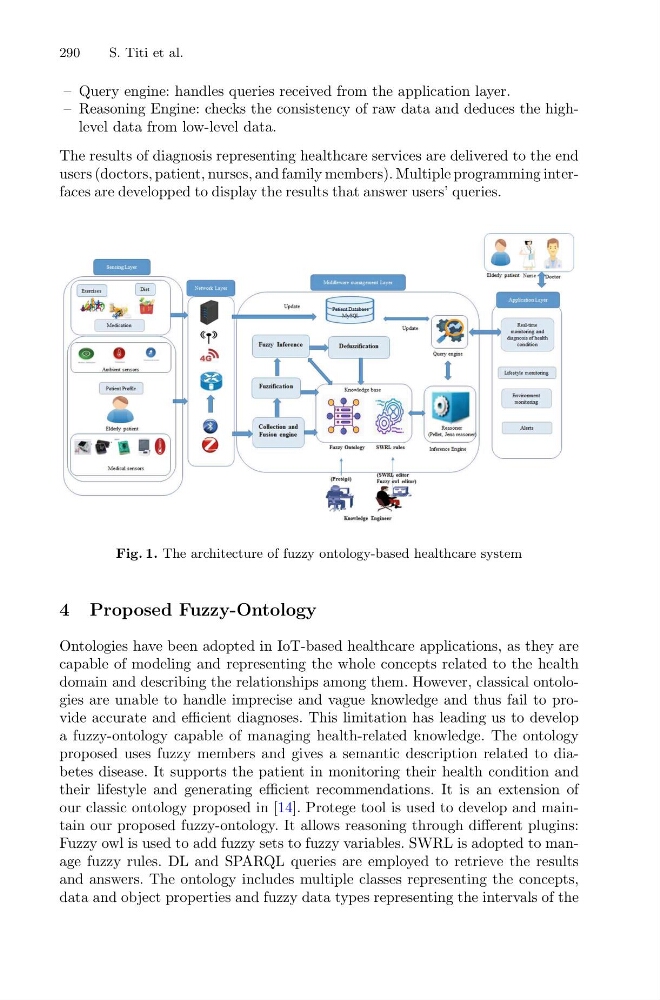
– Query engine: handles queries received from the application layer.
– Reasoning Engine: checks the consistency of raw data and deduces the highlevel data from low-level data.
The results of diagnosis representing healthcare services are delivered to the end
users (doctors, patient, nurses, and family members). Multiple programming interfaces are developped to display the results that answer users’ queries.
Fig. 1. The architecture of fuzzy ontology-based healthcare system
4 Proposed Fuzzy-Ontology
Ontologies have been adopted in IoT-based healthcare applications, as they are
capable of modeling and representing the whole concepts related to the health
domain and describing the relationships among them. However, classical ontologies are unable to handle imprecise and vague knowledge and thus fail to provide accurate and efficient diagnoses. This limitation has leading us to develop
a fuzzy-ontology capable of managing health-related knowledge. The ontology
proposed uses fuzzy members and gives a semantic description related to diabetes disease. It supports the patient in monitoring their health condition and
their lifestyle and generating efficient recommendations. It is an extension of
our classic ontology proposed in [14]. Protege tool is used to develop and maintain our proposed fuzzy-ontology. It allows reasoning through different plugins:
Fuzzy owl is used to add fuzzy sets to fuzzy variables. SWRL is adopted to manage fuzzy rules. DL and SPARQL queries are employed to retrieve the results
and answers. The ontology includes multiple classes representing the concepts,
data and object properties and fuzzy data types representing the intervals of the
S. Titi et al.
– Query engine: handles queries received from the application layer.
– Reasoning Engine: checks the consistency of raw data and deduces the highlevel data from low-level data.
The results of diagnosis representing healthcare services are delivered to the end
users (doctors, patient, nurses, and family members). Multiple programming interfaces are developped to display the results that answer users’ queries.
Fig. 1. The architecture of fuzzy ontology-based healthcare system
4 Proposed Fuzzy-Ontology
Ontologies have been adopted in IoT-based healthcare applications, as they are
capable of modeling and representing the whole concepts related to the health
domain and describing the relationships among them. However, classical ontologies are unable to handle imprecise and vague knowledge and thus fail to provide accurate and efficient diagnoses. This limitation has leading us to develop
a fuzzy-ontology capable of managing health-related knowledge. The ontology
proposed uses fuzzy members and gives a semantic description related to diabetes disease. It supports the patient in monitoring their health condition and
their lifestyle and generating efficient recommendations. It is an extension of
our classic ontology proposed in [14]. Protege tool is used to develop and maintain our proposed fuzzy-ontology. It allows reasoning through different plugins:
Fuzzy owl is used to add fuzzy sets to fuzzy variables. SWRL is adopted to manage fuzzy rules. DL and SPARQL queries are employed to retrieve the results
and answers. The ontology includes multiple classes representing the concepts,
data and object properties and fuzzy data types representing the intervals of the