

for this enhanced interest is the disappearance of the trusted medium, to operate in a
decentralized manner with an acceptable degree of confidence.
The IT community hails the Blockchain as the next great technological innovation.
According to Marc Andreessen, co-founder of Netscape and co-writer of Mosaic the
Blockchain: “When we sit here in 20 years, we will talk about [Bitcoin and Blockchain
technology] the way we talk about the internet today” [1].
1.1 Blockchain
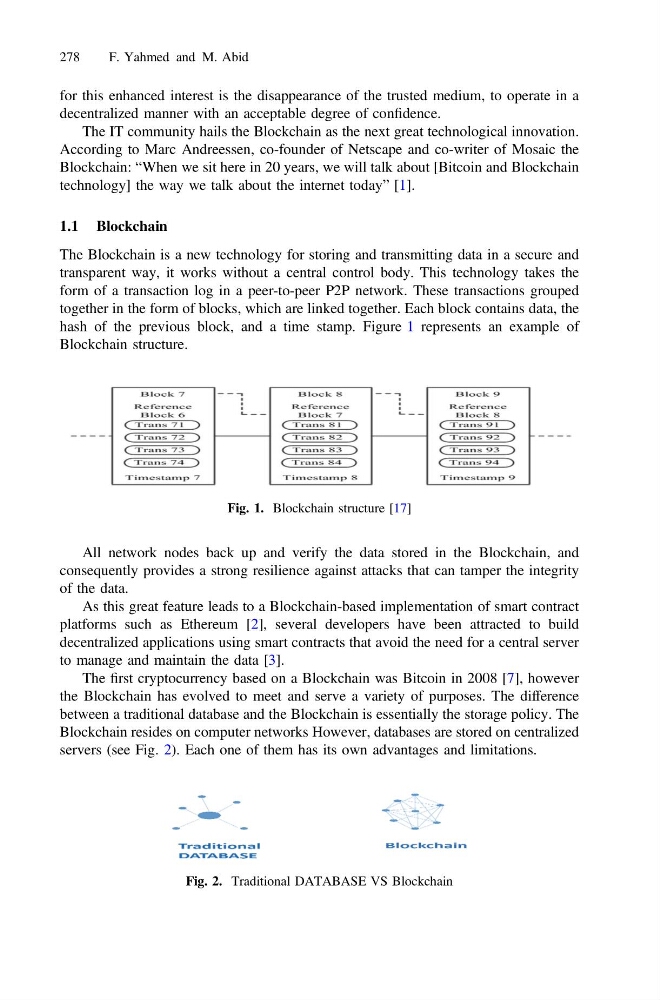
The Blockchain is a new technology for storing and transmitting data in a secure and
transparent way, it works without a central control body. This technology takes the
form of a transaction log in a peer-to-peer P2P network. These transactions grouped
together in the form of blocks, which are linked together. Each block contains data, the
hash of the previous block, and a time stamp. Figure 1 represents an example of
Blockchain structure.
All network nodes back up and verify the data stored in the Blockchain, and
consequently provides a strong resilience against attacks that can tamper the integrity
of the data.
As this great feature leads to a Blockchain-based implementation of smart contract
platforms such as Ethereum [2], several developers have been attracted to build
decentralized applications using smart contracts that avoid the need for a central server
to manage and maintain the data [3].
The first cryptocurrency based on a Blockchain was Bitcoin in 2008 [7], however
the Blockchain has evolved to meet and serve a variety of purposes. The difference
between a traditional database and the Blockchain is essentially the storage policy. The
Blockchain resides on computer networks However, databases are stored on centralized
servers (see Fig. 2). Each one of them has its own advantages and limitations.
Fig. 1. Blockchain structure [17]
Fig. 2. Traditional DATABASE VS Blockchain
278
F. Yahmed and M. Abid
decentralized manner with an acceptable degree of confidence.
The IT community hails the Blockchain as the next great technological innovation.
According to Marc Andreessen, co-founder of Netscape and co-writer of Mosaic the
Blockchain: “When we sit here in 20 years, we will talk about [Bitcoin and Blockchain
technology] the way we talk about the internet today” [1].
1.1 Blockchain
The Blockchain is a new technology for storing and transmitting data in a secure and
transparent way, it works without a central control body. This technology takes the
form of a transaction log in a peer-to-peer P2P network. These transactions grouped
together in the form of blocks, which are linked together. Each block contains data, the
hash of the previous block, and a time stamp. Figure 1 represents an example of
Blockchain structure.
All network nodes back up and verify the data stored in the Blockchain, and
consequently provides a strong resilience against attacks that can tamper the integrity
of the data.
As this great feature leads to a Blockchain-based implementation of smart contract
platforms such as Ethereum [2], several developers have been attracted to build
decentralized applications using smart contracts that avoid the need for a central server
to manage and maintain the data [3].
The first cryptocurrency based on a Blockchain was Bitcoin in 2008 [7], however
the Blockchain has evolved to meet and serve a variety of purposes. The difference
between a traditional database and the Blockchain is essentially the storage policy. The
Blockchain resides on computer networks However, databases are stored on centralized
servers (see Fig. 2). Each one of them has its own advantages and limitations.
Fig. 1. Blockchain structure [17]
Fig. 2. Traditional DATABASE VS Blockchain
278
F. Yahmed and M. Abid