

246
K. Djouadi and A. Belkhir
Test 3: Incrementing the number of users without Threads and encryption:
Finally, we tested the incrementation of the number of users without the activation of simultaneous access by using “Threads”, and without encryption.
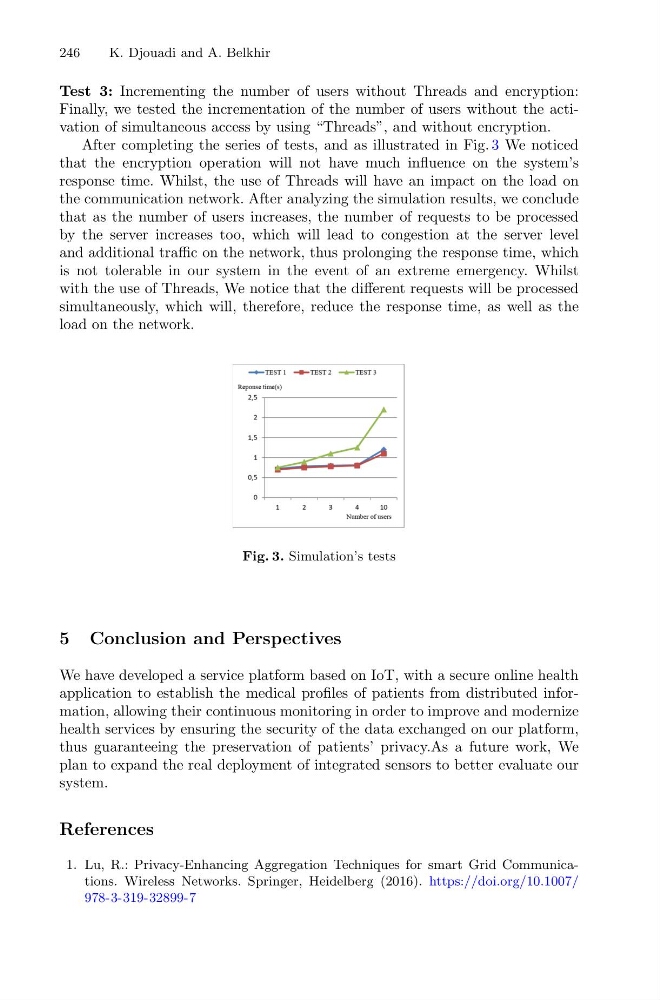
After completing the series of tests, and as illustrated in Fig. 3 We noticed
that the encryption operation will not have much influence on the system’s
response time. Whilst, the use of Threads will have an impact on the load on
the communication network. After analyzing the simulation results, we conclude
that as the number of users increases, the number of requests to be processed
by the server increases too, which will lead to congestion at the server level
and additional traffic on the network, thus prolonging the response time, which
is not tolerable in our system in the event of an extreme emergency. Whilst
with the use of Threads, We notice that the different requests will be processed
simultaneously, which will, therefore, reduce the response time, as well as the
load on the network.
Fig. 3. Simulation’s tests
5 Conclusion and Perspectives
We have developed a service platform based on IoT, with a secure online health
application to establish the medical profiles of patients from distributed information, allowing their continuous monitoring in order to improve and modernize
health services by ensuring the security of the data exchanged on our platform,
thus guaranteeing the preservation of patients’ privacy.As a future work, We
plan to expand the real deployment of integrated sensors to better evaluate our
system.
References
1. Lu, R.: Privacy-Enhancing Aggregation Techniques for smart Grid Communications. Wireless Networks. Springer, Heidelberg (2016). https://doi.org/10.1007/
978-3-319-32899-7
K. Djouadi and A. Belkhir
Test 3: Incrementing the number of users without Threads and encryption:
Finally, we tested the incrementation of the number of users without the activation of simultaneous access by using “Threads”, and without encryption.
After completing the series of tests, and as illustrated in Fig. 3 We noticed
that the encryption operation will not have much influence on the system’s
response time. Whilst, the use of Threads will have an impact on the load on
the communication network. After analyzing the simulation results, we conclude
that as the number of users increases, the number of requests to be processed
by the server increases too, which will lead to congestion at the server level
and additional traffic on the network, thus prolonging the response time, which
is not tolerable in our system in the event of an extreme emergency. Whilst
with the use of Threads, We notice that the different requests will be processed
simultaneously, which will, therefore, reduce the response time, as well as the
load on the network.
Fig. 3. Simulation’s tests
5 Conclusion and Perspectives
We have developed a service platform based on IoT, with a secure online health
application to establish the medical profiles of patients from distributed information, allowing their continuous monitoring in order to improve and modernize
health services by ensuring the security of the data exchanged on our platform,
thus guaranteeing the preservation of patients’ privacy.As a future work, We
plan to expand the real deployment of integrated sensors to better evaluate our
system.
References
1. Lu, R.: Privacy-Enhancing Aggregation Techniques for smart Grid Communications. Wireless Networks. Springer, Heidelberg (2016). https://doi.org/10.1007/
978-3-319-32899-7