

242
K. Djouadi and A. Belkhir
3 E-Health Platform
In this section we present the architecture of our IoT system which is based on
fog-enabled cloud computing as described in [10]. Then we will present the two
main processes of our system and we finish by presenting the different security
aspects available on our platform.
3.1 System Architecture
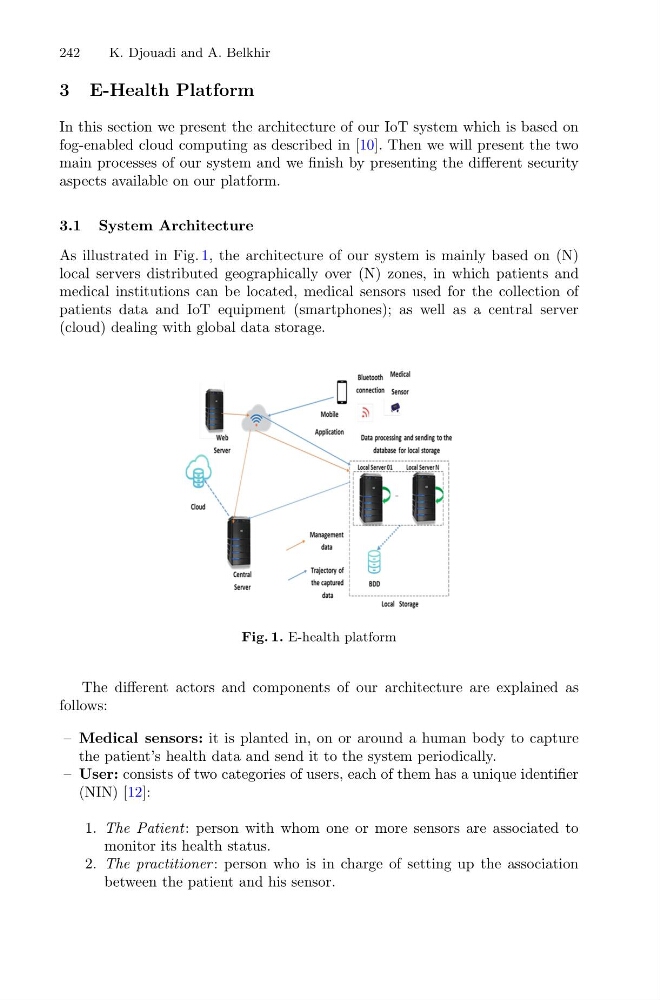
As illustrated in Fig. 1, the architecture of our system is mainly based on (N)
local servers distributed geographically over (N) zones, in which patients and
medical institutions can be located, medical sensors used for the collection of
patients data and IoT equipment (smartphones); as well as a central server
(cloud) dealing with global data storage.
Fig. 1. E-health platform
The different actors and components of our architecture are explained as
follows:
– Medical sensors: it is planted in, on or around a human body to capture
the patient’s health data and send it to the system periodically.
– User: consists of two categories of users, each of them has a unique identifier
(NIN) [12]:
1. The Patient: person with whom one or more sensors are associated to
monitor its health status.
2. The practitioner : person who is in charge of setting up the association
between the patient and his sensor.
K. Djouadi and A. Belkhir
3 E-Health Platform
In this section we present the architecture of our IoT system which is based on
fog-enabled cloud computing as described in [10]. Then we will present the two
main processes of our system and we finish by presenting the different security
aspects available on our platform.
3.1 System Architecture
As illustrated in Fig. 1, the architecture of our system is mainly based on (N)
local servers distributed geographically over (N) zones, in which patients and
medical institutions can be located, medical sensors used for the collection of
patients data and IoT equipment (smartphones); as well as a central server
(cloud) dealing with global data storage.
Fig. 1. E-health platform
The different actors and components of our architecture are explained as
follows:
– Medical sensors: it is planted in, on or around a human body to capture
the patient’s health data and send it to the system periodically.
– User: consists of two categories of users, each of them has a unique identifier
(NIN) [12]:
1. The Patient: person with whom one or more sensors are associated to
monitor its health status.
2. The practitioner : person who is in charge of setting up the association
between the patient and his sensor.