

Uncertainty in IoT for Smart Healthcare : Challenges, and Opportunities
233
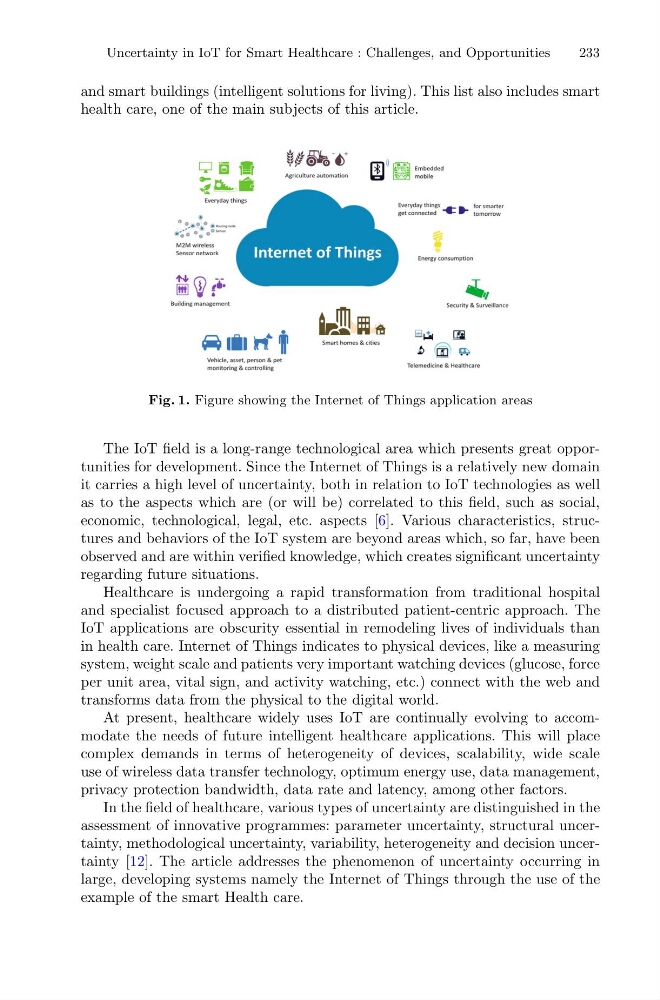
and smart buildings (intelligent solutions for living). This list also includes smart
health care, one of the main subjects of this article.
Fig. 1. Figure showing the Internet of Things application areas
The IoT field is a long-range technological area which presents great opportunities for development. Since the Internet of Things is a relatively new domain
it carries a high level of uncertainty, both in relation to IoT technologies as well
as to the aspects which are (or will be) correlated to this field, such as social,
economic, technological, legal, etc. aspects [6]. Various characteristics, structures and behaviors of the IoT system are beyond areas which, so far, have been
observed and are within verified knowledge, which creates significant uncertainty
regarding future situations.
Healthcare is undergoing a rapid transformation from traditional hospital
and specialist focused approach to a distributed patient-centric approach. The
IoT applications are obscurity essential in remodeling lives of individuals than
in health care. Internet of Things indicates to physical devices, like a measuring
system, weight scale and patients very important watching devices (glucose, force
per unit area, vital sign, and activity watching, etc.) connect with the web and
transforms data from the physical to the digital world.
At present, healthcare widely uses IoT are continually evolving to accommodate the needs of future intelligent healthcare applications. This will place
complex demands in terms of heterogeneity of devices, scalability, wide scale
use of wireless data transfer technology, optimum energy use, data management,
privacy protection bandwidth, data rate and latency, among other factors.
In the field of healthcare, various types of uncertainty are distinguished in the
assessment of innovative programmes: parameter uncertainty, structural uncertainty, methodological uncertainty, variability, heterogeneity and decision uncertainty [12]. The article addresses the phenomenon of uncertainty occurring in
large, developing systems namely the Internet of Things through the use of the
example of the smart Health care.
233
and smart buildings (intelligent solutions for living). This list also includes smart
health care, one of the main subjects of this article.
Fig. 1. Figure showing the Internet of Things application areas
The IoT field is a long-range technological area which presents great opportunities for development. Since the Internet of Things is a relatively new domain
it carries a high level of uncertainty, both in relation to IoT technologies as well
as to the aspects which are (or will be) correlated to this field, such as social,
economic, technological, legal, etc. aspects [6]. Various characteristics, structures and behaviors of the IoT system are beyond areas which, so far, have been
observed and are within verified knowledge, which creates significant uncertainty
regarding future situations.
Healthcare is undergoing a rapid transformation from traditional hospital
and specialist focused approach to a distributed patient-centric approach. The
IoT applications are obscurity essential in remodeling lives of individuals than
in health care. Internet of Things indicates to physical devices, like a measuring
system, weight scale and patients very important watching devices (glucose, force
per unit area, vital sign, and activity watching, etc.) connect with the web and
transforms data from the physical to the digital world.
At present, healthcare widely uses IoT are continually evolving to accommodate the needs of future intelligent healthcare applications. This will place
complex demands in terms of heterogeneity of devices, scalability, wide scale
use of wireless data transfer technology, optimum energy use, data management,
privacy protection bandwidth, data rate and latency, among other factors.
In the field of healthcare, various types of uncertainty are distinguished in the
assessment of innovative programmes: parameter uncertainty, structural uncertainty, methodological uncertainty, variability, heterogeneity and decision uncertainty [12]. The article addresses the phenomenon of uncertainty occurring in
large, developing systems namely the Internet of Things through the use of the
example of the smart Health care.