

228
G. Fersi
some middleware solutions like [11] and [9] that offered a very flexible architecture that allowed them to be applied in a wide applications range. So, we should
now answer at this crucial question: What is the most suitable middleware for
Internet of healthcare things?
The answer at this question is not trivial. Effectively, we see that there is
no ‘perfect’ solution since there are miscillaneous applications in the healthcare
that have different uses cases with different constraints. For example, in some
healthcare applications, there are lot of events that occur and require a quick
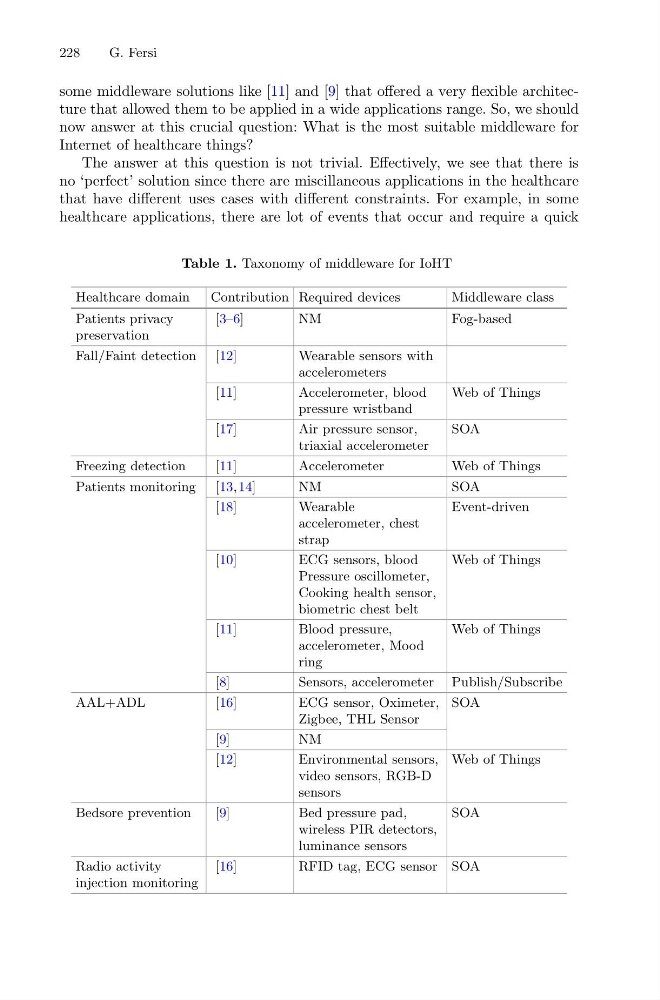
Table 1. Taxonomy of middleware for IoHT
Healthcare domain
Contribution Required devices
Middleware class
Patients privacy
preservation
[3–6]
NM
Fog-based
Fall/Faint detection [12]
Wearable sensors with
accelerometers
[11]
Accelerometer, blood
pressure wristband
Web of Things
[17]
Air pressure sensor,
triaxial accelerometer
SOA
Freezing detection
[11]
Accelerometer
Web of Things
Patients monitoring [13, 14]
NM
SOA
[18]
Wearable
accelerometer, chest
strap
Event-driven
[10]
ECG sensors, blood
Pressure oscillometer,
Cooking health sensor,
biometric chest belt
Web of Things
[11]
Blood pressure,
accelerometer, Mood
ring
Web of Things
[8]
Sensors, accelerometer Publish/Subscribe
AAL+ADL
[16]
ECG sensor, Oximeter,
Zigbee, THL Sensor
SOA
[9]
NM
[12]
Environmental sensors,
video sensors, RGB-D
sensors
Web of Things
Bedsore prevention
[9]
Bed pressure pad,
wireless PIR detectors,
luminance sensors
SOA
Radio activity
injection monitoring
[16]
RFID tag, ECG sensor SOA
G. Fersi
some middleware solutions like [11] and [9] that offered a very flexible architecture that allowed them to be applied in a wide applications range. So, we should
now answer at this crucial question: What is the most suitable middleware for
Internet of healthcare things?
The answer at this question is not trivial. Effectively, we see that there is
no ‘perfect’ solution since there are miscillaneous applications in the healthcare
that have different uses cases with different constraints. For example, in some
healthcare applications, there are lot of events that occur and require a quick
Table 1. Taxonomy of middleware for IoHT
Healthcare domain
Contribution Required devices
Middleware class
Patients privacy
preservation
[3–6]
NM
Fog-based
Fall/Faint detection [12]
Wearable sensors with
accelerometers
[11]
Accelerometer, blood
pressure wristband
Web of Things
[17]
Air pressure sensor,
triaxial accelerometer
SOA
Freezing detection
[11]
Accelerometer
Web of Things
Patients monitoring [13, 14]
NM
SOA
[18]
Wearable
accelerometer, chest
strap
Event-driven
[10]
ECG sensors, blood
Pressure oscillometer,
Cooking health sensor,
biometric chest belt
Web of Things
[11]
Blood pressure,
accelerometer, Mood
ring
Web of Things
[8]
Sensors, accelerometer Publish/Subscribe
AAL+ADL
[16]
ECG sensor, Oximeter,
Zigbee, THL Sensor
SOA
[9]
NM
[12]
Environmental sensors,
video sensors, RGB-D
sensors
Web of Things
Bedsore prevention
[9]
Bed pressure pad,
wireless PIR detectors,
luminance sensors
SOA
Radio activity
injection monitoring
[16]
RFID tag, ECG sensor SOA