

ML and Ontology Based Situation Awareness System
203
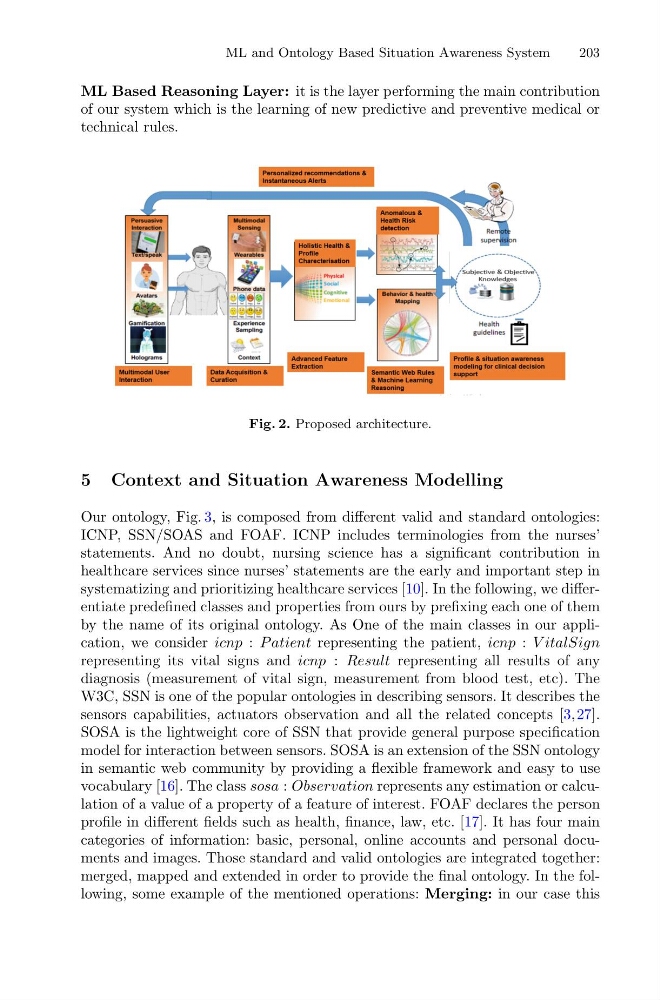
ML Based Reasoning Layer: it is the layer performing the main contribution
of our system which is the learning of new predictive and preventive medical or
technical rules.
Fig. 2. Proposed architecture.
5 Context and Situation Awareness Modelling
Our ontology, Fig. 3, is composed from different valid and standard ontologies:
ICNP, SSN/SOAS and FOAF. ICNP includes terminologies from the nurses’
statements. And no doubt, nursing science has a significant contribution in
healthcare services since nurses’ statements are the early and important step in
systematizing and prioritizing healthcare services [10]. In the following, we differentiate predefined classes and properties from ours by prefixing each one of them
by the name of its original ontology. As One of the main classes in our application, we consider icnp : P atient representing the patient, icnp : V italSign
representing its vital signs and icnp : Result representing all results of any
diagnosis (measurement of vital sign, measurement from blood test, etc). The
W3C, SSN is one of the popular ontologies in describing sensors. It describes the
sensors capabilities, actuators observation and all the related concepts [3,27].
SOSA is the lightweight core of SSN that provide general purpose specification
model for interaction between sensors. SOSA is an extension of the SSN ontology
in semantic web community by providing a flexible framework and easy to use
vocabulary [16]. The class sosa : Observation represents any estimation or calculation of a value of a property of a feature of interest. FOAF declares the person
profile in different fields such as health, finance, law, etc. [17]. It has four main
categories of information: basic, personal, online accounts and personal documents and images. Those standard and valid ontologies are integrated together:
merged, mapped and extended in order to provide the final ontology. In the following, some example of the mentioned operations: Merging: in our case this
203
ML Based Reasoning Layer: it is the layer performing the main contribution
of our system which is the learning of new predictive and preventive medical or
technical rules.
Fig. 2. Proposed architecture.
5 Context and Situation Awareness Modelling
Our ontology, Fig. 3, is composed from different valid and standard ontologies:
ICNP, SSN/SOAS and FOAF. ICNP includes terminologies from the nurses’
statements. And no doubt, nursing science has a significant contribution in
healthcare services since nurses’ statements are the early and important step in
systematizing and prioritizing healthcare services [10]. In the following, we differentiate predefined classes and properties from ours by prefixing each one of them
by the name of its original ontology. As One of the main classes in our application, we consider icnp : P atient representing the patient, icnp : V italSign
representing its vital signs and icnp : Result representing all results of any
diagnosis (measurement of vital sign, measurement from blood test, etc). The
W3C, SSN is one of the popular ontologies in describing sensors. It describes the
sensors capabilities, actuators observation and all the related concepts [3,27].
SOSA is the lightweight core of SSN that provide general purpose specification
model for interaction between sensors. SOSA is an extension of the SSN ontology
in semantic web community by providing a flexible framework and easy to use
vocabulary [16]. The class sosa : Observation represents any estimation or calculation of a value of a property of a feature of interest. FOAF declares the person
profile in different fields such as health, finance, law, etc. [17]. It has four main
categories of information: basic, personal, online accounts and personal documents and images. Those standard and valid ontologies are integrated together:
merged, mapped and extended in order to provide the final ontology. In the following, some example of the mentioned operations: Merging: in our case this