

A Novel On-Wrist Fall Detection System Using SDL Technique
193
We listed in Table 3 a full synthesis of performances, in terms of sensitivity,
specificity, and accuracy of prior works related to the on-wrist fall detection
system. Zheng et al. [33] achieved the best accuracy performance of 99.86%
with the use of an accelerometer and gyroscope using the Convolution Neural
Network (CNN) architecture, yet very close with the one accomplished with
our proposed study using a single sensor adopting a simpler algorithm SRC.
Moreover, our work reached the maximum sensitivity of 100% likewise the one
obtained by de Quadros et al. [19] resulting in a maximum ability to distinguish
real falls, thereafter a more reliable system.
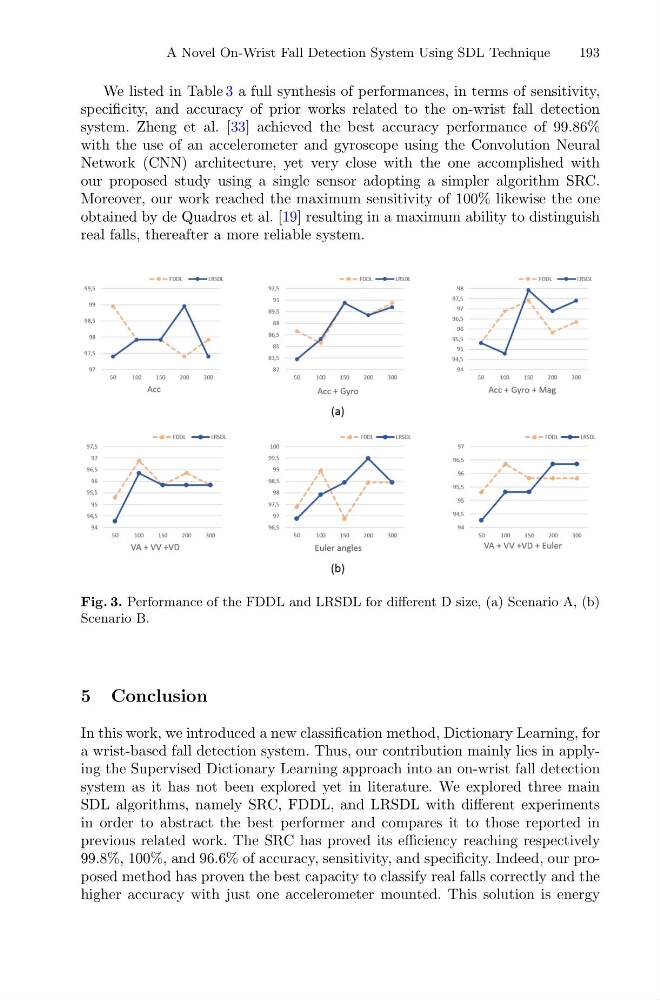
Fig. 3. Performance of the FDDL and LRSDL for different D size, (a) Scenario A, (b)
Scenario B.
5 Conclusion
In this work, we introduced a new classification method, Dictionary Learning, for
a wrist-based fall detection system. Thus, our contribution mainly lies in applying the Supervised Dictionary Learning approach into an on-wrist fall detection
system as it has not been explored yet in literature. We explored three main
SDL algorithms, namely SRC, FDDL, and LRSDL with different experiments
in order to abstract the best performer and compares it to those reported in
previous related work. The SRC has proved its efficiency reaching respectively
99.8%, 100%, and 96.6% of accuracy, sensitivity, and specificity. Indeed, our proposed method has proven the best capacity to classify real falls correctly and the
higher accuracy with just one accelerometer mounted. This solution is energy
193
We listed in Table 3 a full synthesis of performances, in terms of sensitivity,
specificity, and accuracy of prior works related to the on-wrist fall detection
system. Zheng et al. [33] achieved the best accuracy performance of 99.86%
with the use of an accelerometer and gyroscope using the Convolution Neural
Network (CNN) architecture, yet very close with the one accomplished with
our proposed study using a single sensor adopting a simpler algorithm SRC.
Moreover, our work reached the maximum sensitivity of 100% likewise the one
obtained by de Quadros et al. [19] resulting in a maximum ability to distinguish
real falls, thereafter a more reliable system.
Fig. 3. Performance of the FDDL and LRSDL for different D size, (a) Scenario A, (b)
Scenario B.
5 Conclusion
In this work, we introduced a new classification method, Dictionary Learning, for
a wrist-based fall detection system. Thus, our contribution mainly lies in applying the Supervised Dictionary Learning approach into an on-wrist fall detection
system as it has not been explored yet in literature. We explored three main
SDL algorithms, namely SRC, FDDL, and LRSDL with different experiments
in order to abstract the best performer and compares it to those reported in
previous related work. The SRC has proved its efficiency reaching respectively
99.8%, 100%, and 96.6% of accuracy, sensitivity, and specificity. Indeed, our proposed method has proven the best capacity to classify real falls correctly and the
higher accuracy with just one accelerometer mounted. This solution is energy