

3.1.2 Artificial Neural Network (ANN)
The Propounded ANN Architecture
The idea of creating an artificial neural network architecture was inspired by the
biological neural system [12]. Indeed, our proposed artificial neural network consists
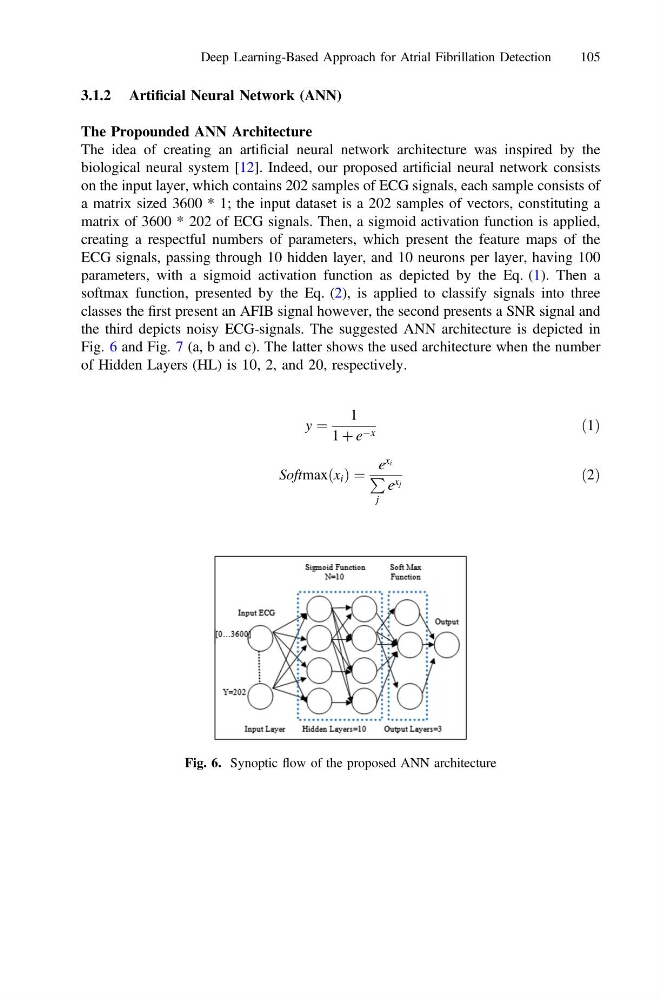
on the input layer, which contains 202 samples of ECG signals, each sample consists of
a matrix sized 3600 * 1; the input dataset is a 202 samples of vectors, constituting a
matrix of 3600 * 202 of ECG signals. Then, a sigmoid activation function is applied,
creating a respectful numbers of parameters, which present the feature maps of the
ECG signals, passing through 10 hidden layer, and 10 neurons per layer, having 100
parameters, with a sigmoid activation function as depicted by the Eq. (1). Then a
softmax function, presented by the Eq. (2), is applied to classify signals into three
classes the first present an AFIB signal however, the second presents a SNR signal and
the third depicts noisy ECG-signals. The suggested ANN architecture is depicted in
Fig. 6 and Fig. 7 (a, b and c). The latter shows the used architecture when the number
of Hidden Layers (HL) is 10, 2, and 20, respectively.
y ¼
1
1 þ e Àx
ð1Þ
Softmaxðx i Þ ¼
e
x i
P
j
e x j
ð2Þ
Fig. 6. Synoptic flow of the proposed ANN architecture
Deep Learning-Based Approach for Atrial Fibrillation Detection
105
The Propounded ANN Architecture
The idea of creating an artificial neural network architecture was inspired by the
biological neural system [12]. Indeed, our proposed artificial neural network consists
on the input layer, which contains 202 samples of ECG signals, each sample consists of
a matrix sized 3600 * 1; the input dataset is a 202 samples of vectors, constituting a
matrix of 3600 * 202 of ECG signals. Then, a sigmoid activation function is applied,
creating a respectful numbers of parameters, which present the feature maps of the
ECG signals, passing through 10 hidden layer, and 10 neurons per layer, having 100
parameters, with a sigmoid activation function as depicted by the Eq. (1). Then a
softmax function, presented by the Eq. (2), is applied to classify signals into three
classes the first present an AFIB signal however, the second presents a SNR signal and
the third depicts noisy ECG-signals. The suggested ANN architecture is depicted in
Fig. 6 and Fig. 7 (a, b and c). The latter shows the used architecture when the number
of Hidden Layers (HL) is 10, 2, and 20, respectively.
y ¼
1
1 þ e Àx
ð1Þ
Softmaxðx i Þ ¼
e
x i
P
j
e x j
ð2Þ
Fig. 6. Synoptic flow of the proposed ANN architecture
Deep Learning-Based Approach for Atrial Fibrillation Detection
105