

A Convolutional Neural Network for Lentigo Diagnosis
93
3.2 Data Preprocessing
In the first step of the preprocessing procedure, the RCM images of the training set are resized to fit in the InceptionV3 network. A normalization step is
added to help the CNN better process the input images, in order that all feature
values have the same range and the system needs only one global learning rate
multiplier. Afterwards, the data augmentation step is proposed to improve our
classification results. This step prevents accuracy decay and overfitting. In [20]
the authors demonstrate the importance of data augmentation as a regulazier
in the CNN classification model.
3.3 InceptionV3 Model
The InceptionV3 model is a complex heavily engineered network that considered
a major breakthrough in CNN’s [9]. Before the current model, many common
CNN’s claimed that stacking layers after layers is the only way to increase accuracy. However, this network suggested some solutions to improve accuracy and
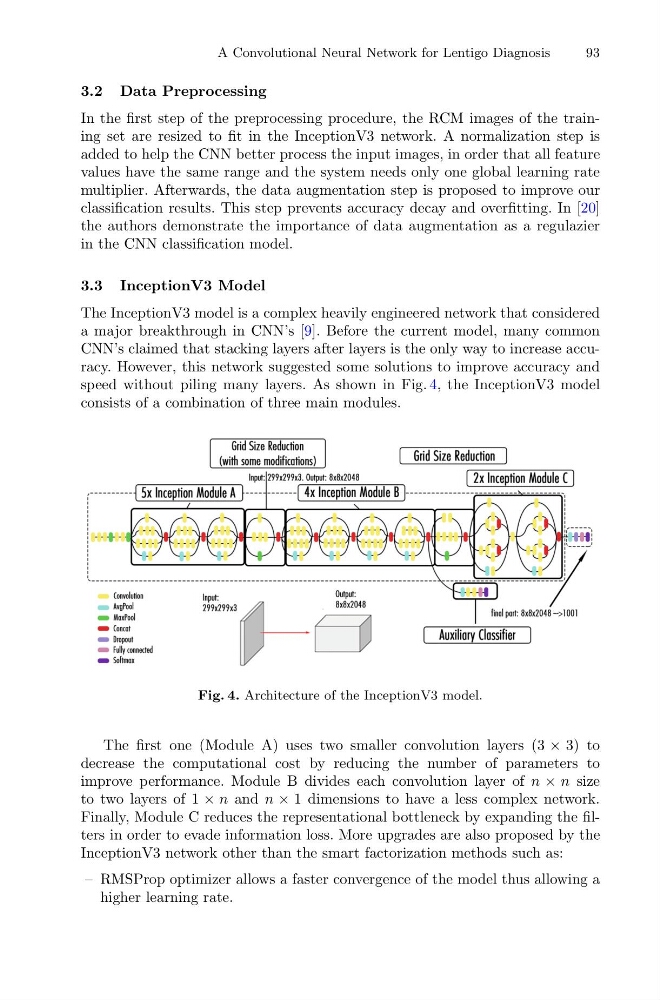
speed without piling many layers. As shown in Fig. 4, the InceptionV3 model
consists of a combination of three main modules.
Fig. 4. Architecture of the InceptionV3 model.
The first one (Module A) uses two smaller convolution layers (3 × 3) to
decrease the computational cost by reducing the number of parameters to
improve performance. Module B divides each convolution layer of n × n size
to two layers of 1 × n and n × 1 dimensions to have a less complex network.
Finally, Module C reduces the representational bottleneck by expanding the filters in order to evade information loss. More upgrades are also proposed by the
InceptionV3 network other than the smart factorization methods such as:
– RMSProp optimizer allows a faster convergence of the model thus allowing a
higher learning rate.
93
3.2 Data Preprocessing
In the first step of the preprocessing procedure, the RCM images of the training set are resized to fit in the InceptionV3 network. A normalization step is
added to help the CNN better process the input images, in order that all feature
values have the same range and the system needs only one global learning rate
multiplier. Afterwards, the data augmentation step is proposed to improve our
classification results. This step prevents accuracy decay and overfitting. In [20]
the authors demonstrate the importance of data augmentation as a regulazier
in the CNN classification model.
3.3 InceptionV3 Model
The InceptionV3 model is a complex heavily engineered network that considered
a major breakthrough in CNN’s [9]. Before the current model, many common
CNN’s claimed that stacking layers after layers is the only way to increase accuracy. However, this network suggested some solutions to improve accuracy and
speed without piling many layers. As shown in Fig. 4, the InceptionV3 model
consists of a combination of three main modules.
Fig. 4. Architecture of the InceptionV3 model.
The first one (Module A) uses two smaller convolution layers (3 × 3) to
decrease the computational cost by reducing the number of parameters to
improve performance. Module B divides each convolution layer of n × n size
to two layers of 1 × n and n × 1 dimensions to have a less complex network.
Finally, Module C reduces the representational bottleneck by expanding the filters in order to evade information loss. More upgrades are also proposed by the
InceptionV3 network other than the smart factorization methods such as:
– RMSProp optimizer allows a faster convergence of the model thus allowing a
higher learning rate.