

182
7 Solving Nonlinear Algebraic Equations
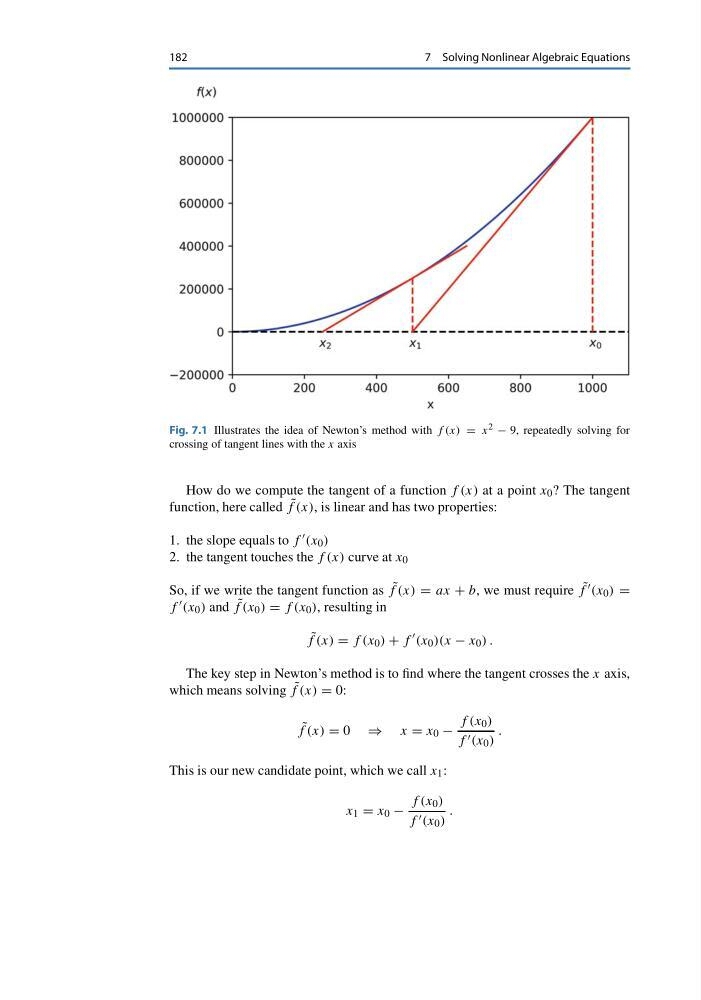
Fig. 7.1 Illustrates the idea of Newton’s method with f (x) = x 2 − 9, repeatedly solving for
crossing of tangent lines with the x axis
How do we compute the tangent of a function f (x) at a point x 0 ? The tangent
function, here called ˜
f (x), is linear and has two properties:
1. the slope equals to f (x 0 )
2. the tangent touches the f (x) curve at x 0
So, if we write the tangent function as ˜
f (x) = ax + b, we must require ˜
f (x 0 ) =
f (x 0 ) and ˜
f (x 0 ) = f (x 0 ), resulting in
˜
f (x) = f (x 0 ) + f
(x 0 )(x − x 0 ) .
The key step in Newton’s method is to find where the tangent crosses the x axis,
which means solving ˜
f (x) = 0:
˜
f (x) = 0 ⇒ x = x 0 −
f (x 0 )
f (x 0 )
.
This is our new candidate point, which we call x 1 :
x 1 = x 0 −
f (x 0 )
f (x 0 )
.
7 Solving Nonlinear Algebraic Equations
Fig. 7.1 Illustrates the idea of Newton’s method with f (x) = x 2 − 9, repeatedly solving for
crossing of tangent lines with the x axis
How do we compute the tangent of a function f (x) at a point x 0 ? The tangent
function, here called ˜
f (x), is linear and has two properties:
1. the slope equals to f (x 0 )
2. the tangent touches the f (x) curve at x 0
So, if we write the tangent function as ˜
f (x) = ax + b, we must require ˜
f (x 0 ) =
f (x 0 ) and ˜
f (x 0 ) = f (x 0 ), resulting in
˜
f (x) = f (x 0 ) + f
(x 0 )(x − x 0 ) .
The key step in Newton’s method is to find where the tangent crosses the x axis,
which means solving ˜
f (x) = 0:
˜
f (x) = 0 ⇒ x = x 0 −
f (x 0 )
f (x 0 )
.
This is our new candidate point, which we call x 1 :
x 1 = x 0 −
f (x 0 )
f (x 0 )
.