

RES for non-Markovian repairable fault trees
471
In view of the above, any attempt to define an importance function for an
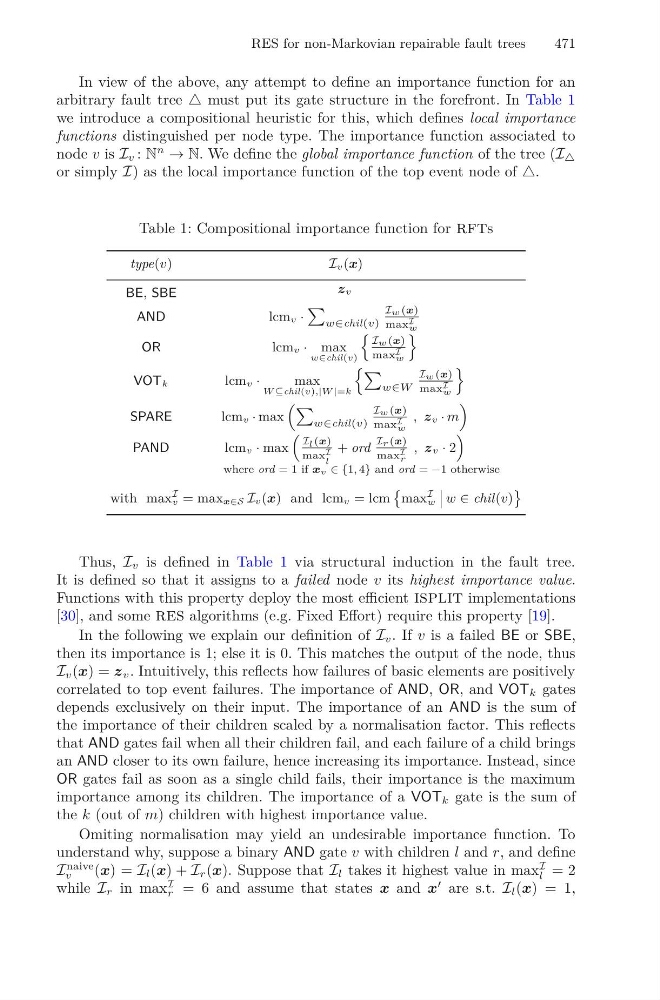
arbitrary fault tree must put its gate structure in the forefront. In Table 1
we introduce a compositional heuristic for this, which defines local importance
functions distinguished per node type. The importance function associated to
node v is I v : N
n
→ N. We define the global importance function of the tree (I
or simply I) as the local importance function of the top event node of .
Table 1: Compositional importance function for rfts
type(v)
Iv(x)
BE, SBE
z v
AND
lcmv ·
w∈chil(v)
I w (x)
max I
w
OR
lcmv · max
w∈chil(v)
I w (x)
max I
w
VOT k
lcmv ·
max
W ⊆chil(v),|W |=k
w∈W
I w (x)
max I
w
SPARE
lcmv · max
w∈chil(v)
I w (x)
max I
w
, zv · m
PAND
lcmv · max
I l (x)
max I
l
+ ord
I r (x)
max I
r
, zv · 2
where ord = 1 if xv ∈ {1, 4} and ord = −1 otherwise
with max
I
v = max x∈S Iv(x) and lcmv = lcm
max
I
w
w ∈ chil(v)
Thus, I v is defined in Table 1 via structural induction in the fault tree.
It is defined so that it assigns to a failed node v its highest importance value.
Functions with this property deploy the most efficient isplit implementations
[30], and some res algorithms (e.g. Fixed Effort) require this property [19].
In the following we explain our definition of I v . If v is a failed BE or SBE,
then its importance is 1; else it is 0. This matches the output of the node, thus
I v (x) = z v . Intuitively, this reflects how failures of basic elements are positively
correlated to top event failures. The importance of AND, OR, and VOT k gates
depends exclusively on their input. The importance of an AND is the sum of
the importance of their children scaled by a normalisation factor. This reflects
that AND gates fail when all their children fail, and each failure of a child brings
an AND closer to its own failure, hence increasing its importance. Instead, since
OR gates fail as soon as a single child fails, their importance is the maximum
importance among its children. The importance of a VOT k gate is the sum of
the k (out of m) children with highest importance value.
Omiting normalisation may yield an undesirable importance function. To
understand why, suppose a binary AND gate v with children l and r, and define
I
naive
v
(x) = I l (x) + I r (x). Suppose that I l takes it highest value in max I
l = 2
while I r in max I
r = 6 and assume that states x and x
are s.t. I l (x) = 1,
471
In view of the above, any attempt to define an importance function for an
arbitrary fault tree must put its gate structure in the forefront. In Table 1
we introduce a compositional heuristic for this, which defines local importance
functions distinguished per node type. The importance function associated to
node v is I v : N
n
→ N. We define the global importance function of the tree (I
or simply I) as the local importance function of the top event node of .
Table 1: Compositional importance function for rfts
type(v)
Iv(x)
BE, SBE
z v
AND
lcmv ·
w∈chil(v)
I w (x)
max I
w
OR
lcmv · max
w∈chil(v)
I w (x)
max I
w
VOT k
lcmv ·
max
W ⊆chil(v),|W |=k
w∈W
I w (x)
max I
w
SPARE
lcmv · max
w∈chil(v)
I w (x)
max I
w
, zv · m
PAND
lcmv · max
I l (x)
max I
l
+ ord
I r (x)
max I
r
, zv · 2
where ord = 1 if xv ∈ {1, 4} and ord = −1 otherwise
with max
I
v = max x∈S Iv(x) and lcmv = lcm
max
I
w
w ∈ chil(v)
Thus, I v is defined in Table 1 via structural induction in the fault tree.
It is defined so that it assigns to a failed node v its highest importance value.
Functions with this property deploy the most efficient isplit implementations
[30], and some res algorithms (e.g. Fixed Effort) require this property [19].
In the following we explain our definition of I v . If v is a failed BE or SBE,
then its importance is 1; else it is 0. This matches the output of the node, thus
I v (x) = z v . Intuitively, this reflects how failures of basic elements are positively
correlated to top event failures. The importance of AND, OR, and VOT k gates
depends exclusively on their input. The importance of an AND is the sum of
the importance of their children scaled by a normalisation factor. This reflects
that AND gates fail when all their children fail, and each failure of a child brings
an AND closer to its own failure, hence increasing its importance. Instead, since
OR gates fail as soon as a single child fails, their importance is the maximum
importance among its children. The importance of a VOT k gate is the sum of
the k (out of m) children with highest importance value.
Omiting normalisation may yield an undesirable importance function. To
understand why, suppose a binary AND gate v with children l and r, and define
I
naive
v
(x) = I l (x) + I r (x). Suppose that I l takes it highest value in max I
l = 2
while I r in max I
r = 6 and assume that states x and x
are s.t. I l (x) = 1,