

33
developers collaborated in the Storage and Networking Industry Association (SNIA) to
define a common programming model, so the methods for using persistent memory
described in this chapter are available in both operating systems. More details can be
found in the SNIA NVM programming model specification (https://www.snia.org/
tech_activities/standards/curr_standards/npm).
Persistent Memory As Block Storage
The first operating system extension for persistent memory is the ability to detect the
existence of persistent memory modules and load a device driver into the operating
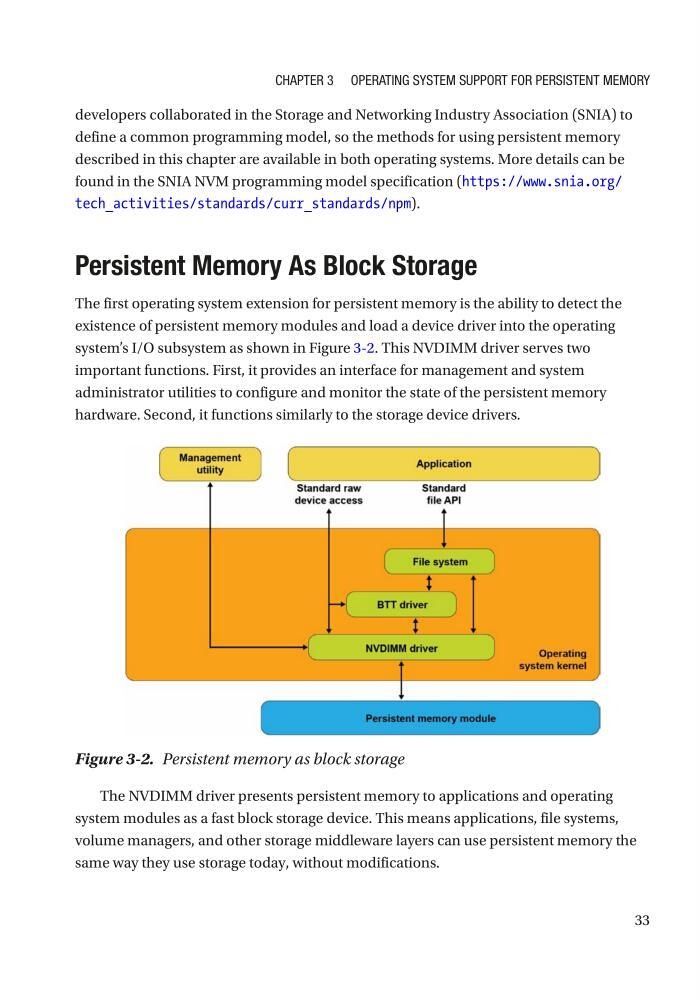
system’s I/O subsystem as shown in Figure 3-2. This NVDIMM driver serves two
important functions. First, it provides an interface for management and system
administrator utilities to configure and monitor the state of the persistent memory
hardware. Second, it functions similarly to the storage device drivers.
The NVDIMM driver presents persistent memory to applications and operating
system modules as a fast block storage device. This means applications, file systems,
volume managers, and other storage middleware layers can use persistent memory the
same way they use storage today, without modifications.
Figure 3-2. Persistent memory as block storage
Chapter 3 Operating SyStem SuppOrt fOr perSiStent memOry
developers collaborated in the Storage and Networking Industry Association (SNIA) to
define a common programming model, so the methods for using persistent memory
described in this chapter are available in both operating systems. More details can be
found in the SNIA NVM programming model specification (https://www.snia.org/
tech_activities/standards/curr_standards/npm).
Persistent Memory As Block Storage
The first operating system extension for persistent memory is the ability to detect the
existence of persistent memory modules and load a device driver into the operating
system’s I/O subsystem as shown in Figure 3-2. This NVDIMM driver serves two
important functions. First, it provides an interface for management and system
administrator utilities to configure and monitor the state of the persistent memory
hardware. Second, it functions similarly to the storage device drivers.
The NVDIMM driver presents persistent memory to applications and operating
system modules as a fast block storage device. This means applications, file systems,
volume managers, and other storage middleware layers can use persistent memory the
same way they use storage today, without modifications.
Figure 3-2. Persistent memory as block storage
Chapter 3 Operating SyStem SuppOrt fOr perSiStent memOry