

354
How Does the General-Purpose Remote Replication Method
Make Data Persistent?
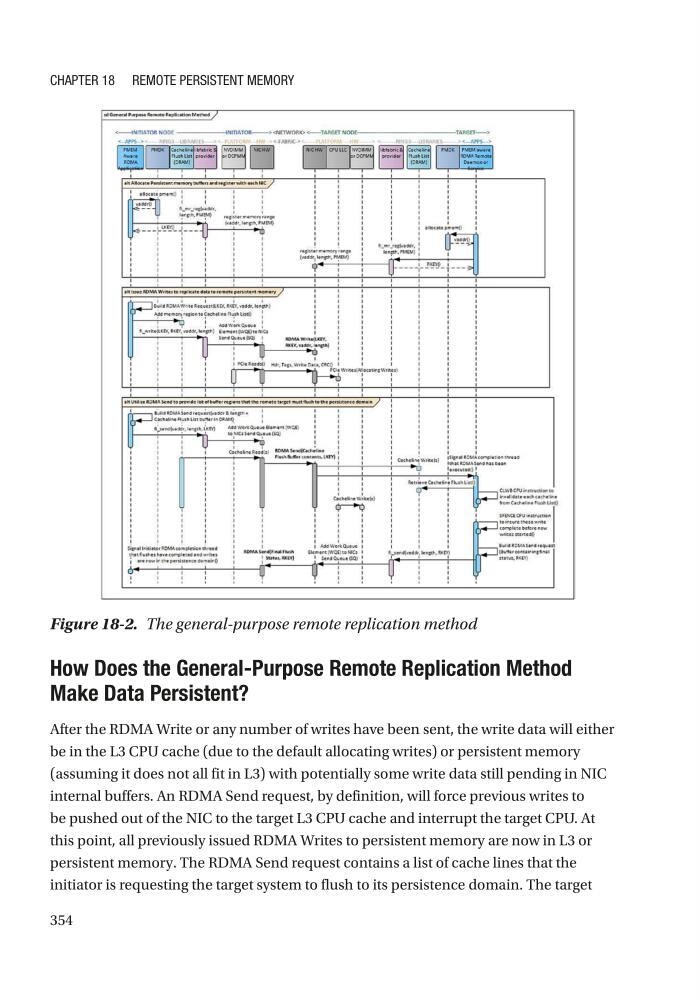
After the RDMA Write or any number of writes have been sent, the write data will either
be in the L3 CPU cache (due to the default allocating writes) or persistent memory
(assuming it does not all fit in L3) with potentially some write data still pending in NIC
internal buffers. An RDMA Send request, by definition, will force previous writes to
be pushed out of the NIC to the target L3 CPU cache and interrupt the target CPU. At
this point, all previously issued RDMA Writes to persistent memory are now in L3 or
persistent memory. The RDMA Send request contains a list of cache lines that the
initiator is requesting the target system to flush to its persistence domain. The target
Figure 18-2. The general-purpose remote replication method
Chapter 18 remote persistent memory
How Does the General-Purpose Remote Replication Method
Make Data Persistent?
After the RDMA Write or any number of writes have been sent, the write data will either
be in the L3 CPU cache (due to the default allocating writes) or persistent memory
(assuming it does not all fit in L3) with potentially some write data still pending in NIC
internal buffers. An RDMA Send request, by definition, will force previous writes to
be pushed out of the NIC to the target L3 CPU cache and interrupt the target CPU. At
this point, all previously issued RDMA Writes to persistent memory are now in L3 or
persistent memory. The RDMA Send request contains a list of cache lines that the
initiator is requesting the target system to flush to its persistence domain. The target
Figure 18-2. The general-purpose remote replication method
Chapter 18 remote persistent memory