

Measuring the Dynamics of Mammalian Societies
373
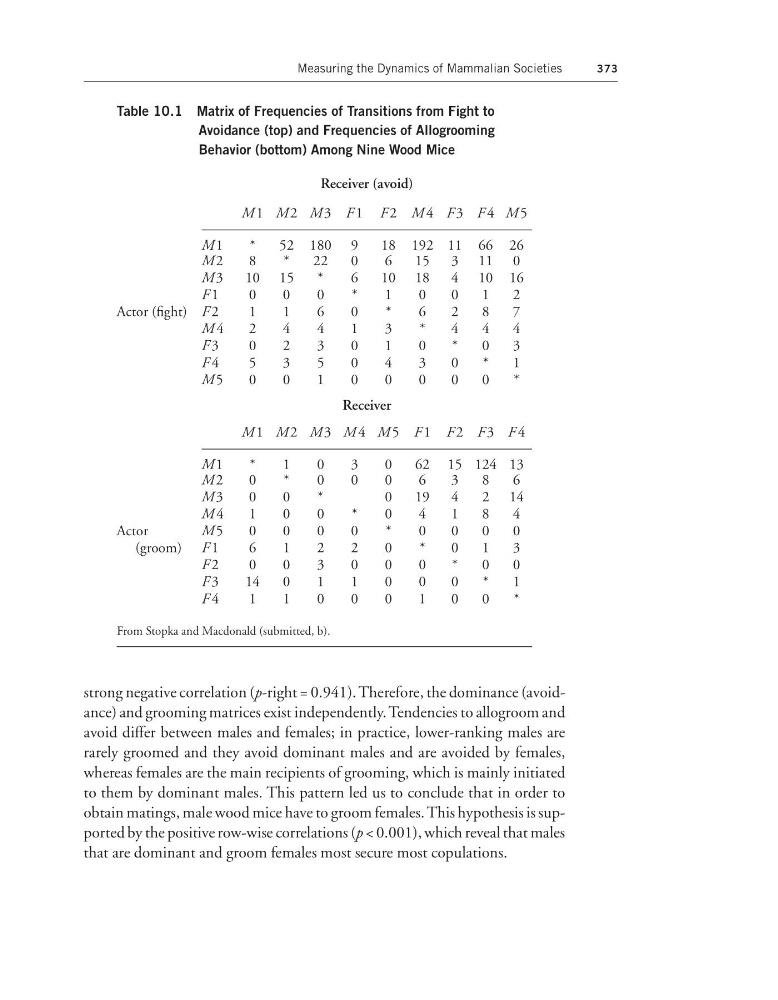
Table 10.1 Matrix of Frequencies of Transitions from Fight to
Avoidance (top) and Frequencies of Allogrooming
Behavior (bottom) Among Nine Wood Mice
Receiver (avoid)
M1 M2 M3 F 1 F 2 M 4 F 3 F 4 M5
M1
*
52 180 9
18 192 11 66 26
M2
8
*
22
0
6
15 3 11 0
M3 10 15
*
6
10 18 4 10 16
F 1
0
0
0
*
1
0
0
1
2
Actor (fight) F 2
1
1
6
0
*
6
2
8
7
M 4
2
4
4
1
3
*
4
4
4
F 3
0
2
3
0
1
0
*
0
3
F 4
5
3
5
0
4
3
0
*
1
M5
0
0
1
0
0
0
0
0
*
Receiver
M1 M2 M3 M 4 M5 F 1 F 2 F 3 F 4
M1
*
1
0
3
0
62 15 124 13
M2
0
*
0
0
0
6
3
8
6
M3
0
0
*
0
19 4
2 14
M 4
1
0
0
*
0
4
1
8
4
Actor
M5
0
0
0
0
*
0
0
0
0
(groom) F 1
6
1
2
2
0
*
0
1
3
F 2
0
0
3
0
0
0
*
0
0
F 3
14
0
1
1
0
0
0
*
1
F 4
1
1
0
0
0
1
0
0
*
From Stopka and Macdonald (submitted, b).
strong negative correlation (p-right = 0.941). Therefore, the dominance (avoidance) and grooming matrices exist independently. Tendencies to allogroom and
avoid differ between males and females; in practice, lower-ranking males are
rarely groomed and they avoid dominant males and are avoided by females,
whereas females are the main recipients of grooming, which is mainly initiated
to them by dominant males. This pattern led us to conclude that in order to
obtain matings, male wood mice have to groom females. This hypothesis is supported by the positive row-wise correlations (p < 0.001), which reveal that males
that are dominant and groom females most secure most copulations.
373
Table 10.1 Matrix of Frequencies of Transitions from Fight to
Avoidance (top) and Frequencies of Allogrooming
Behavior (bottom) Among Nine Wood Mice
Receiver (avoid)
M1 M2 M3 F 1 F 2 M 4 F 3 F 4 M5
M1
*
52 180 9
18 192 11 66 26
M2
8
*
22
0
6
15 3 11 0
M3 10 15
*
6
10 18 4 10 16
F 1
0
0
0
*
1
0
0
1
2
Actor (fight) F 2
1
1
6
0
*
6
2
8
7
M 4
2
4
4
1
3
*
4
4
4
F 3
0
2
3
0
1
0
*
0
3
F 4
5
3
5
0
4
3
0
*
1
M5
0
0
1
0
0
0
0
0
*
Receiver
M1 M2 M3 M 4 M5 F 1 F 2 F 3 F 4
M1
*
1
0
3
0
62 15 124 13
M2
0
*
0
0
0
6
3
8
6
M3
0
0
*
0
19 4
2 14
M 4
1
0
0
*
0
4
1
8
4
Actor
M5
0
0
0
0
*
0
0
0
0
(groom) F 1
6
1
2
2
0
*
0
1
3
F 2
0
0
3
0
0
0
*
0
0
F 3
14
0
1
1
0
0
0
*
1
F 4
1
1
0
0
0
1
0
0
*
From Stopka and Macdonald (submitted, b).
strong negative correlation (p-right = 0.941). Therefore, the dominance (avoidance) and grooming matrices exist independently. Tendencies to allogroom and
avoid differ between males and females; in practice, lower-ranking males are
rarely groomed and they avoid dominant males and are avoided by females,
whereas females are the main recipients of grooming, which is mainly initiated
to them by dominant males. This pattern led us to conclude that in order to
obtain matings, male wood mice have to groom females. This hypothesis is supported by the positive row-wise correlations (p < 0.001), which reveal that males
that are dominant and groom females most secure most copulations.