

Investigating Food Habits of Terrestrial Vertebrates
181
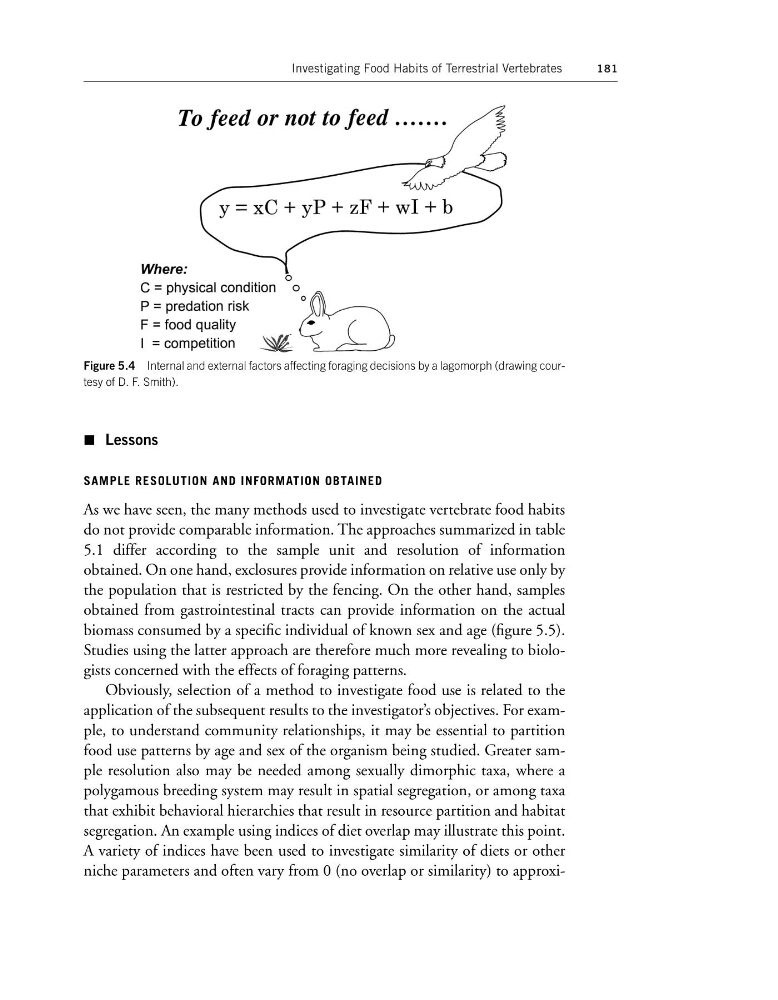
Figure 5.4 Internal and external factors affecting foraging decisions by a lagomorph (drawing courtesy of D. F. Smith).
Lessons
SAMPLE RESOLUTION AND INFORMATION OBTAINED
As we have seen, the many methods used to investigate vertebrate food habits
do not provide comparable information. The approaches summarized in table
5.1 differ according to the sample unit and resolution of information
obtained. On one hand, exclosures provide information on relative use only by
the population that is restricted by the fencing. On the other hand, samples
obtained from gastrointestinal tracts can provide information on the actual
biomass consumed by a specific individual of known sex and age (figure 5.5).
Studies using the latter approach are therefore much more revealing to biologists concerned with the effects of foraging patterns.
Obviously, selection of a method to investigate food use is related to the
application of the subsequent results to the investigator’s objectives. For example, to understand community relationships, it may be essential to partition
food use patterns by age and sex of the organism being studied. Greater sample resolution also may be needed among sexually dimorphic taxa, where a
polygamous breeding system may result in spatial segregation, or among taxa
that exhibit behavioral hierarchies that result in resource partition and habitat
segregation. An example using indices of diet overlap may illustrate this point.
A variety of indices have been used to investigate similarity of diets or other
niche parameters and often vary from 0 (no overlap or similarity) to approxi-
181
Figure 5.4 Internal and external factors affecting foraging decisions by a lagomorph (drawing courtesy of D. F. Smith).
Lessons
SAMPLE RESOLUTION AND INFORMATION OBTAINED
As we have seen, the many methods used to investigate vertebrate food habits
do not provide comparable information. The approaches summarized in table
5.1 differ according to the sample unit and resolution of information
obtained. On one hand, exclosures provide information on relative use only by
the population that is restricted by the fencing. On the other hand, samples
obtained from gastrointestinal tracts can provide information on the actual
biomass consumed by a specific individual of known sex and age (figure 5.5).
Studies using the latter approach are therefore much more revealing to biologists concerned with the effects of foraging patterns.
Obviously, selection of a method to investigate food use is related to the
application of the subsequent results to the investigator’s objectives. For example, to understand community relationships, it may be essential to partition
food use patterns by age and sex of the organism being studied. Greater sample resolution also may be needed among sexually dimorphic taxa, where a
polygamous breeding system may result in spatial segregation, or among taxa
that exhibit behavioral hierarchies that result in resource partition and habitat
segregation. An example using indices of diet overlap may illustrate this point.
A variety of indices have been used to investigate similarity of diets or other
niche parameters and often vary from 0 (no overlap or similarity) to approxi-