

66
R O G E R A . P O W E L L
tinued, “Like people, my animals frequently disclose by their actions what
they decline to divulge in words.”
We do know that members of some species, probably many species, have
cognitive maps of where they live (Peters 1978) or concepts of where different
resources and features are located within their home ranges and of how to travel
between them. Such cognitive maps may be sensitive to where an animal finds
itself within its home range or to its nutritional state; for example, resources that
the animal perceives to be close at hand or resources far away that balance the
diet may be more valuable than others. From extensive research on optimal foraging (Ellner and Real 1989; Pyke 1984; Pyke et al. 1977), we know that animals often rank resources in some manner. Consequently, we might envision
an animal’s cognitive map of its home range as an integration of contour maps,
one (or more) for food resources, one for escape cover, one for travel routes, one
for known home ranges of members of the other sex, and so forth.
Why do animals have home ranges? Stamps (1995:41) argued that animals
have home ranges because individuals learn “site-specific serial motor programs,” which might be envisioned as near reflex movements that take an animal along well traveled routes to safety. These movements should enhance the
animal’s ability to maneuver through its environment and thereby to avoid or
escape predators. Stamps argued that the willingness of an animal to incur costs
to remain in a familiar area implies that being familiar with that area provides
a fitness benefit greater than the costs. For animals with small home ranges that
live their lives as potential prey, Stamps’s hypothesis makes sense. However,
many animals, especially predatory mammals and birds, have home ranges too
large and use specific places too seldom for site-specific serial motor programs
to have an important benefit. Site-specific serial motor patterns of greatest use
to a predator would have to match the escape routes of each prey individual,
but each of these might be used only once after it is learned. The reason that
animals maintain home ranges must be broader than Stamps’s hypothesis.
Nonetheless, Stamps has undoubtedly identified the key reason that animals establish and maintain home ranges: The benefits of maintaining a home
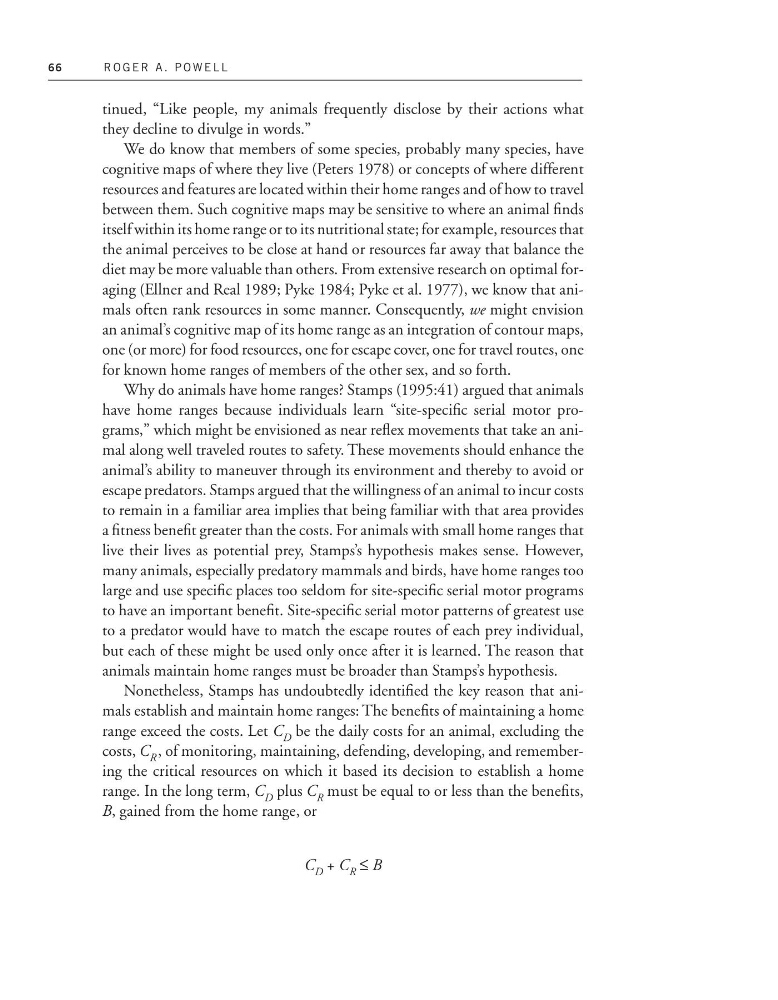
range exceed the costs. Let C D be the daily costs for an animal, excluding the
costs, C R , of monitoring, maintaining, defending, developing, and remembering the critical resources on which it based its decision to establish a home
range. In the long term, C D plus C R must be equal to or less than the benefits,
B, gained from the home range, or
C D + C R ≤ B
R O G E R A . P O W E L L
tinued, “Like people, my animals frequently disclose by their actions what
they decline to divulge in words.”
We do know that members of some species, probably many species, have
cognitive maps of where they live (Peters 1978) or concepts of where different
resources and features are located within their home ranges and of how to travel
between them. Such cognitive maps may be sensitive to where an animal finds
itself within its home range or to its nutritional state; for example, resources that
the animal perceives to be close at hand or resources far away that balance the
diet may be more valuable than others. From extensive research on optimal foraging (Ellner and Real 1989; Pyke 1984; Pyke et al. 1977), we know that animals often rank resources in some manner. Consequently, we might envision
an animal’s cognitive map of its home range as an integration of contour maps,
one (or more) for food resources, one for escape cover, one for travel routes, one
for known home ranges of members of the other sex, and so forth.
Why do animals have home ranges? Stamps (1995:41) argued that animals
have home ranges because individuals learn “site-specific serial motor programs,” which might be envisioned as near reflex movements that take an animal along well traveled routes to safety. These movements should enhance the
animal’s ability to maneuver through its environment and thereby to avoid or
escape predators. Stamps argued that the willingness of an animal to incur costs
to remain in a familiar area implies that being familiar with that area provides
a fitness benefit greater than the costs. For animals with small home ranges that
live their lives as potential prey, Stamps’s hypothesis makes sense. However,
many animals, especially predatory mammals and birds, have home ranges too
large and use specific places too seldom for site-specific serial motor programs
to have an important benefit. Site-specific serial motor patterns of greatest use
to a predator would have to match the escape routes of each prey individual,
but each of these might be used only once after it is learned. The reason that
animals maintain home ranges must be broader than Stamps’s hypothesis.
Nonetheless, Stamps has undoubtedly identified the key reason that animals establish and maintain home ranges: The benefits of maintaining a home
range exceed the costs. Let C D be the daily costs for an animal, excluding the
costs, C R , of monitoring, maintaining, defending, developing, and remembering the critical resources on which it based its decision to establish a home
range. In the long term, C D plus C R must be equal to or less than the benefits,
B, gained from the home range, or
C D + C R ≤ B