

3.3 The Governance Assessment Tool
The previous section has explained some theoretical roots of the type of governance
assessment that we use in this book. In this section we will explain the Governance
Assessment Tool that has been further developed in the context of the DROP
project. To be able to systematically describe what the five dimensions of governance look like in the given governance context we developed a set of questions
that can be used to guide the analysis of policy and other archival documents, and
structure the conduct and analysis of qualitative interviews with key informants.
Figure 3.5 gives an overview. All five dimensions include a descriptive question
regarding the time dimension—that is, ‘Have any of these changed over time or are
likely to change in the foreseeable future’. In the context of the DROP project, it
was particularly relevant to include this time dimension to spot any visible trends in
the governance dimensions across case study regions. This is particularly important
in Europe where countries face the same deadlines, like the 2015–2021–2027
assessment years of the Water Framework Directive.
While it is not difficult to see that all five elements of governance have strong
relevance for the inputs into the process and the motivations, cognitions and
resources of the actors therein, they do not specify what aspects of them create a
more or a less stimulating context for the process.
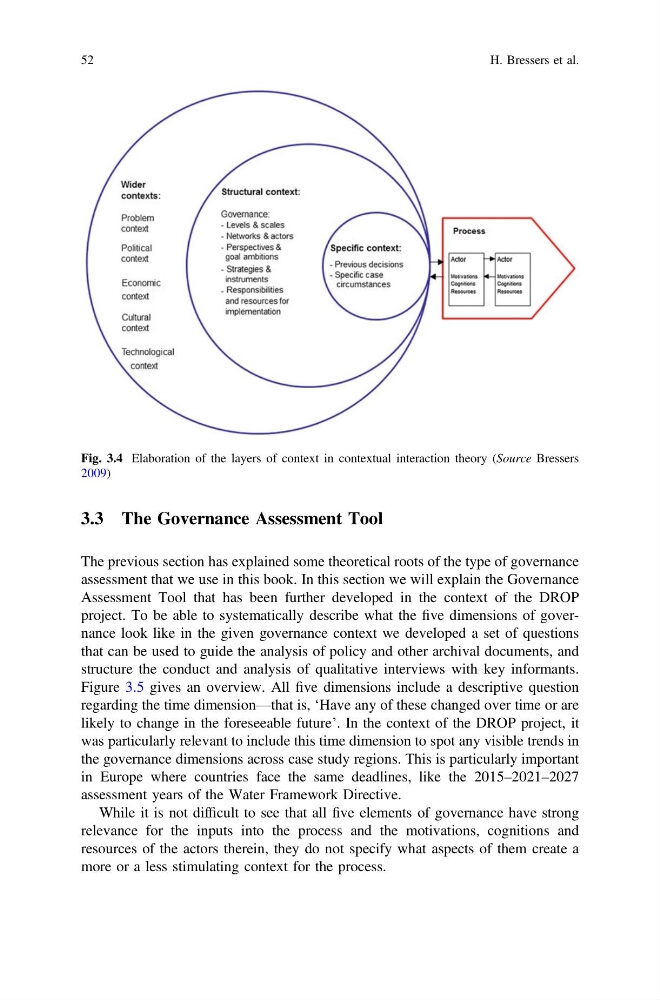
Fig. 3.4 Elaboration of the layers of context in contextual interaction theory (Source Bressers
2009)
52
H. Bressers et al.
The previous section has explained some theoretical roots of the type of governance
assessment that we use in this book. In this section we will explain the Governance
Assessment Tool that has been further developed in the context of the DROP
project. To be able to systematically describe what the five dimensions of governance look like in the given governance context we developed a set of questions
that can be used to guide the analysis of policy and other archival documents, and
structure the conduct and analysis of qualitative interviews with key informants.
Figure 3.5 gives an overview. All five dimensions include a descriptive question
regarding the time dimension—that is, ‘Have any of these changed over time or are
likely to change in the foreseeable future’. In the context of the DROP project, it
was particularly relevant to include this time dimension to spot any visible trends in
the governance dimensions across case study regions. This is particularly important
in Europe where countries face the same deadlines, like the 2015–2021–2027
assessment years of the Water Framework Directive.
While it is not difficult to see that all five elements of governance have strong
relevance for the inputs into the process and the motivations, cognitions and
resources of the actors therein, they do not specify what aspects of them create a
more or a less stimulating context for the process.
Fig. 3.4 Elaboration of the layers of context in contextual interaction theory (Source Bressers
2009)
52
H. Bressers et al.