

strong combination of motivations, cognitions and resources to enable the process
to succeed (Bressers 2004; Owens 2008).
The basic assumptions of Contextual Interaction Theory are quite simple and
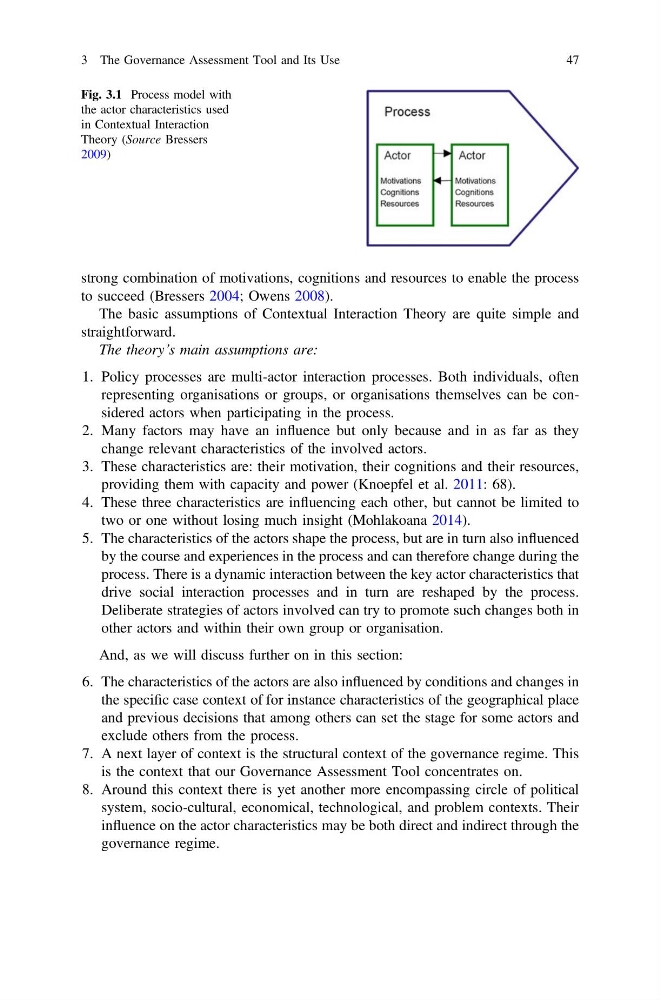
straightforward.
The theory’s main assumptions are:
1. Policy processes are multi-actor interaction processes. Both individuals, often
representing organisations or groups, or organisations themselves can be considered actors when participating in the process.
2. Many factors may have an influence but only because and in as far as they
change relevant characteristics of the involved actors.
3. These characteristics are: their motivation, their cognitions and their resources,
providing them with capacity and power (Knoepfel et al. 2011: 68).
4. These three characteristics are influencing each other, but cannot be limited to
two or one without losing much insight (Mohlakoana 2014).
5. The characteristics of the actors shape the process, but are in turn also influenced
by the course and experiences in the process and can therefore change during the
process. There is a dynamic interaction between the key actor characteristics that
drive social interaction processes and in turn are reshaped by the process.
Deliberate strategies of actors involved can try to promote such changes both in
other actors and within their own group or organisation.
And, as we will discuss further on in this section:
6. The characteristics of the actors are also influenced by conditions and changes in
the specific case context of for instance characteristics of the geographical place
and previous decisions that among others can set the stage for some actors and
exclude others from the process.
7. A next layer of context is the structural context of the governance regime. This
is the context that our Governance Assessment Tool concentrates on.
8. Around this context there is yet another more encompassing circle of political
system, socio-cultural, economical, technological, and problem contexts. Their
influence on the actor characteristics may be both direct and indirect through the
governance regime.
Fig. 3.1 Process model with
the actor characteristics used
in Contextual Interaction
Theory (Source Bressers
2009)
3 The Governance Assessment Tool and Its Use
47
to succeed (Bressers 2004; Owens 2008).
The basic assumptions of Contextual Interaction Theory are quite simple and
straightforward.
The theory’s main assumptions are:
1. Policy processes are multi-actor interaction processes. Both individuals, often
representing organisations or groups, or organisations themselves can be considered actors when participating in the process.
2. Many factors may have an influence but only because and in as far as they
change relevant characteristics of the involved actors.
3. These characteristics are: their motivation, their cognitions and their resources,
providing them with capacity and power (Knoepfel et al. 2011: 68).
4. These three characteristics are influencing each other, but cannot be limited to
two or one without losing much insight (Mohlakoana 2014).
5. The characteristics of the actors shape the process, but are in turn also influenced
by the course and experiences in the process and can therefore change during the
process. There is a dynamic interaction between the key actor characteristics that
drive social interaction processes and in turn are reshaped by the process.
Deliberate strategies of actors involved can try to promote such changes both in
other actors and within their own group or organisation.
And, as we will discuss further on in this section:
6. The characteristics of the actors are also influenced by conditions and changes in
the specific case context of for instance characteristics of the geographical place
and previous decisions that among others can set the stage for some actors and
exclude others from the process.
7. A next layer of context is the structural context of the governance regime. This
is the context that our Governance Assessment Tool concentrates on.
8. Around this context there is yet another more encompassing circle of political
system, socio-cultural, economical, technological, and problem contexts. Their
influence on the actor characteristics may be both direct and indirect through the
governance regime.
Fig. 3.1 Process model with
the actor characteristics used
in Contextual Interaction
Theory (Source Bressers
2009)
3 The Governance Assessment Tool and Its Use
47