

strategies, such as reducing leaks infrastructure, smarter water use for agricultural
purposes, public and water user education on conservation, as well as tailored
pricing schemes and policies.
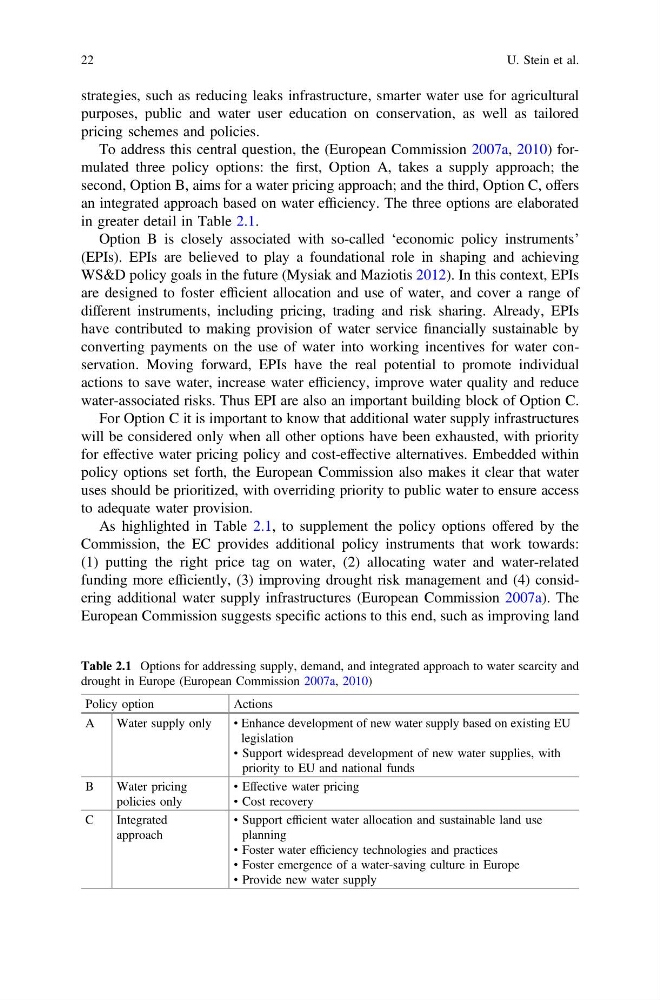
To address this central question, the (European Commission 2007a, 2010) formulated three policy options: the first, Option A, takes a supply approach; the
second, Option B, aims for a water pricing approach; and the third, Option C, offers
an integrated approach based on water efficiency. The three options are elaborated
in greater detail in Table 2.1.
Option B is closely associated with so-called ‘economic policy instruments’
(EPIs). EPIs are believed to play a foundational role in shaping and achieving
WS&D policy goals in the future (Mysiak and Maziotis 2012). In this context, EPIs
are designed to foster efficient allocation and use of water, and cover a range of
different instruments, including pricing, trading and risk sharing. Already, EPIs
have contributed to making provision of water service financially sustainable by
converting payments on the use of water into working incentives for water conservation. Moving forward, EPIs have the real potential to promote individual
actions to save water, increase water efficiency, improve water quality and reduce
water-associated risks. Thus EPI are also an important building block of Option C.
For Option C it is important to know that additional water supply infrastructures
will be considered only when all other options have been exhausted, with priority
for effective water pricing policy and cost-effective alternatives. Embedded within
policy options set forth, the European Commission also makes it clear that water
uses should be prioritized, with overriding priority to public water to ensure access
to adequate water provision.
As highlighted in Table 2.1, to supplement the policy options offered by the
Commission, the EC provides additional policy instruments that work towards:
(1) putting the right price tag on water, (2) allocating water and water-related
funding more efficiently, (3) improving drought risk management and (4) considering additional water supply infrastructures (European Commission 2007a). The
European Commission suggests specific actions to this end, such as improving land
Table 2.1 Options for addressing supply, demand, and integrated approach to water scarcity and
drought in Europe (European Commission 2007a, 2010)
Policy option
Actions
A
Water supply only
• Enhance development of new water supply based on existing EU
legislation
• Support widespread development of new water supplies, with
priority to EU and national funds
B
Water pricing
policies only
• Effective water pricing
• Cost recovery
C
Integrated
approach
• Support efficient water allocation and sustainable land use
planning
• Foster water efficiency technologies and practices
• Foster emergence of a water-saving culture in Europe
• Provide new water supply
22
U. Stein et al.
purposes, public and water user education on conservation, as well as tailored
pricing schemes and policies.
To address this central question, the (European Commission 2007a, 2010) formulated three policy options: the first, Option A, takes a supply approach; the
second, Option B, aims for a water pricing approach; and the third, Option C, offers
an integrated approach based on water efficiency. The three options are elaborated
in greater detail in Table 2.1.
Option B is closely associated with so-called ‘economic policy instruments’
(EPIs). EPIs are believed to play a foundational role in shaping and achieving
WS&D policy goals in the future (Mysiak and Maziotis 2012). In this context, EPIs
are designed to foster efficient allocation and use of water, and cover a range of
different instruments, including pricing, trading and risk sharing. Already, EPIs
have contributed to making provision of water service financially sustainable by
converting payments on the use of water into working incentives for water conservation. Moving forward, EPIs have the real potential to promote individual
actions to save water, increase water efficiency, improve water quality and reduce
water-associated risks. Thus EPI are also an important building block of Option C.
For Option C it is important to know that additional water supply infrastructures
will be considered only when all other options have been exhausted, with priority
for effective water pricing policy and cost-effective alternatives. Embedded within
policy options set forth, the European Commission also makes it clear that water
uses should be prioritized, with overriding priority to public water to ensure access
to adequate water provision.
As highlighted in Table 2.1, to supplement the policy options offered by the
Commission, the EC provides additional policy instruments that work towards:
(1) putting the right price tag on water, (2) allocating water and water-related
funding more efficiently, (3) improving drought risk management and (4) considering additional water supply infrastructures (European Commission 2007a). The
European Commission suggests specific actions to this end, such as improving land
Table 2.1 Options for addressing supply, demand, and integrated approach to water scarcity and
drought in Europe (European Commission 2007a, 2010)
Policy option
Actions
A
Water supply only
• Enhance development of new water supply based on existing EU
legislation
• Support widespread development of new water supplies, with
priority to EU and national funds
B
Water pricing
policies only
• Effective water pricing
• Cost recovery
C
Integrated
approach
• Support efficient water allocation and sustainable land use
planning
• Foster water efficiency technologies and practices
• Foster emergence of a water-saving culture in Europe
• Provide new water supply
22
U. Stein et al.