

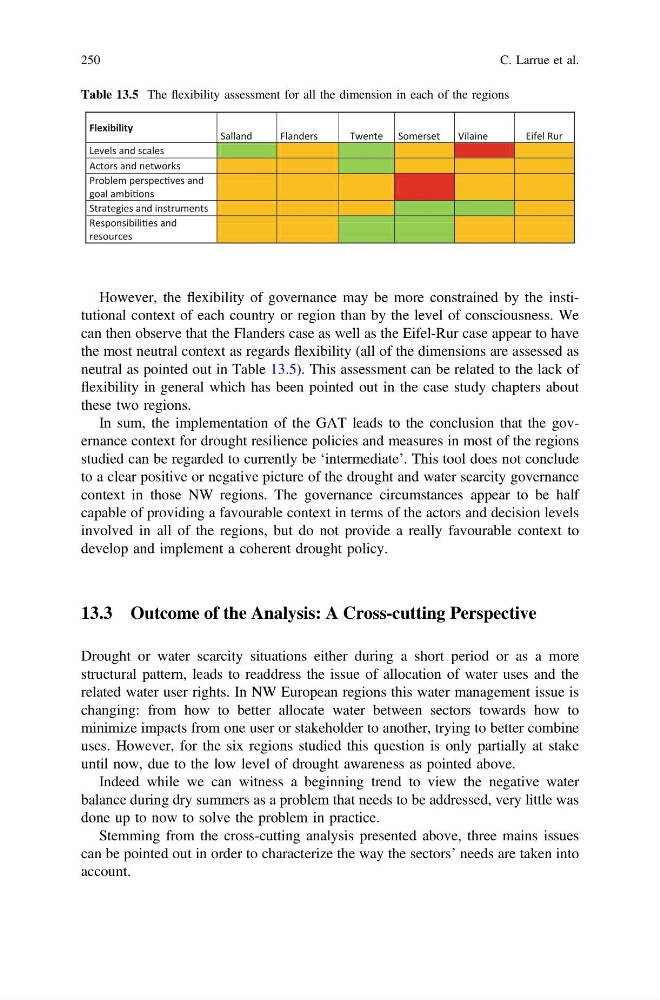
However, the flexibility of governance may be more constrained by the institutional context of each country or region than by the level of consciousness. We
can then observe that the Flanders case as well as the Eifel-Rur case appear to have
the most neutral context as regards flexibility (all of the dimensions are assessed as
neutral as pointed out in Table 13.5). This assessment can be related to the lack of
flexibility in general which has been pointed out in the case study chapters about
these two regions.
In sum, the implementation of the GAT leads to the conclusion that the governance context for drought resilience policies and measures in most of the regions
studied can be regarded to currently be ‘intermediate’. This tool does not conclude
to a clear positive or negative picture of the drought and water scarcity governance
context in those NW regions. The governance circumstances appear to be half
capable of providing a favourable context in terms of the actors and decision levels
involved in all of the regions, but do not provide a really favourable context to
develop and implement a coherent drought policy.
13.3 Outcome of the Analysis: A Cross-cutting Perspective
Drought or water scarcity situations either during a short period or as a more
structural pattern, leads to readdress the issue of allocation of water uses and the
related water user rights. In NW European regions this water management issue is
changing: from how to better allocate water between sectors towards how to
minimize impacts from one user or stakeholder to another, trying to better combine
uses. However, for the six regions studied this question is only partially at stake
until now, due to the low level of drought awareness as pointed above.
Indeed while we can witness a beginning trend to view the negative water
balance during dry summers as a problem that needs to be addressed, very little was
done up to now to solve the problem in practice.
Stemming from the cross-cutting analysis presented above, three mains issues
can be pointed out in order to characterize the way the sectors’ needs are taken into
account.
Table 13.5 The flexibility assessment for all the dimension in each of the regions
250
C. Larrue et al.
can then observe that the Flanders case as well as the Eifel-Rur case appear to have
the most neutral context as regards flexibility (all of the dimensions are assessed as
neutral as pointed out in Table 13.5). This assessment can be related to the lack of
flexibility in general which has been pointed out in the case study chapters about
these two regions.
In sum, the implementation of the GAT leads to the conclusion that the governance context for drought resilience policies and measures in most of the regions
studied can be regarded to currently be ‘intermediate’. This tool does not conclude
to a clear positive or negative picture of the drought and water scarcity governance
context in those NW regions. The governance circumstances appear to be half
capable of providing a favourable context in terms of the actors and decision levels
involved in all of the regions, but do not provide a really favourable context to
develop and implement a coherent drought policy.
13.3 Outcome of the Analysis: A Cross-cutting Perspective
Drought or water scarcity situations either during a short period or as a more
structural pattern, leads to readdress the issue of allocation of water uses and the
related water user rights. In NW European regions this water management issue is
changing: from how to better allocate water between sectors towards how to
minimize impacts from one user or stakeholder to another, trying to better combine
uses. However, for the six regions studied this question is only partially at stake
until now, due to the low level of drought awareness as pointed above.
Indeed while we can witness a beginning trend to view the negative water
balance during dry summers as a problem that needs to be addressed, very little was
done up to now to solve the problem in practice.
Stemming from the cross-cutting analysis presented above, three mains issues
can be pointed out in order to characterize the way the sectors’ needs are taken into
account.
Table 13.5 The flexibility assessment for all the dimension in each of the regions
250
C. Larrue et al.