

almost all of the dimensions. Taking into account the outcome of the regional case
study analysis we can relate low level of drought awareness and low level of
intensity of the drought governance context in NW regions.
Next to the dimension of problem perception and goal ambitions, also the
dimension of responsibilities and resources for implementation is problematic. It
generally scored low on coherence, flexibility and intensity, though not on extent.
In most of the regions studied, the drought issue is not completely out of sight.
The actors interviewed are aware of the potential occurrence of such a drought
situation. Therefore, in most cases, the governance team members positively
assessed the extent of the responsibilities and resources or the strategies and
instrument dimensions. However, this does not always imply a true involvement of
the stakeholders, preventing them from developing a coherent policy in this area.
The anticipation capacity throughout all of the regions is limited to a few measures,
the relevance of which is easily challenged if other more urgent problems arise, as
in the Somerset case.
13.2.2 Effective Water Governance as Regards Actors
and Their Networks in All of the Regions
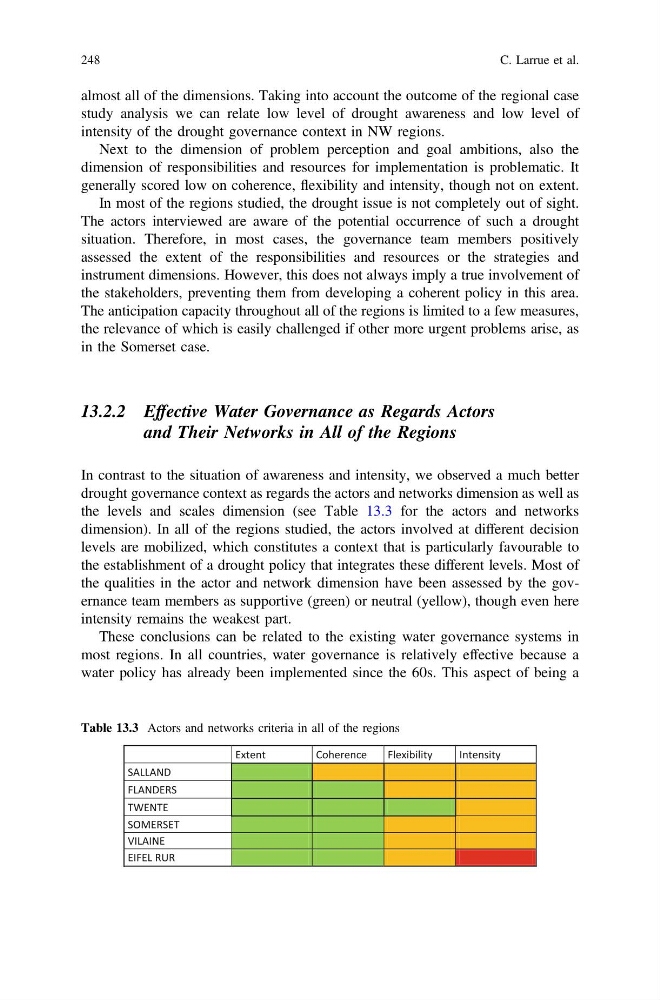
In contrast to the situation of awareness and intensity, we observed a much better
drought governance context as regards the actors and networks dimension as well as
the levels and scales dimension (see Table 13.3 for the actors and networks
dimension). In all of the regions studied, the actors involved at different decision
levels are mobilized, which constitutes a context that is particularly favourable to
the establishment of a drought policy that integrates these different levels. Most of
the qualities in the actor and network dimension have been assessed by the governance team members as supportive (green) or neutral (yellow), though even here
intensity remains the weakest part.
These conclusions can be related to the existing water governance systems in
most regions. In all countries, water governance is relatively effective because a
water policy has already been implemented since the 60s. This aspect of being a
Table 13.3 Actors and networks criteria in all of the regions
248
C. Larrue et al.
study analysis we can relate low level of drought awareness and low level of
intensity of the drought governance context in NW regions.
Next to the dimension of problem perception and goal ambitions, also the
dimension of responsibilities and resources for implementation is problematic. It
generally scored low on coherence, flexibility and intensity, though not on extent.
In most of the regions studied, the drought issue is not completely out of sight.
The actors interviewed are aware of the potential occurrence of such a drought
situation. Therefore, in most cases, the governance team members positively
assessed the extent of the responsibilities and resources or the strategies and
instrument dimensions. However, this does not always imply a true involvement of
the stakeholders, preventing them from developing a coherent policy in this area.
The anticipation capacity throughout all of the regions is limited to a few measures,
the relevance of which is easily challenged if other more urgent problems arise, as
in the Somerset case.
13.2.2 Effective Water Governance as Regards Actors
and Their Networks in All of the Regions
In contrast to the situation of awareness and intensity, we observed a much better
drought governance context as regards the actors and networks dimension as well as
the levels and scales dimension (see Table 13.3 for the actors and networks
dimension). In all of the regions studied, the actors involved at different decision
levels are mobilized, which constitutes a context that is particularly favourable to
the establishment of a drought policy that integrates these different levels. Most of
the qualities in the actor and network dimension have been assessed by the governance team members as supportive (green) or neutral (yellow), though even here
intensity remains the weakest part.
These conclusions can be related to the existing water governance systems in
most regions. In all countries, water governance is relatively effective because a
water policy has already been implemented since the 60s. This aspect of being a
Table 13.3 Actors and networks criteria in all of the regions
248
C. Larrue et al.