

provision systems. This development is usually the result of contingency planning,
and sometimes the result of legal requirements for contingency preparedness. This
increased connectivity does not target exclusively or even primarily the risk to
water provision due to droughts (they address many different risks that may
interrupt water service provision), but it does enhance preparedness for drought
episodes. The solutions emerging in the northwest of Europe illustrated by case
studies analysis also reflect this perception of a scale expansion in connectivity to
improve the robustness of drinking water systems.
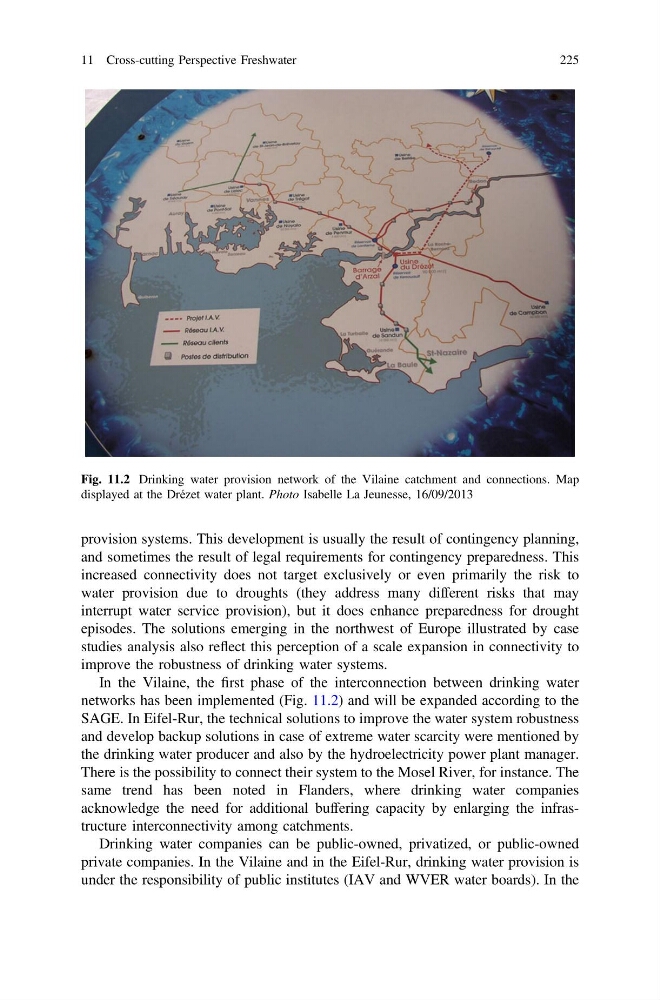
In the Vilaine, the first phase of the interconnection between drinking water
networks has been implemented (Fig. 11.2) and will be expanded according to the
SAGE. In Eifel-Rur, the technical solutions to improve the water system robustness
and develop backup solutions in case of extreme water scarcity were mentioned by
the drinking water producer and also by the hydroelectricity power plant manager.
There is the possibility to connect their system to the Mosel River, for instance. The
same trend has been noted in Flanders, where drinking water companies
acknowledge the need for additional buffering capacity by enlarging the infrastructure interconnectivity among catchments.
Drinking water companies can be public-owned, privatized, or public-owned
private companies. In the Vilaine and in the Eifel-Rur, drinking water provision is
under the responsibility of public institutes (IAV and WVER water boards). In the
Fig. 11.2 Drinking water provision network of the Vilaine catchment and connections. Map
displayed at the Drézet water plant. Photo Isabelle La Jeunesse, 16/09/2013
11 Cross-cutting Perspective Freshwater
225
and sometimes the result of legal requirements for contingency preparedness. This
increased connectivity does not target exclusively or even primarily the risk to
water provision due to droughts (they address many different risks that may
interrupt water service provision), but it does enhance preparedness for drought
episodes. The solutions emerging in the northwest of Europe illustrated by case
studies analysis also reflect this perception of a scale expansion in connectivity to
improve the robustness of drinking water systems.
In the Vilaine, the first phase of the interconnection between drinking water
networks has been implemented (Fig. 11.2) and will be expanded according to the
SAGE. In Eifel-Rur, the technical solutions to improve the water system robustness
and develop backup solutions in case of extreme water scarcity were mentioned by
the drinking water producer and also by the hydroelectricity power plant manager.
There is the possibility to connect their system to the Mosel River, for instance. The
same trend has been noted in Flanders, where drinking water companies
acknowledge the need for additional buffering capacity by enlarging the infrastructure interconnectivity among catchments.
Drinking water companies can be public-owned, privatized, or public-owned
private companies. In the Vilaine and in the Eifel-Rur, drinking water provision is
under the responsibility of public institutes (IAV and WVER water boards). In the
Fig. 11.2 Drinking water provision network of the Vilaine catchment and connections. Map
displayed at the Drézet water plant. Photo Isabelle La Jeunesse, 16/09/2013
11 Cross-cutting Perspective Freshwater
225