

water authorities and other stakeholders are conscious that water demand tends to
intensify with population and economic growth, rendering water scarcity conceivable and even foreseeable.
Freshwater availability for drinking water supply is therefore an issue that
can motivate the introduction of drought and water scarcity risks into the
political and public agenda, even in “drought-scarce” regions. This chapter highlights the links between drought governance and the vulnerability of freshwater for
drinking water supply, with a focus on drought adaptation. The main issues presented
here are illustrated with how freshwater issues are managed in the DROP project
cases with a particular focus on the two “freshwater reservoir” pilot sites: the Arzal
dam in Brittany France (see Chap. 6) and the Eifel-Rur in Germany (see Chap. 4).
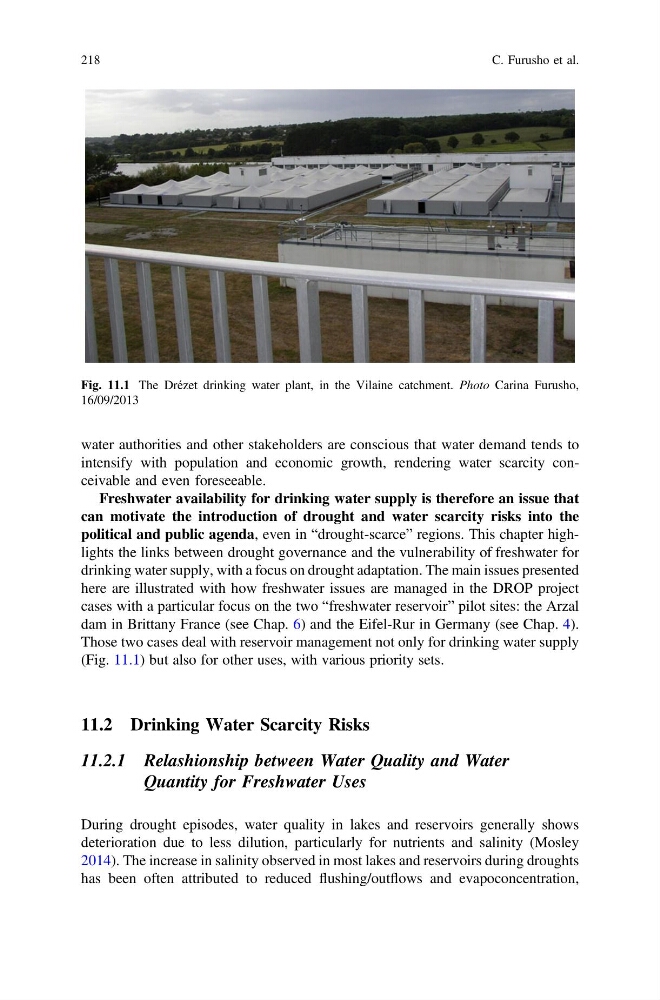
Those two cases deal with reservoir management not only for drinking water supply
(Fig. 11.1) but also for other uses, with various priority sets.
11.2 Drinking Water Scarcity Risks
11.2.1 Relashionship between Water Quality and Water
Quantity for Freshwater Uses
During drought episodes, water quality in lakes and reservoirs generally shows
deterioration due to less dilution, particularly for nutrients and salinity (Mosley
2014). The increase in salinity observed in most lakes and reservoirs during droughts
has been often attributed to reduced flushing/outflows and evapoconcentration,
Fig. 11.1 The Drézet drinking water plant, in the Vilaine catchment. Photo Carina Furusho,
16/09/2013
218
C. Furusho et al.
intensify with population and economic growth, rendering water scarcity conceivable and even foreseeable.
Freshwater availability for drinking water supply is therefore an issue that
can motivate the introduction of drought and water scarcity risks into the
political and public agenda, even in “drought-scarce” regions. This chapter highlights the links between drought governance and the vulnerability of freshwater for
drinking water supply, with a focus on drought adaptation. The main issues presented
here are illustrated with how freshwater issues are managed in the DROP project
cases with a particular focus on the two “freshwater reservoir” pilot sites: the Arzal
dam in Brittany France (see Chap. 6) and the Eifel-Rur in Germany (see Chap. 4).
Those two cases deal with reservoir management not only for drinking water supply
(Fig. 11.1) but also for other uses, with various priority sets.
11.2 Drinking Water Scarcity Risks
11.2.1 Relashionship between Water Quality and Water
Quantity for Freshwater Uses
During drought episodes, water quality in lakes and reservoirs generally shows
deterioration due to less dilution, particularly for nutrients and salinity (Mosley
2014). The increase in salinity observed in most lakes and reservoirs during droughts
has been often attributed to reduced flushing/outflows and evapoconcentration,
Fig. 11.1 The Drézet drinking water plant, in the Vilaine catchment. Photo Carina Furusho,
16/09/2013
218
C. Furusho et al.