

work on drought adaptation as well. One of the measures taken in consultation with
farmers is to remove drainage systems that are in fact making the land vulnerable to
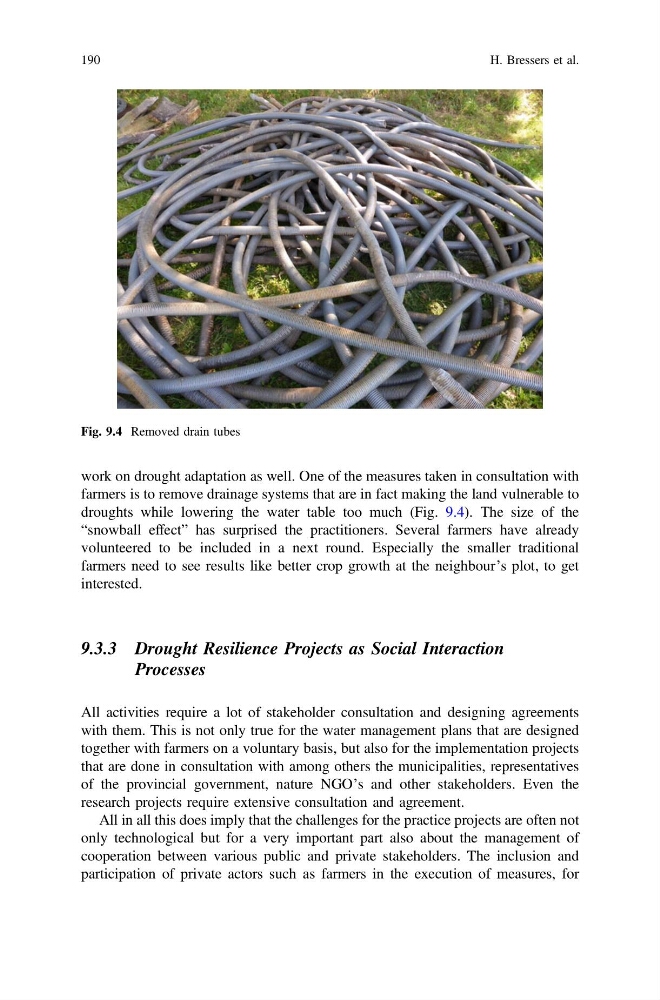
droughts while lowering the water table too much (Fig. 9.4). The size of the
“snowball effect” has surprised the practitioners. Several farmers have already
volunteered to be included in a next round. Especially the smaller traditional
farmers need to see results like better crop growth at the neighbour’s plot, to get
interested.
9.3.3 Drought Resilience Projects as Social Interaction
Processes
All activities require a lot of stakeholder consultation and designing agreements
with them. This is not only true for the water management plans that are designed
together with farmers on a voluntary basis, but also for the implementation projects
that are done in consultation with among others the municipalities, representatives
of the provincial government, nature NGO’s and other stakeholders. Even the
research projects require extensive consultation and agreement.
All in all this does imply that the challenges for the practice projects are often not
only technological but for a very important part also about the management of
cooperation between various public and private stakeholders. The inclusion and
participation of private actors such as farmers in the execution of measures, for
Fig. 9.4 Removed drain tubes
190
H. Bressers et al.
farmers is to remove drainage systems that are in fact making the land vulnerable to
droughts while lowering the water table too much (Fig. 9.4). The size of the
“snowball effect” has surprised the practitioners. Several farmers have already
volunteered to be included in a next round. Especially the smaller traditional
farmers need to see results like better crop growth at the neighbour’s plot, to get
interested.
9.3.3 Drought Resilience Projects as Social Interaction
Processes
All activities require a lot of stakeholder consultation and designing agreements
with them. This is not only true for the water management plans that are designed
together with farmers on a voluntary basis, but also for the implementation projects
that are done in consultation with among others the municipalities, representatives
of the provincial government, nature NGO’s and other stakeholders. Even the
research projects require extensive consultation and agreement.
All in all this does imply that the challenges for the practice projects are often not
only technological but for a very important part also about the management of
cooperation between various public and private stakeholders. The inclusion and
participation of private actors such as farmers in the execution of measures, for
Fig. 9.4 Removed drain tubes
190
H. Bressers et al.